On eBird ↗
Plumbeous Forest-Falcon
Live sightings near you, the range map, bar charts of when it is seen, and Macaulay Library photos and recordings.
Plumbeous Forest-Falcon
Micrastur plumbeus
The plumbeous forest falcon (Micrastur plumbeus) is a species of bird of prey in the family Falconidae. It is endemic to humid forests in the Chocó in south-western Colombia and north-western Ecuador. It is generally poorly known and rare. It is threatened by habitat loss, and consequently considered vulnerable by BirdLife International and IUCN. It closely resembles the lined forest falcon from the Amazon, but adults only have a single white tail-band (in addition to a...
From the article Plumbeous forest falcon on Wikipedia (CC BY-SA), quoted section by section
Description
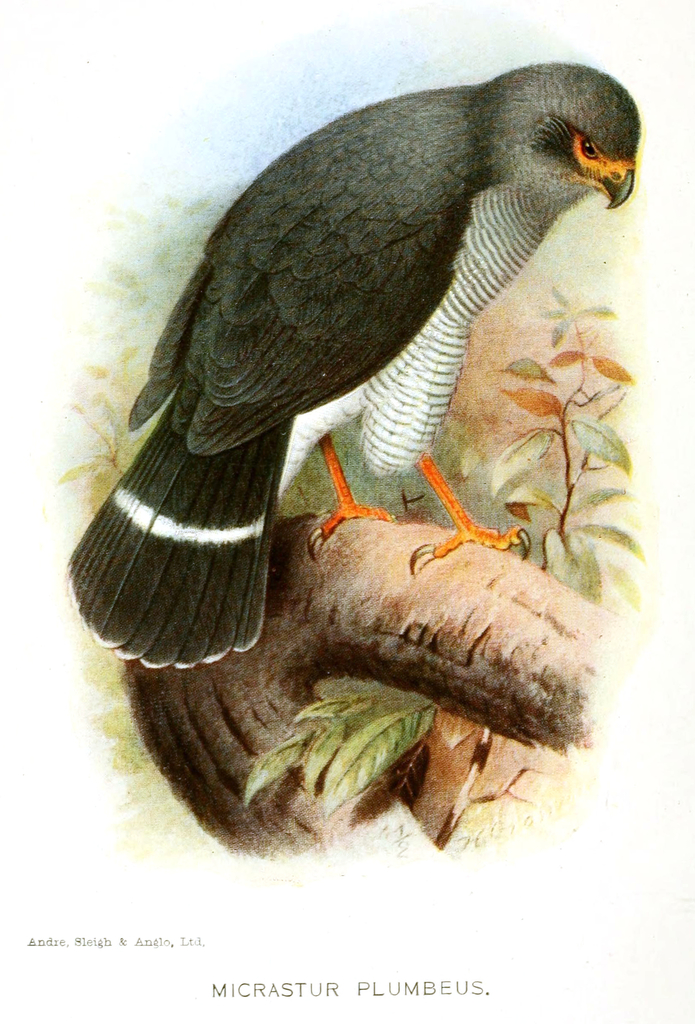
The adult plumbeous forest-falcon has a grey back and a grey head with very bright orange legs and face. Their breast is barred and paler than their back, and their belly is more whitish towards the tail. This raptor has a black tail with a white tip and a white band in the middle, going across the whole width. Their irides are dark brown. The individuals are 30-34 cm (13 in) long and females are bigger than males. As a matter of fact, females weigh 180-213g and males weigh 172-188g. Immature individuals look similar besides a whiter breast and beige-ish irides, clearer than in mature individuals. Forest-falcons usually have long tails and round wings, but the plumbeous forest-falcon has a shorter tail and long wings.
Range & habitat
The plumbeous forest-falcon is endemic to the south of the Chocó region in South America. This region extends in the south-west of Colombia and the north-west of Ecuador. This bird lives all-year long in forest lowlands and foothill forests; it is not a migratory bird. The elevation of its habitat varies from the sea level to approximately 1500m of altitude. One research project studying a few pairs of this species found that their territory extended over 35-40 ha.
Conservation status. This species has been classified as vulnerable by the IUCN because of habitat loss. Deforestation is touching more territories and the plumbeous forest-falcon's habitat is being destructed. It is an unprotected species that needs to be studied more extensively to help its conservation. Efforts should be focused on the Chocó area where this organism is solely contained.
Wikipedia: “Habitat and Distribution”
What it does
Due to the lack of study, the diet of this forest-falcon is not perfectly known. However, it is most probable that it is an opportunistic predator feeding on small vertebrates and large invertebrates. Land crabs, birds and lizards were found in the digestive system of a few individuals. Its main source of food is thought to be lizards. Moreover, this family of birds prey on forest-dwelling birds and rodents. They have two principal ways to forage. With the first one, they remain on the ground while running after the prey that they eventually catch with their feet. They keep their tail high when they chase the prey. The second technique consists of being perched about 2m above the ground, looking for sounds and movements in the leaf litter and then jumping on the detected prey.
Wikipedia: “Diet”
Listen
Looking for field recordings…
Where it lives
Recorded sightings
—
geo-referenced records in GBIF, from museums, herbaria and field observers.
Drag the globe to turn it. Dots are where records exist, not a range map; darker means more records.
In the stacks
Searching the stacks…
Every page naming Micrastur plumbeus in the Biodiversity Heritage Library →
This page is assembled live from iNaturalist, GBIF, Wikipedia, the Source Library and the Internet Archive. It is not yet part of the hand-edited codex. iNaturalist taxon 4694.