- Animals
- ›Chordates
- ›Vertebrates
- ›Mammals
- ›Therians
- ›Placental Mammals
- ›Ungulates, Carnivorans, and Allies
- ›Shrews, Moles, Hedgehogs, and Allies
- ›Shrews, Moles, and Hedgehogs
- ›Moles and Desmans
- ›Old World Moles and Desmans
- ›Short-tailed Eurasian Moles
- ›Mogera
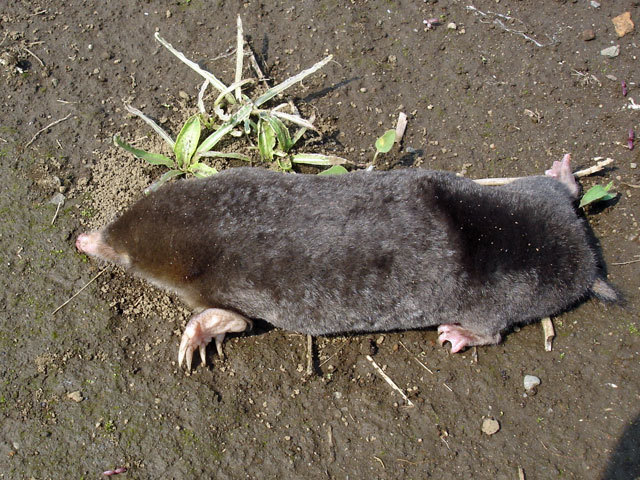
Lesser Japanese Mole
Mogera imaizumii
The small Japanese mole, lesser Japanese mole or Japanese Eastern Mole (Mogera imaizumii) is a species of mammal in the family Talpidae. It is endemic to Japan.
From the article Small Japanese mole on Wikipedia (CC BY-SA), quoted section by section
Description
They measure a full length of 12.1 to 15.9 centimetres (4.8 to 6.3 in), with tail length 1.4 to 2.2 centimetres (0.55 to 0.87 in), weighing 48 to 127 grams (1.7 to 4.5 oz). There is considerable variation in size, and the mountainous populations are smaller while the Pacific coastal plain populations tend to be larger, almost double by weight. They have poor eyesight, and the tails are short. Dark-brown furred in mountainous regions, more brownish tinted in floodplain populations. The naked (hairless) area on its upper snout is rectangular-shaped. Palate of normal size and length. Upper incisors aligned in widened V-shape fashion. 3 upper premolars per each (right or left) side, 2 lower premolars per side.
Wikipedia: “Morphology”
Range & habitat
Populations of the species occur mostly in Eastern and Northern Honshū (mainland of Japan). Namely, Shizuoka, Nagano, and Ishikawa Prefectures and further north up to the mountainous edges of the Shimokita Peninsula. except for a portion of the Echigo Plain of Niigata Prefecture. They are also found in sporadic populations in mountainous regions in the West and South, in mountains terrains within Kyoto Prefecture and the city of Shōbara, Hiroshima, in the Suzuka Mountains in Mie, southern Kii Peninsula (Wakayama), Mount Tsurugi, Mount Ishizuchi, etc. in Shikoku, and parts of Shōdo Island. It is endemic to Japan. Although it can still be found within the inner city (23 wards of Tokyo) in places where crop fields remain, but they become scarce when such sites undergo urban development. For example, they are rarely spotted inside the circular track of the Yamanote Line. However, it is found within the grounds of the Imperial Palace. These moles were cut off from the surrounding environment after the completion of the palace moat in the 1630s, and the isolated gene pool is thought to have survived since then within the palace grounds. However, DNA sequence studies have shown the population to have a 98.5% close match to the genetics of moles found in Hino, Tokyo and confirmed to be the same species as the M. imaizumii of the Kantō region.
Mole war. …
Wikipedia: “Distribution”
What it does
Their habitat ranges from grassland plains or farmed lands in the lowlands to forested hills and mountainous terrain, but prefer the moist, deep soil in the plains. They burrow tunnels underground in which they live. The removed soil are taken to the surface to form mole mounds. They live on a cycle of shifting from activity to rest 3 times a day. In February 2025, a Yamagata University team reported on the distribution densities of the species in mountain forests, with quantified population analysis comparing different sites. The study involved thorough investigation of the species' tunnels found while trekking the hiking paths, and found that the population density varied greatly according to the forest type (vegetation) and soil environments, and that abundance of earthworms correlated with the mole's abundance.。 Although they mainly prey on insects and earthworms, they also feed on soil centipedes, leeches, and plant seeds. They build their nest deep in the forest, about 40 centimetres (16 in) diameter and 36 centimetres (14 in) height, where they gather deciduous leaves for lining, in order to breed. They have their litter in the spring (sometimes fall), with 1 to 6 pups per birth. A study of the microsatellite genetic markers on the mother and 3 offspring revealed a single father for the offspring. and follow-up studies using greater number of samples is anticipated. …
Wikipedia: “Behavioral traits”
Listen
Looking for field recordings…
Where it lives
Recorded sightings
—
geo-referenced records in GBIF, from museums, herbaria and field observers.
Drag the globe to turn it. Dots are where records exist, not a range map; darker means more records.
In the stacks
Searching the stacks…
Every page naming Mogera imaizumii in the Biodiversity Heritage Library →
This page is assembled live from iNaturalist, GBIF, Wikipedia, the Source Library and the Internet Archive. It is not yet part of the hand-edited codex. iNaturalist taxon 46985.