- Animals
- ›Chordates
- ›Vertebrates
- ›Mammals
- ›Therians
- ›Placental Mammals
- ›Ungulates, Carnivorans, and Allies
- ›Shrews, Moles, Hedgehogs, and Allies
- ›Shrews, Moles, and Hedgehogs
- ›Moles and Desmans
- ›New World Moles
- ›New World Moles
- ›Scapanus
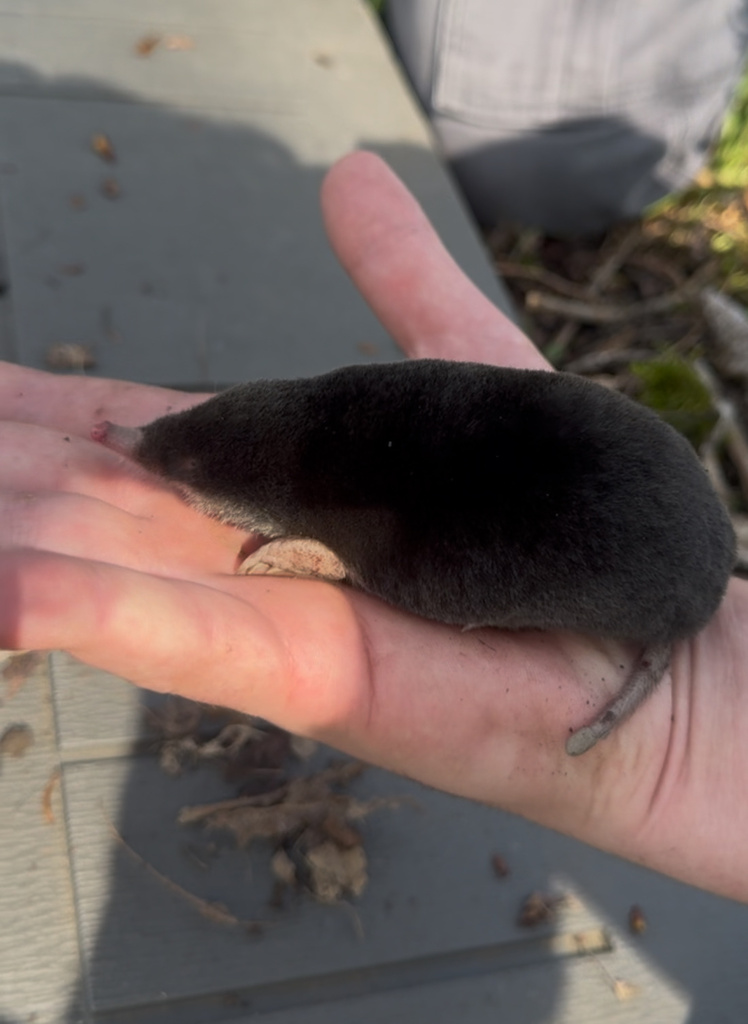
Coast Mole
Scapanus orarius
The coast mole or Pacific mole (Scapanus orarius) is a medium-sized North American mole found in forested and open areas with moist soils along the Pacific coast from southwestern British Columbia to northwestern California.
From the article Coast mole on Wikipedia (CC BY-SA), quoted section by section
Description
The coast mole is generally less than 200 mm long, with the tail being one-fourth of its total length. The fur is uniformly black. The skull is relatively narrow and long, with a sublacrimal-maxillary ridge that is underdeveloped. Teeth are uncrowned and evenly spaced.
Range & habitat
The coast mole has a disjunct distribution, occurring from the western end of British Columbia, Canada through the western regions of Oregon and Washington, and in some parts of Northern California (coastal regions). The most extreme divergence of range for the coast mole has been seen to reach some parts of west-central Idaho. The species has a primarily fossorial lifestyle, but is not restricted solely to underground habitats. Like many other species of moles, it is capable of surfacing for scavenging purposes and juvenile dispersals, especially in the summer months. It may inhabit, but is not restricted to, agricultural land, sand dunes, grassy-meadows, sagebrush, deciduous forest, and pine forests (yellow-pine, Douglas fir, spruce, hemlock, and redwood).
Wikipedia: “Distribution and habitat”
What it does
Coast moles eat insects and other small invertebrates including earthworms, which it hunts in moderately moist soil environments. Coast moles will increase their digging activity when they sense shifting densities of earthworms. Food items found in coast mole stomachs included earthworms (the majority by mass), slugs, earthworm eggs, and larval and adult insects.
Wikipedia: “Diet”
Listen
Looking for field recordings…
Where it lives
Recorded sightings
—
geo-referenced records in GBIF, from museums, herbaria and field observers.
Drag the globe to turn it. Dots are where records exist, not a range map; darker means more records.
In the stacks
Searching the stacks…
Every page naming Scapanus orarius in the Biodiversity Heritage Library →
This page is assembled live from iNaturalist, GBIF, Wikipedia, the Source Library and the Internet Archive. It is not yet part of the hand-edited codex. iNaturalist taxon 47007.