- Animals
- ›Chordates
- ›Vertebrates
- ›Mammals
- ›Therians
- ›Placental Mammals
- ›Ungulates, Carnivorans, and Allies
- ›Shrews, Moles, Hedgehogs, and Allies
- ›Shrews, Moles, and Hedgehogs
- ›Moles and Desmans
- ›Old World Moles and Desmans
- ›Desmans
- ›Desmana
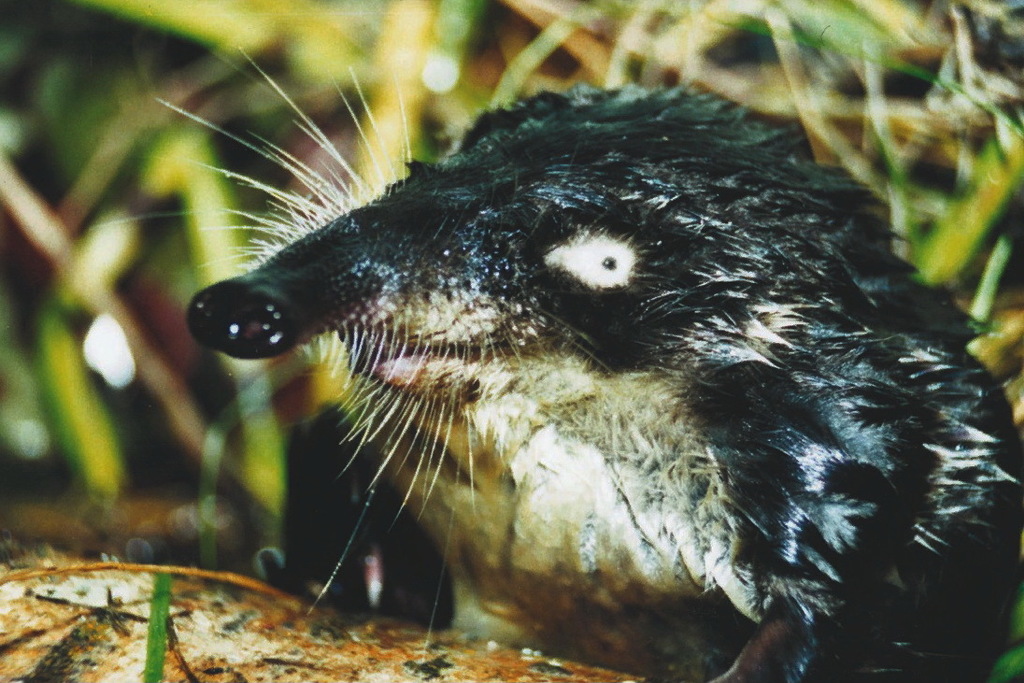
Russian Desman
Desmana moschata
The Russian desman (Desmana moschata; Russian: выхухоль vykhukhol') is a small semiaquatic mammal that inhabits the Volga, Don and Ural River basins in Russia. Some authorities, citing old Soviet sources, claim the animal can be found in Eastern Ukraine and Northern Kazakhstan, but, as of 2020, the accuracy of such claims is disputed. It constructs burrows into the banks of ponds and slow-moving streams, but prefers small, overgrown ponds with abundance of insects, crayfish and amphibians. The Russian desman often lives in small groups of two to five animals, that are usually not related, and appears to have a complex (but largely unstudied) communication and social system.
From the article Russian desman on Wikipedia (CC BY-SA), quoted section by section
Description
Russian desman provide comfort to themselves by grooming. More specifically, scratching with hind feet, washing, biting out of nails, and biting out of fur. The main reasons for these actions are supporting the air layer and heat-insulating properties of fur.
Wikipedia: “Characteristics”
Range & habitat
Russian desman's natural habitat is limited to the Dnieper and Don river basins in Russia. It is an endemic and highly endangered species. A 1961 attempt to acclimatize desmans in the Tobol river basin in Western Siberia was semi-successful. According to a 2020 report, the number of desmans is estimated at 6,000. From 2009 to 2011, the Don Basin rivers in Saratov Oblast were searched for Russian desman to evaluate if this environment was sustainable for the species. No evidence was found that the species lives in this area but if so, the population was very small. The limiting factors consist of global factors, interspecific processes, and new immigrating species in the river ecosystem.
Wikipedia: “Distribution and habitat”
Listen
Looking for field recordings…
Where it lives
Recorded sightings
—
geo-referenced records in GBIF, from museums, herbaria and field observers.
Drag the globe to turn it. Dots are where records exist, not a range map; darker means more records.
In the stacks
Searching the stacks…
Every page naming Desmana moschata in the Biodiversity Heritage Library →
This page is assembled live from iNaturalist, GBIF, Wikipedia, the Source Library and the Internet Archive. It is not yet part of the hand-edited codex. iNaturalist taxon 47032.