 NL·0738
Herbarium of the Nature Library
- Name
- Condylura cristata
- Family
- Talpidae
- Native to
- Eastern Canada and northeastern USA, south along the Appalachians to Georgia; also coastal Carolinas
- Habitat
- Wetland, Wet meadow, Stream banks, Bogs
Star-nosed mole
Condylura cristata
Also calledCondylure étoilé (French) · Topo de nariz estrellada (Spanish)
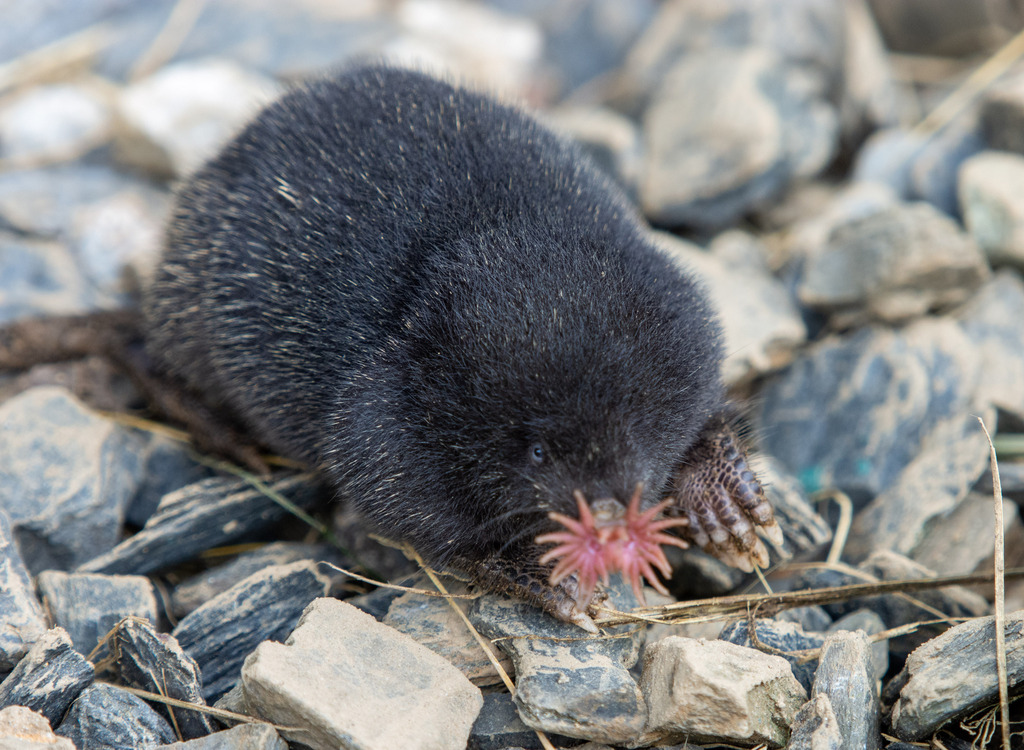
A wetland mole whose nose is ringed by 22 pink, fleshy tentacles, the most sensitive touch organ known in any mammal. It touches its surroundings about 10 times a second and can identify and eat a prey item in a fraction of a second. It also swims and forages underwater.
The star-nosed mole is a small semiaquatic mole found in moist, low elevation areas in the northeastern parts of North America. It is the only extant member of the tribe Condylurini and genus Condylura. It has more than 25,000 minute sensory receptors in touch organs, known as Eimer's organs, with which this hamster-sized mole feels its way around. With the help of its Eimer's organs, it may be perfectly poised to detect seismic wave vibrations. Wikipedia
What it can do
- iIts star carries about 25,000 touch receptors (Eimer's organs) served by over 100,000 nerve fibres
- iiIdentifies and eats prey in as little as about 120 milliseconds, among the fastest foragers known
- iiiSmells underwater by blowing out air bubbles and re-inhaling them
- ivSwims well and tunnels into stream banks and under ice
In the field
Field marks
- aUnmistakable ring of 22 pink fleshy rays around the nostrils
- bDark, dense, water-repellent fur
- cLong hairy tail (thickens in winter as fat is stored)
- dBroad digging forefeet; signs include molehills in wet soil and tunnels leading into water
- Not to be confused with
- Eastern and hairy-tailed moles lack the star and live in drier soils; shrews are smaller with pointed snouts.
- Where to see it
- Rarely seen; wet meadows and bog edges in Nova Scotia and Quebec; Great Smoky Mountains National Park; Adirondacks (New York); often found by cats or in pitfall surveys
- When
- Resident; active year-round
Listen
Looking for field recordings…
Life & habits
- Diet
- Aquatic insects, worms, small crustaceans, molluscs and small fish
- Habitat
- Poorly drained wet soils of marshes, bogs, wet meadows and stream banks
- Size
- Body 10–13 cm, tail 6–8 cm; 35–75 g
- Lifespan
- About 3–4 years
Active day and night year-round, foraging in tunnels, on the surface and underwater, even under winter ice.
Where it lives
Recorded sightings
—
geo-referenced records in GBIF, from museums, herbaria and field observers.
Native range
Eastern Canada and northeastern USA, south along the Appalachians to Georgia; also coastal Carolinas
Drag the globe to turn it. Dots are where records exist, not a range map; darker means more records.
In the stacks
Searching the stacks…
Every page naming Condylura cristata in the Biodiversity Heritage Library →
Marginalia
It was described by Linnaeus in 1758 as Sorex cristatus; neuroscientist Kenneth Catania's studies since the 1990s made the star a model for how brains map touch.
Curiosity
Despite its appearance, the star is not used to grab food; it is purely a touch organ, while the mole's teeth do the eating.
Kinship




Photographs: iNaturalist contributors under the licences shown. Records: GBIF.org. Historical plates: Source Library (CC BY-SA 4.0; originals public domain). Summary text: Nature Library editors and Wikipedia (CC BY-SA). Medicinal and edibility notes are historical and educational, not advice. iNaturalist taxon 47056.