On eBird ↗
Philippine Falconet
Live sightings near you, the range map, bar charts of when it is seen, and Macaulay Library photos and recordings.
Philippine Falconet
Microhierax erythrogenys
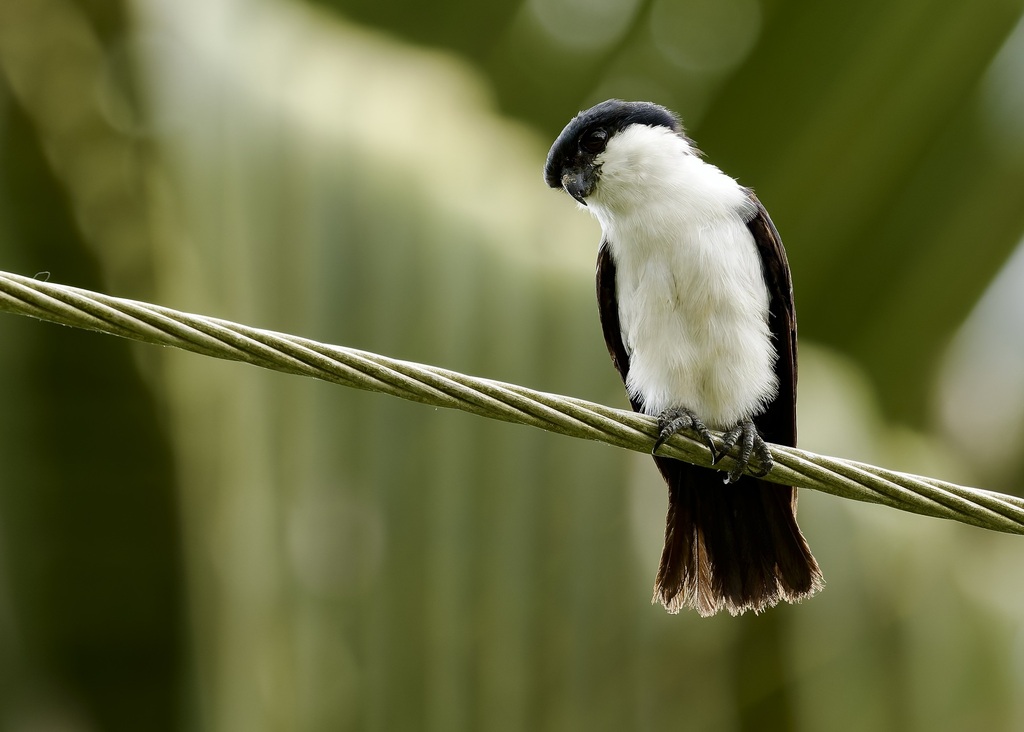
The Philippine falconet (Microhierax erythrogenys) is a species of bird of prey in the family Falconidae, genus Microhierax. It is endemic to the lowland forests of Philippines, and can often be seen near open forest edges hunting flying insects. Philippine falconets nest in woodpecker holes of dead trees, and can be seen fairly commonly within their suitable habitats. Although the Philippine falconet population is declining due to habitat loss, it is still evaluated as "Least Concern" globally.
From the article Philippine falconet on Wikipedia (CC BY-SA), quoted section by section
Description
The Philippine falconet has a length of 15 – 18 cm, a wingspan of 32 – 37 cm, and a body mass of 37 – 52 g. Compared to other members in the Falconidae family, it is extremely small. Philippine falconet has a plumage coloration of black and white. It has uniformly black upperparts from head to tail, and white underparts from cheek to lower neck, with a washed buff belly. The underwing converts are black, and the flight feathers are inconspicuously barred white. Female has all-black underwings (unlike male, which has white spots on inner webs to the remiges) and is also up to 20% larger. The southern subspecies are slightly larger than the northern subspecies. Scientists also found that individuals on different islands have distinct differences in tail, bill, and wing, indicating exceptional degrees of endemism in this species.
Range & habitat
The Philippine falconet is endemic to the Philippine archipelago. It is distributed across several Philippine islands (Luzon, Mindoro, Negros, Catanduanes, Bohol, Calicoan, Samar, Leyte, Cebu, Mindanao and Panay) and can be found in subtropical or tropical moist lowland forests. Philippine falconet usually occurs in pairs, or in family groups, and is usually singing. When foraging, this species perches on prominent branches or canopy of old dead trees where it hawks for prey.
Wikipedia: “Habitat and Distribution”
What it does
Like other falconets, Philippine falconets do not hover or soar. They hunt aerial prey from exposed tree perches and chase them down with fast and powerful flights. Once the prey is snatched in the bird's bill, it is carried back to the same perch where it gets eaten. The species feeds mainly on insects and smaller birds. The proportions of insects and birds in the diet may vary according to availability. One study suggests that dragonfly makes up nearly 70% of their diet, alongside other insects such as bees, butterflies, grasshoppers, and beetles. Juvenile Philippine falconets learn how to hunt by watching and participating in communal hunting with experienced adults. It is often seen up to six adult and juvenile Philippine falconets feeding on a single prey item that was caught previously.
Wikipedia: “Diet”
Listen
Looking for field recordings…
Where it lives
Recorded sightings
—
geo-referenced records in GBIF, from museums, herbaria and field observers.
Drag the globe to turn it. Dots are where records exist, not a range map; darker means more records.
In the stacks
Searching the stacks…
Every page naming Microhierax erythrogenys in the Biodiversity Heritage Library →
This page is assembled live from iNaturalist, GBIF, Wikipedia, the Source Library and the Internet Archive. It is not yet part of the hand-edited codex. iNaturalist taxon 4707.