- Animals
- ›Chordates
- ›Vertebrates
- ›Mammals
- ›Therians
- ›Placental Mammals
- ›Armadillos, Sloths, and Anteaters
- ›Armadillos
- ›Short-nosed Armadillos
- ›Euphractidae
- ›Hairy and Pygmy Armadillos
- ›Zaedyus
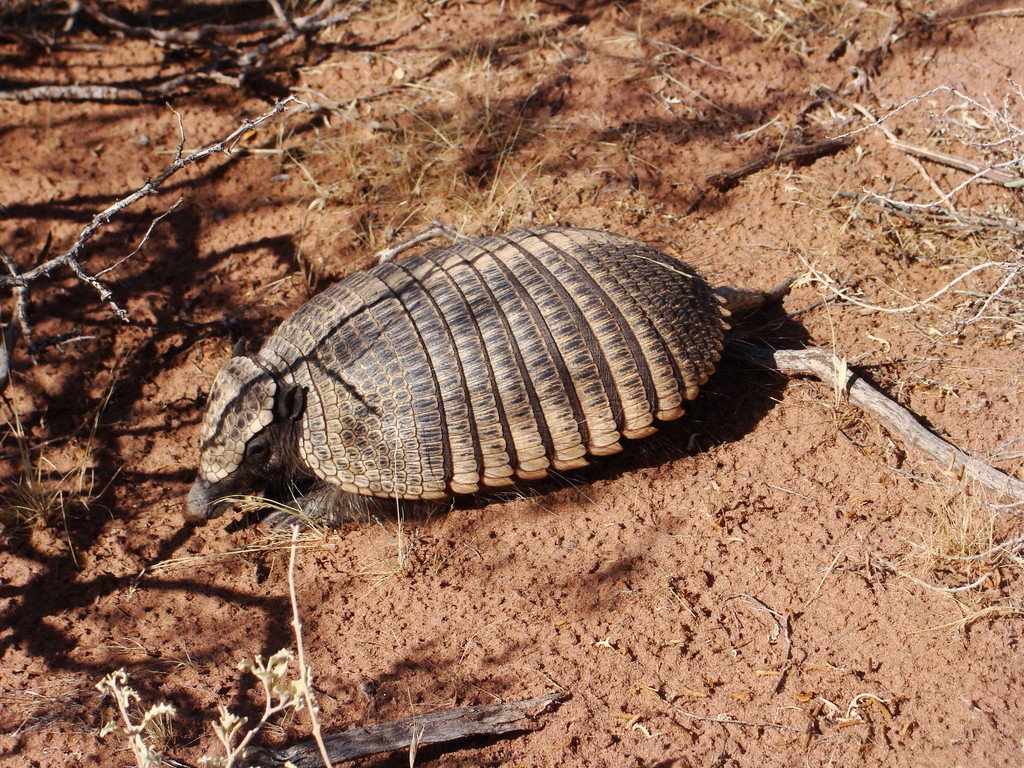
Pichi
Zaedyus pichiy
The pichi (Zaedyus pichiy), dwarf armadillo or pygmy armadillo is an armadillo native to Argentina and Chile. It is the only living member of the genus Zaedyus, and the only armadillo to hibernate. Fossil remains from the Cerro Azul Formation indicate this species had already evolved during the late Miocene epoch.
From the article Pichi on Wikipedia (CC BY-SA), quoted section by section
Description
Pichis are relatively small armadillos, measuring approximately 27 cm (11 in) long, with a tail of about 11 cm (4.3 in). Adults weigh anything from 700 to 1,500 grams (25 to 53 oz), and males may be slightly larger than females. The carapace varies from light yellow to near-black, and consists of heavy scapular and pelvic shields composed of rectangular osteoderms, and separated by six to eight movable bands. An additional "nuchal" band lies in front of the scapular shield, and there is also a triangular shield on top of the head, and further osteoderms along the tail. The underside of the animal has a coat of tan-coloured hair, which is thicker and longer in winter; there are also a few long hairs protruding through small holes near the posterior edge of some of the scales. Pichis have well-developed claws on all four feet. The ears are short, and the eyes dark and relatively small. Pichis have eight teeth on each side of the upper jaw, and nine on the lower. The absence of teeth on the premaxillary bone of the upper jaw is one of the features that allows them to be distinguished from other, similar, armadillos, such as the six-banded armadillo. Females have two teats, located in the chest region, and, like most armadillos, lack a true vagina, instead having a single urogenital sinus about 18 mm (0.71 in) in length. …
Range & habitat
Pichis are found from central and southern Argentina (Patagonia), west to the Andean grasslands of Chile, and south to the Strait of Magellan. Within this region, it most commonly inhabits arid or semiarid steppe grasslands, but may be found in other environments if they have sandy soils suitable for burrowing.
Wikipedia: “Distribution and habitat”
What it does
Pichis are solitary and diurnal. They dig burrows in sandy soil, which they use for shelter from extremes of weather. The burrows have a dome-shaped entrance and a single passage that can reach several metres in length, before terminating in a bare, unlined, resting chamber. They do not inhabit their burrows for extended periods, digging new ones at least every few weeks, and sometimes daily. During the winter, when the weather is more extreme, the burrows may be deeper than they are in the summer, reaching as much as 1.5 m (4 ft 11 in) below ground. Pichis are solitary outside of the mating season. When threatened, they wedge themselves into their shallow burrow making it difficult for an attacker to drag them out because of their jagged scales, or else lie flat on the ground to protect their vulnerable belly. They have been reported to make both purring sounds and a loud grunt or scream.
Wikipedia: “Behaviour”
Listen
Looking for field recordings…
Where it lives
Recorded sightings
—
geo-referenced records in GBIF, from museums, herbaria and field observers.
Drag the globe to turn it. Dots are where records exist, not a range map; darker means more records.
In the stacks
Searching the stacks…
Every page naming Zaedyus pichiy in the Biodiversity Heritage Library →
This page is assembled live from iNaturalist, GBIF, Wikipedia, the Source Library and the Internet Archive. It is not yet part of the hand-edited codex. iNaturalist taxon 47078.