- Animals
- ›Chordates
- ›Vertebrates
- ›Mammals
- ›Therians
- ›Placental Mammals
- ›Armadillos, Sloths, and Anteaters
- ›Armadillos
- ›Short-nosed Armadillos
- ›Tolypeutidae
- ›Three-banded, Giant, and Naked-tailed Armadillos
- ›Tolypeutes
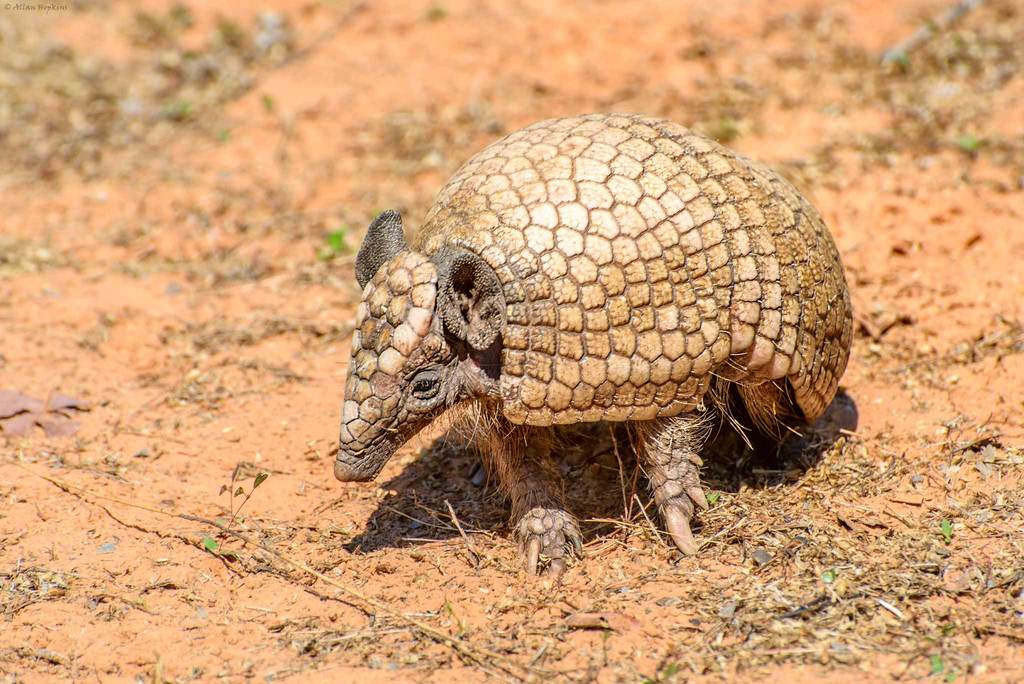
Brazilian Three-banded Armadillo
Tolypeutes tricinctus
The Brazilian three-banded armadillo (Tolypeutes tricinctus) is an armadillo species endemic to Brazil, where it is known as tatu-bola (Portuguese pronunciation: , lit. ball armadillo). It is one of only two species of armadillo (the other is the southern three-banded armadillo) that can roll into a ball. It has suffered a 30% decline in population in the last 10 years.
From the article Brazilian three-banded armadillo on Wikipedia (CC BY-SA), quoted section by section
Description
Brazilian three-banded armadillos have a head-and-body length of about 22 to 27 cm (8.7 to 10.6 in) and the tail is between 6 and 8 cm (2.4 and 3.1 in) long. They weigh 1–1.6 kg (2.2–3.5 lb). The armor is composed of ossified dermal scutes covered by nonoverlapping, keratinized epidermal scales, which are connected by flexible bands of skin. This armor covers the back, sides, head, tail, ears, and outside surfaces of the legs. The underside of the body and the inner surfaces of the legs have no armored protection, and are covered instead by long, coarse hair. The genus Tolypeutes, which includes both the Brazilian and southern species of three-banded armadillos, is unique in the ability to roll up in a tight, almost impenetrable ball. This is because their armor is slightly looser than that of other armadillo genera, which allows for greater freedom of movement. The loose armor also creates a layer of air between the shell and the body, which insulates the animal. This higher capacity for thermoregulation allows them to survive in climates too arid for some of the other armadillo species. When the armadillo rolls into a defensive ball, the ears are tucked into the shell and the head and tail interlock to seal the shell completely. The teeth are soft and peg-like, adapted solely for smashing the exoskeletons of insects.
Wikipedia: “Anatomy”
Range & habitat
As its name suggests, the Brazilian three-banded armadillo is indigenous to Brazil, living primarily in the northeastern part of the country, just south of the equator. They are rarely seen west of 50°W longitude. The Brazilian three-banded armadillo lives primarily in open savannahs (Cerrado) and dry woodlands (Caatinga), where low rainfall and poor soil limit the vegetation to tall, woody grasses, scattered bushes, and gnarled trees. There is an abundance of cactus-like plants in the northern reaches of its range. The Brazilian three-banded armadillo builds its own burrows for shelter and survival but takes advantage of reusing existing burrows in its environment.
Wikipedia: “Range and habitat”
What it does
The main staples of its diet are ants and termites, which it can smell through up to 20 cm (8 in) of soil. It finds food by shuffling slowly along with its nose to the ground. When it detects prey, it frantically digs a hole and thrust its nose into it, using its long, sticky tongue to lap up any insects it may find. Other foods include mollusks, worms, fruit, and carrion.
Wikipedia: “Diet”
Listen
Looking for field recordings…
Where it lives
Recorded sightings
—
geo-referenced records in GBIF, from museums, herbaria and field observers.
Drag the globe to turn it. Dots are where records exist, not a range map; darker means more records.
In the stacks
Searching the stacks…
Every page naming Tolypeutes tricinctus in the Biodiversity Heritage Library →
This page is assembled live from iNaturalist, GBIF, Wikipedia, the Source Library and the Internet Archive. It is not yet part of the hand-edited codex. iNaturalist taxon 47080.