- Animals
- ›Chordates
- ›Vertebrates
- ›Mammals
- ›Therians
- ›Placental Mammals
- ›Armadillos, Sloths, and Anteaters
- ›Armadillos
- ›Short-nosed Armadillos
- ›Tolypeutidae
- ›Three-banded, Giant, and Naked-tailed Armadillos
- ›Cabassous
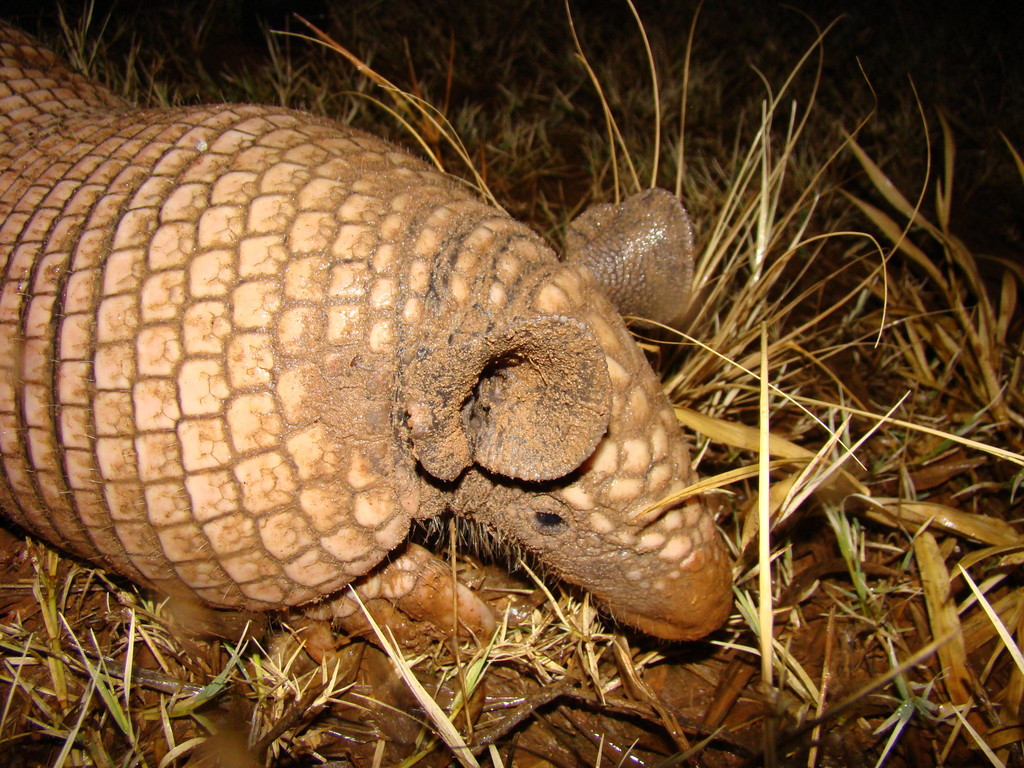
Greater Naked-tailed Armadillo
Cabassous tatouay
The greater naked-tailed armadillo (Cabassous tatouay) is an armadillo species from South America.
From the article Greater naked-tailed armadillo on Wikipedia (CC BY-SA), quoted section by section
Description
Larger than the closely related southern naked-tailed armadillos, adults of the greater species measure 41 to 49 cm (16 to 19 in) in head-body length, with a tail 15 to 20 cm (5.9 to 7.9 in) in length. There are eight or nine uniformly shaped teeth on each side of each jaw, with no identifiable incisors or canines. The carapace includes an average of 13 movable bands between the solid shields over the shoulders and hips, with each band having about 30 individual scutes. There is also a scaled shield over the upper surface of the head, with much smaller scales on the ears and on the cheeks below the eyes. The tail bears only small, isolated scales.
Range & habitat
Greater naked-tailed armadillos are found in southern Brazil, eastern Paraguay and Uruguay and extreme north-eastern Argentina. It inhabits lowland and submontane forests, and also relatively open areas such as the Cerrado and Pantanal. There are no recognised subspecies.
Wikipedia: “Distribution and habitat”
What it does
Greater naked-tailed armadillos feed on ants and termites and sleeps in burrows, often dug within termite mounds. Burrows are typically about 20 to 25 cm (7.9 to 9.8 in) in width, and positioned so that their entrances face away from the prevailing winds.
== References ==
Wikipedia: “Behaviour”
Listen
Looking for field recordings…
Where it lives
Recorded sightings
—
geo-referenced records in GBIF, from museums, herbaria and field observers.
Drag the globe to turn it. Dots are where records exist, not a range map; darker means more records.
In the stacks
Searching the stacks…
Every page naming Cabassous tatouay in the Biodiversity Heritage Library →
This page is assembled live from iNaturalist, GBIF, Wikipedia, the Source Library and the Internet Archive. It is not yet part of the hand-edited codex. iNaturalist taxon 47091.