- Animals
- ›Chordates
- ›Vertebrates
- ›Mammals
- ›Therians
- ›Placental Mammals
- ›Armadillos, Sloths, and Anteaters
- ›Sloths and Anteaters
- ›Anteaters
- ›Giant Anteater and Tamanduas
- ›Tamandua
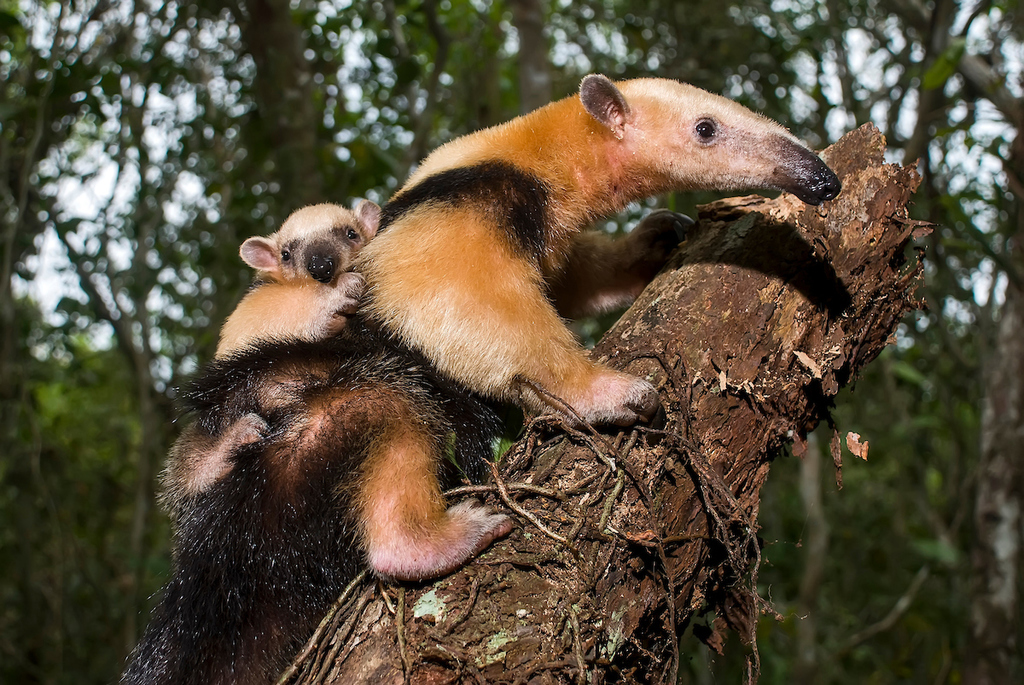
Southern Tamandua
Tamandua tetradactyla
The southern tamandua (Tamandua tetradactyla), also called the collared anteater or lesser anteater, is a species of anteater from South America and the island of Trinidad in the Caribbean. It is a solitary animal found in many habitats, from mature to highly disturbed secondary forests and arid savannas. It feeds on ants, termites, and bees. Its very strong foreclaws can be used to break insect nests and to defend itself.
From the article Southern tamandua on Wikipedia (CC BY-SA), quoted section by section
Description
The southern tamandua is a medium-sized anteater, though it can vary considerably in size based on environmental conditions. It has a head and body length ranging from 34 to 88 cm (13 to 35 in), and a prehensile tail 37 to 67 cm (15 to 26 in) long. Adults weigh from 1.5 to 8.4 kg (3.3 to 18.5 lb), with no significant difference in size between males and females. Like their close relative, the northern tamandua, they have four-clawed digits on the forefeet and five on the hind feet and walk on the outer surfaces of their forefeet to avoid puncturing their palms with their sharp claws. The underside and the tip of the tail are hairless, in order to help them climb and hang onto branches. The snout is long and decurved with an opening only as wide as the diameter of a stick, from which the tongue is protruded. Although some differences in the shape of the skull are seen, they can most easily be distinguished from the northern tamandua by their slightly longer ears, which average around 5 cm (2.0 in) instead of 4 cm (1.6 in), as in the northern species.
The individual and geographic variation observed in the southern tamandua have made the taxonomic description of these animals a difficult task. …
Range & habitat
The southern tamandua is found in Trinidad and throughout South America from Venezuela to northern Argentina, southern Brazil, and Uruguay at elevations up to 1,600 m (5,200 ft). It inhabits both wet and dry forests, including tropical rainforest, savanna, and thorn scrub. It seems to be most common in habitats near streams and rivers, especially those thick with vines and epiphytes (presumably because its prey is common in these areas). The oldest fossil tamanduas date from the Pleistocene of South America, although genetic evidence suggests they may have diverged from their closest relative, the giant anteater, in the late Miocene, 12.9 million years ago.
Subspecies. The four recognised subspecies of Tamandua tetradactyla are:
T. t. tetradactyla (Linnaeus, 1758): southern and eastern Brazil, Uruguay T. t. nigra (Geoffroy, 1803): northern Brazil, Colombia, Venezuela, Trinidad, the Guianas T. t. quichua (Thomas, 1927): Peru, Ecuador, extreme western Brazil T. t. straminea (Cope, 1889): southern Brazil, Paraguay, Bolivia, Argentina
Wikipedia: “Distribution and habitat”
What it does
Females are polyestrous; mating generally takes place in the fall. The estrous cycle will last approximately about 42 days. Gestation ranges from 130 to 190 days. The female gives birth to one offspring per year. At birth, the young anteater does not resemble its parents; its coat varies from white to black. It rides on the mother's back for several months up to a year and is sometimes deposited on a safe branch while the mother forages.
Wikipedia: “Reproduction”
Listen
Looking for field recordings…
Where it lives
Recorded sightings
—
geo-referenced records in GBIF, from museums, herbaria and field observers.
Drag the globe to turn it. Dots are where records exist, not a range map; darker means more records.
In the stacks
Searching the stacks…
Every page naming Tamandua tetradactyla in the Biodiversity Heritage Library →
This page is assembled live from iNaturalist, GBIF, Wikipedia, the Source Library and the Internet Archive. It is not yet part of the hand-edited codex. iNaturalist taxon 47104.