On eBird ↗
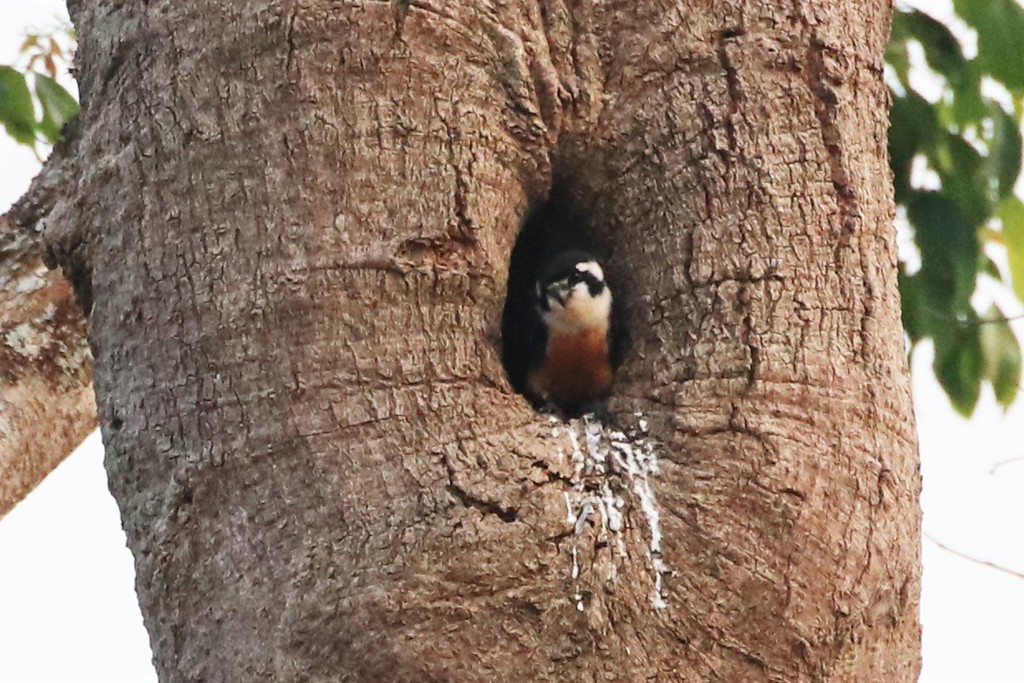
Black-thighed Falconet
Live sightings near you, the range map, bar charts of when it is seen, and Macaulay Library photos and recordings.
Black-thighed Falconet
Microhierax fringillarius
The black-thighed falconet (Microhierax fringillarius) is one of the smallest birds of prey, typically measuring between 14–16 centimetres (5.5–6.3 in) long, with a 27–32 centimetres (11–13 in) wingspan, which is a size comparable to a typical sparrow. It is native to Brunei Darussalam, Myanmar, Thailand, Malaysia, Singapore and Indonesia. and vagrant to Sri Lanka.
From the article Black-thighed falconet on Wikipedia (CC BY-SA), quoted section by section
Description
This is a minute, shrike-like falcon, with a squarish tail that is frequently spread. The adult male is glossy black above, with a white forehead streak that arcs around black cheeks. It has a white or rufous-washed throat, with a white breast shading into a rufous abdomen. Its thighs and flanks are black, as is its cere and legs. In flight the male has white wings underneath with black barring on the primaries and secondary flight feathers, and light streaking on the underwing coverts. There are three white bars underneath on the otherwise plain black tail. The adult female is similar to the adult male, except the tail is longer. The juvenile is similar to the adults, except that the white areas of the head are rufous. The voice is a hard, high-pitched cry shiew and a fast repeated kli-kli-kli-kli.
Range & habitat
The typical habitat is forest, forest edge and wooded open area. It can also frequently be found around human cultivation, villages, and near active slash-and-burn forest clearance; often by rivers, streams, and paddy fields. It mostly lives below 1,500m elevation.
Wikipedia: “Habitat”
What it does
This falconet is generally social and gregarious, often found in loose pairs or groups of ten or more. The breeding season for this falcon varies by location, with populations up to the North of the equator breeding mostly in February–June. To the South of the equator, egg-laying is recorded in Java in November–December. This falconet usually uses old nest holes of barbets, or occasionally old woodpecker holes. No material is added in the cavity aside from insect remains. The typical clutch size is between 2-5 eggs. Incubation and fledging periods are unknown. The nest hole may be used as a roost by adults year-round.
Wikipedia: “Sociosexual behaviour and breeding”
At the table
This falconet mainly feeds on insects, including moths, butterflies, dragonflies, alate termites and cicadas, occasional small birds, and lizards. Feeding behaviour appears to often be social, with feeding parties up to ten recorded. Much of the prey is taken during quick flights from a perch.
Wikipedia: “Food”
Listen
Looking for field recordings…
Where it lives
Recorded sightings
—
geo-referenced records in GBIF, from museums, herbaria and field observers.
Drag the globe to turn it. Dots are where records exist, not a range map; darker means more records.
In the stacks
Searching the stacks…
Every page naming Microhierax fringillarius in the Biodiversity Heritage Library →
This page is assembled live from iNaturalist, GBIF, Wikipedia, the Source Library and the Internet Archive. It is not yet part of the hand-edited codex. iNaturalist taxon 4711.