On eBird ↗
Guadalupe Caracara
Live sightings near you, the range map, bar charts of when it is seen, and Macaulay Library photos and recordings.
Guadalupe Caracara
Caracara lutosa
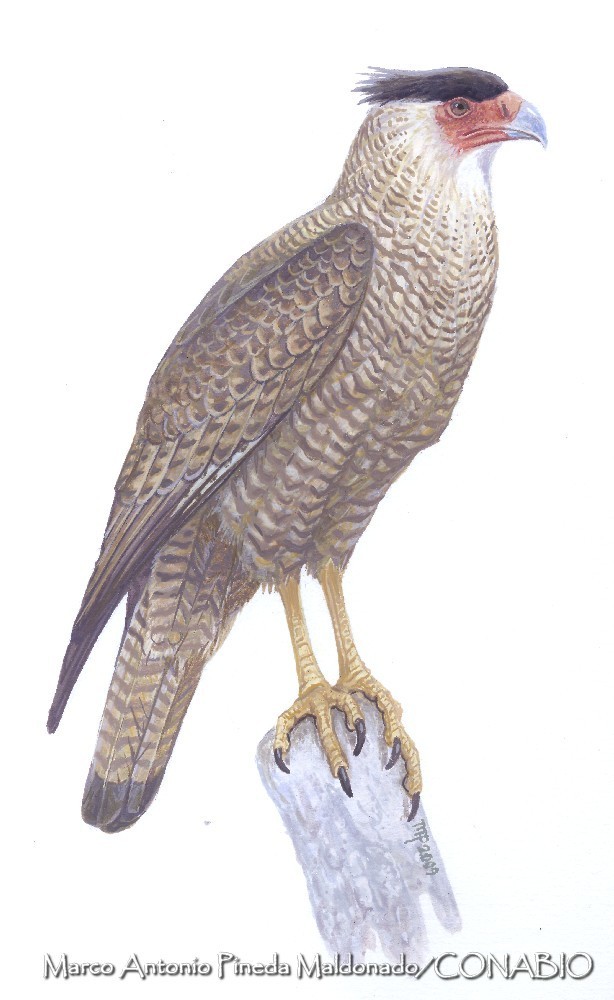
The Guadalupe caracara (Caracara lutosa) or mourning caracara is an extinct bird of prey belonging to the falcon family (Falconidae). It was, together with the closely related crested caracara (Caracara plancus), formerly placed in the genus Polyborus. It was also known as the quelili or the calalie.
From the article Guadalupe caracara on Wikipedia (CC BY-SA), quoted section by section
Description
The Guadalupe caracara was similar to the crested caracara, but differed in having less white on the upper breast and being barred on the belly rather than black.
Range & habitat
This species inhabited Mexico's Guadalupe Island until the beginning of the 20th century. The crested caracara is sometimes incorrectly referred to as "Guadalupe caracara", because the extinct birds were formerly considered a subspecies of the extant taxon. They were reinstated as a full species in 2000.
Wikipedia: “Distribution and taxonomy”
In human culture
Described as "evil" and "vicious" by early observers, it was driven to extinction by a hunting and poisoning campaign led by goat herders on Guadalupe Island. As described by Edward Palmer:
The "Calalie" is abundant on every part of the island; and no bird could be a more persistent or more cruel enemy of the poultry and domestic animals. It is continually on the watch, and in spite of every precaution often snatches its prey from the very doors of the houses. The destruction of the wild goats is not so great, as these animals are better able to protect themselves than the tame ones. No sooner is one kid born - while the mother is in labor with the second - than the birds pounce upon it; and should the old one be able to interfere, she is also assaulted. No kid is safe from their attacks. Should a number be together, the birds unite their forces, and, with great noise and flapping of their wings, generally manage to separate the weakest one and dispatch it. They sometimes fasten upon the tongue when the poor creature opens its mouth to bleat, and have been known to tear it out, leaving the animal to perish, if not otherwise destroyed. Sometimes the anus is the point of first attack. The birds are cruel in the extreme, and the torture sometimes inflicted upon the defenceless animals is painful to witness... …
Wikipedia: “History”
Listen
Looking for field recordings…
Where it lives
Recorded sightings
—
geo-referenced records in GBIF, from museums, herbaria and field observers.
Drag the globe to turn it. Dots are where records exist, not a range map; darker means more records.
In the stacks
Searching the stacks…
Every page naming Caracara lutosa in the Biodiversity Heritage Library →
This page is assembled live from iNaturalist, GBIF, Wikipedia, the Source Library and the Internet Archive. It is not yet part of the hand-edited codex. iNaturalist taxon 4713.