- Animals
- ›Chordates
- ›Vertebrates
- ›Ray-finned Fishes
- ›Spiny-rayed fishes
- ›Jacks, Flounders, Barracudas, and Allies
- ›Jacks, Remoras, and Allies
- ›Jacks
- ›Caranginae
- ›Caranx
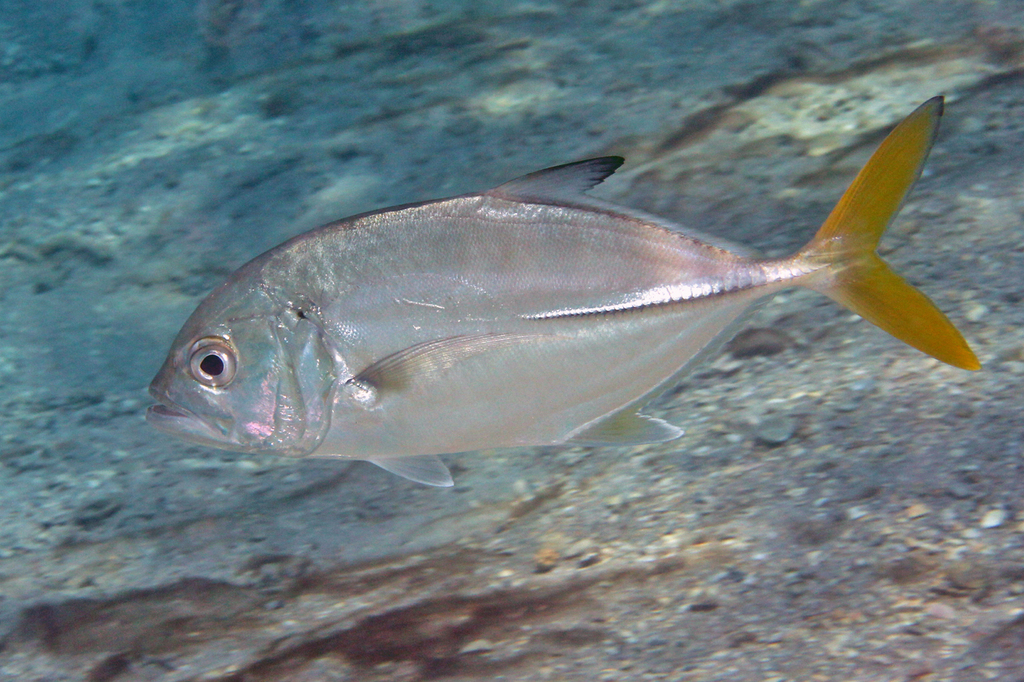
Horse-eye Jack
Caranx latus
The horse-eye jack (Caranx latus) is a gamefish and minor commercial fish in the family Carangidae. It is also known as the big-eye jack, and is similar in appearance to the crevalle jack, although the head of the horse-eye jack is not as blunt. The horse-eye jack is known to feed on smaller fish and on many invertebrates, such as shrimp and crab.
From the article Horse-eye jack on Wikipedia (CC BY-SA), quoted section by section
Description
The horse-eye jack is a large fish; it can grow to a maximum recorded length of 101 cm and a weight of 13.4 kg but is more common at lengths less than 60 cm. The horse-eye jack has a body form similar to other large jacks found throughout its range, with a moderately compressed elongate and deep body. The dorsal profile becomes more strongly curved anteriorly, however the forehead is less blunt than the crevalle jack. The eyes are large in proportion to the rest of the head and covered by a well-developed adipose eyelid, with the posterior extremity of the jaw vertically under or past the posterior margin of the eye. The dorsal fin is in two parts, the first consisting of eight spines and the second of one spine followed by 19 to 22 soft rays. The anal fin consists of two anteriorly detached spines followed by one spine and 16 to 18 soft rays. The lobes of the soft dorsal and anal fins are elongated, and the pectoral fin is falcate and longer than the length of the head. The lateral line has a pronounced and moderately long anterior arch. The straight section contains 32 to 39 very strong scutes, with bilateral keels present on the caudal peduncle. The chest is completely scaled. The upper jaw contains a series of strong outer canines with an inner band of smaller teeth, while the lower jaw contains a single row of teeth. …
Range & habitat
The horse-eye jack is commonly found in the subtropical Atlantic Ocean from Bermuda and the northern Gulf of Mexico and south to Rio de Janeiro. In the eastern Atlantic, it is found from St. Paul's Rocks to Ascension Island and, rarely, in the Gulf of Guinea. It is a pelagic fish. It can be found on reefs and offshore oil rigs. The juvenile can be found closer to shore along sandy and muddy bottoms. The species may venture into brackish waters and can live in river mouths, but it is typically found in saltwater up to 140 m in depth. The adult horse-eye jack commonly swims with others in a school, either as one species or mixed with crevalle jack. Sometimes it also swims as a pair with a member of a very different species, such as Halichoeres radiatus, a type of wrasse.
Wikipedia: “Distribution”
Where it lives
Recorded sightings
—
geo-referenced records in GBIF, from museums, herbaria and field observers.
Drag the globe to turn it. Dots are where records exist, not a range map; darker means more records.
In the stacks
Searching the stacks…
Every page naming Caranx latus in the Biodiversity Heritage Library →
This page is assembled live from iNaturalist, GBIF, Wikipedia, the Source Library and the Internet Archive. It is not yet part of the hand-edited codex. iNaturalist taxon 47227.