- Animals
- ›Chordates
- ›Vertebrates
- ›Cartilaginous Fishes
- ›Sharks and Rays
- ›Sharks
- ›Squalean Sharks
- ›Cow and Frilled Sharks
- ›Frilled Sharks
- ›Chlamydoselachus
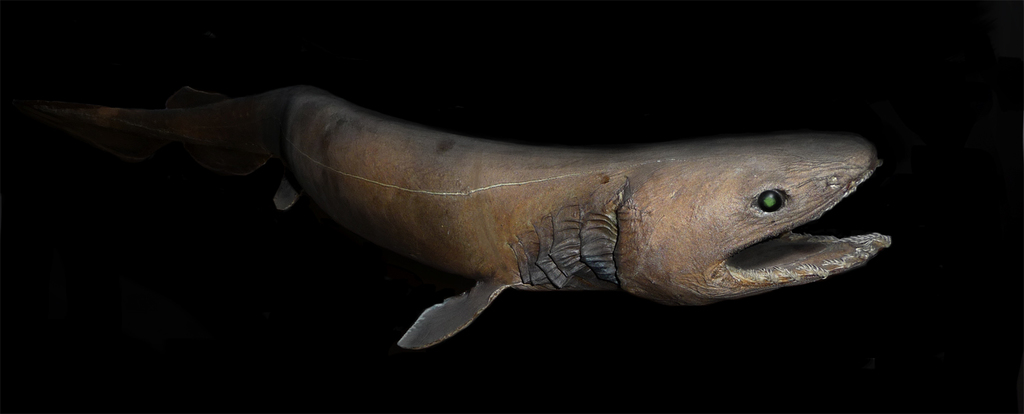
Frilled Shark
Chlamydoselachus anguineus
The frilled shark (Chlamydoselachus anguineus), also known as the lizard shark, is one of the two extant species of shark in the family Chlamydoselachidae (the other is the southern African frilled shark, Chlamydoselachus africana). The frilled shark is considered a living fossil, because of its primitive, anguilliform (eel-like) physical traits, such as a dark-brown color, amphistyly (the articulation of the jaws to the cranium), and a 2.0 m (6.6 ft)–long body, which has dorsal, pelvic, and anal fins located towards the tail. The common name, frilled shark, derives from the fringed appearance of the six pairs of gill slits at the shark's throat.
The two species of frilled shark are distributed throughout regions of the Atlantic and the Pacific oceans, usually in the waters of the outer continental shelf and of the upper continental slope, where the sharks usually live near the ocean floor, near biologically productive areas of the ecosystem. To live on a diet of cephalopods, smaller sharks, and bony fish, the frilled shark practices diel vertical migration to feed at night at the surface of the ocean. When hunting food, the frilled shark curls its tail against a rock and moves like an eel, bending and lunging to capture and swallow whole prey with its long and flexible jaws, which are equipped with 300 recurved, needle-like teeth.
From the article Frilled shark on Wikipedia (CC BY-SA), quoted section by section
Description
The eel-like bodies of C. anguineus and C. africana differ anatomically; C. anguineus has a longer head and shorter gill slits, a spinal column with more vertebrae (160–171 vs. 147), and a lower-intestine spiral valve with more turns (35–49 vs. 26–28) than does C. africana. The skin color of either species ranges from uniformly dark-brown to uniformly grey. In addition, C. anguineus has smaller pectoral fins than C. africana, and the mouth is narrower. The recorded, maximum body-length of a male frilled shark is 1.7 m (5.6 ft), and the recorded, maximum body-length of a female frilled shark is 2.0 m (6.6 ft).
The head of the frilled shark is broad and flat, with a short, rounded snout. The nostrils are vertical slits, separated by a flap of skin that forms the incurrent opening and the excurrent opening. The moderately large eyes are horizontal ellipsoids, which have no nictitating membrane, which is a protective, third eyelid. Ligaments articulate the long jaws to the cranium, and the corners of the mouth have neither furrows nor folds. The jaws contain 300 trident-shaped teeth, each needle-tooth has a cusp and two cusplets; the rows of teeth are widely spaced, with 19–28 tooth rows in the upper jaw, and 21–29 tooth rows in the lower jaw. …
Range & habitat
The habitats of the frilled shark include the waters of the outer continental shelf and the upper-to-middle continental slope, favoring upwellings and other biologically productive areas. Usually, the shiver lives close to the ocean floor, yet its diet of cephalopods, smaller sharks, and bony fish, indicates that the frilled shark practices diel vertical migration, and swims up to feed at night at the surface of the ocean. In their Atlantic- and Pacific-ocean habitats, frilled sharks practice spatial segregation determined by the individual size, the sex, and the reproductive condition of each shark in the shiver. In Suruga Bay, on the Pacific coast of Honshu, Japan, the frilled shark is most common at the depth of 50–200 m (160–660 ft), except in the August-to-November period, when the temperature at the 100 m (330 ft) water-layer exceeds 15 °C (59 °F), and then the sharks swim into deeper, cooler water.
In the eastern Atlantic Ocean, the frilled shark occurs off northern Norway, northern Scotland, and western Ireland, ranging from France to Morocco, the archipelago of Madeira, and the coast of Mauritania, in northwest Africa. In the central Atlantic Ocean, the frilled shark has been caught along the region of the Mid-Atlantic Ridge, ranging from north of the Azores islands to the Rio Grande Rise, off southern Brazil, and the Vavilov Ridge, off West Africa. …
Wikipedia: “Habitat and distribution”
What it does
A cartilaginous skeleton and a large liver (filled with low-density lipids) are the mechanical means with which the frilled shark controls and maintains its buoyancy in the deep waters of the ocean. The shark has an open, lateral-line organ system featuring mechanoreceptor hair cells in grooves exposed to the ocean environment; such a basal clade configuration enhances the frilled shark's perception and detection of changes in the movement, the vibration, and the pressure of the surrounding water. Like all animals, the frilled shark is afflicted by parasites, such as the Monorygma tapeworm, the trematoda flatworm, the Otodistomum veliporum, and the Mooleptus rabuka nematode; and by predators, such as other sharks, as indicated by missing tail-tips lost to a hungry attacker. In New Zealand, the Takatika Grit, in the Chatham Islands, yielded frilled-shark, bird, and conifer-cone fossils that dated to the time of the Cretaceous–Paleogene boundary (66.043 ± 0.011 mya) which suggested that the sharks lived inland, in shallow bodies of water far from the ocean. The shallow-water frilled shark had larger, stronger teeth, suitable for eating mollusks; scarcity and plenty of food are indicated in the tooth's morphology of sharper points (cusps) oriented into the mouth. …
Wikipedia: “Biology and ecology”
Where it lives
Recorded sightings
—
geo-referenced records in GBIF, from museums, herbaria and field observers.
Drag the globe to turn it. Dots are where records exist, not a range map; darker means more records.
In the stacks
Searching the stacks…
Every page naming Chlamydoselachus anguineus in the Biodiversity Heritage Library →
This page is assembled live from iNaturalist, GBIF, Wikipedia, the Source Library and the Internet Archive. It is not yet part of the hand-edited codex. iNaturalist taxon 47302.