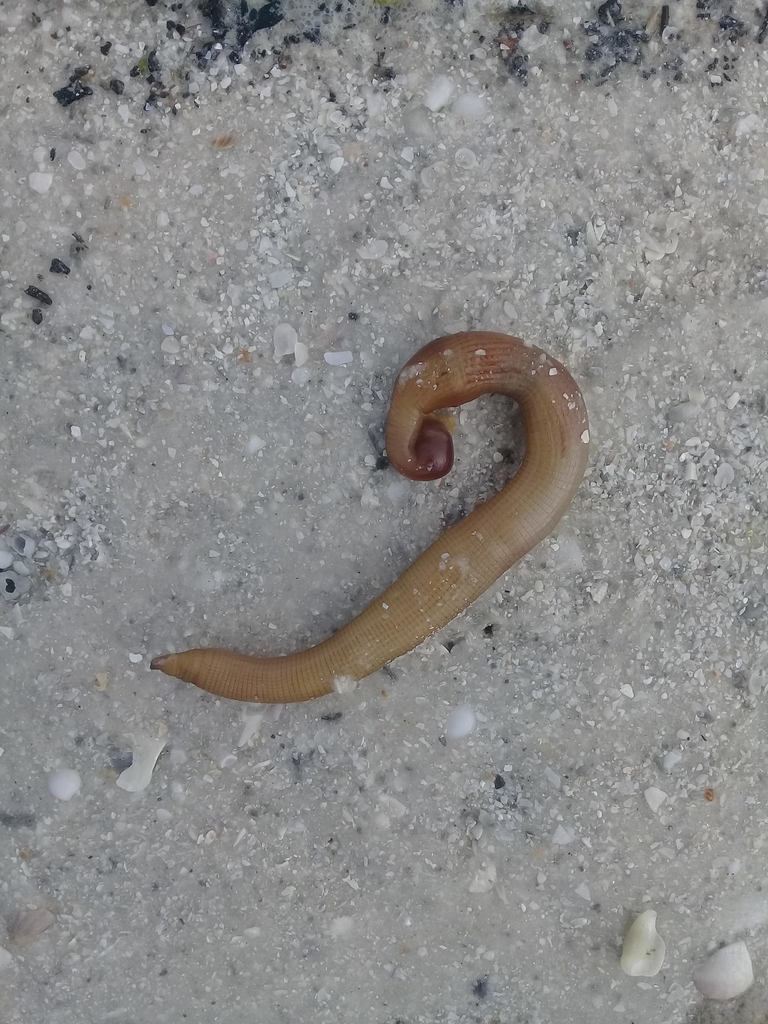
Gould’s Sipunculid
Phascolopsis gouldii
Phascolopsis gouldii is a species of unsegmented benthic marine worm, also known as a peanut worm or star worm. It is the only species in the genus Phascolopsis. It lives in burrows in muddy sand in shallow waters off North America.
From the article Phascolopsis on Wikipedia (CC BY-SA), quoted section by section
Description
Phascolopsis gouldii can reach thirty centimetres long and is a smooth slender cylindrical shape. The body is pinkish and divided into an anterior introvert and a posterior trunk. The introvert is about one quarter of the length of the body and can be retracted inside it by turning outside in. This is done by the contraction of two pairs of large introvert retractor muscles which extend from the body wall of the trunk to near the mouth which is at the tip of the introvert in the centre of the oral disc. This is surrounded by a ring of short tentacles that are used for feeding and in gas exchange. They are pink inside due to the presence of the pigment hemerythrin used in oxygen transport. The anus is on a small mound where the trunk and introvert join. The trunk is covered by a thick integument and is largely composed of bands of longitudinal muscles which can be seen through the cuticle. The anterior part of the trunk, into which the introvert retracts, is broader than the posterior part.
Range & habitat
This peanut worm is found in shallow coastal waters on the eastern seaboard of the United States from Connecticut to Florida, and Canada. Particular locations where it has been found include Cobscook Bay, the Gulf of Maine, Minister's Island, Indian Point, Newfoundland and the St Lawrence estuary.
Wikipedia: “Distribution”
Where it lives
Recorded sightings
—
geo-referenced records in GBIF, from museums, herbaria and field observers.
Drag the globe to turn it. Dots are where records exist, not a range map; darker means more records.
In the stacks
Searching the stacks…
Every page naming Phascolopsis gouldii in the Biodiversity Heritage Library →
This page is assembled live from iNaturalist, GBIF, Wikipedia, the Source Library and the Internet Archive. It is not yet part of the hand-edited codex. iNaturalist taxon 473968.