- Animals
- ›Chordates
- ›Vertebrates
- ›Ray-finned Fishes
- ›Spiny-rayed fishes
- ›Gobies, cardinalfishes and allies
- ›Gobies and allies
- ›Gobies
- ›Sea Gobies
- ›Gobiodon
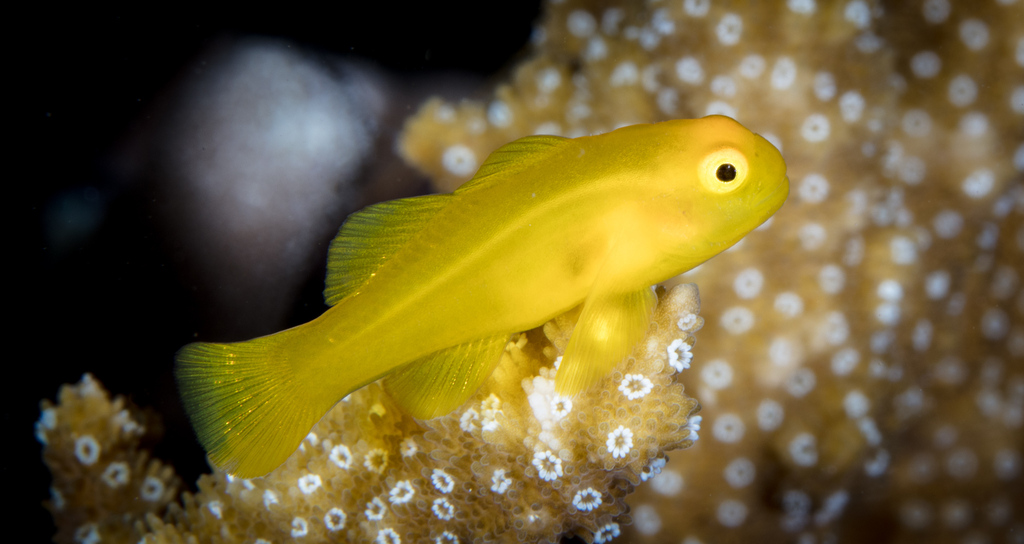
Yellow Coralgoby
Gobiodon okinawae
The yellow clown goby (Gobiodon okinawae), also known as the Okinawa goby or yellow coral goby, is a member of the goby family native to the western Pacific, from southern Japan (including Okinawa) to the southern reaches of the Great Barrier Reef. As the common name implies, this goby is bright yellow in color, save for a whitish patch on each cheek.
From the article Yellow clown goby on Wikipedia (CC BY-SA), quoted section by section
Description
The yellow clown goby is a fusiform fish. It has 7 dorsal spines, 10 dorsal rays, 1 anal spine, and 9 anal rays. At maturity, this goby may reach 3.5 cm in length. It is similar to the citrus goby (Gobiodon citrinus), but lacks the blue and white facial markings present in the latter species.
Range & habitat
The yellow clown goby inhabits the coral reefs of sheltered lagoons. Unlike most gobies, which are burrowers, this goby (and other members of its genus) roosts in the outer branches of Acropora corals, in groups of 5–15 individuals.
Wikipedia: “Habitat”
What it does
The yellow clown goby is not generally aggressive, though it actively protects its territory against other yellow clown gobies (hence, in the small confines of an aquarium tank, this goby is best kept singly or as a breeding pair). The primary defense against predators is a poisonous, bitter mucus on the skin that makes this goby unpalatable.
Wikipedia: “Behavior”
Where it lives
Recorded sightings
—
geo-referenced records in GBIF, from museums, herbaria and field observers.
Drag the globe to turn it. Dots are where records exist, not a range map; darker means more records.
In the stacks
Searching the stacks…
Every page naming Gobiodon okinawae in the Biodiversity Heritage Library →
This page is assembled live from iNaturalist, GBIF, Wikipedia, the Source Library and the Internet Archive. It is not yet part of the hand-edited codex. iNaturalist taxon 474780.