On eBird ↗
Great Shearwater
Live sightings near you, the range map, bar charts of when it is seen, and Macaulay Library photos and recordings.
Great Shearwater
Ardenna gravis
The great shearwater (Ardenna gravis; formerly Puffinus gravis) is a large shearwater in the seabird family Procellariidae. Ardenna was first used to refer to a seabird by Italian naturalist Ulisse Aldrovandi in 1603, and gravis is Latin for "heavy".
From the article Great shearwater on Wikipedia (CC BY-SA), quoted section by section
Description
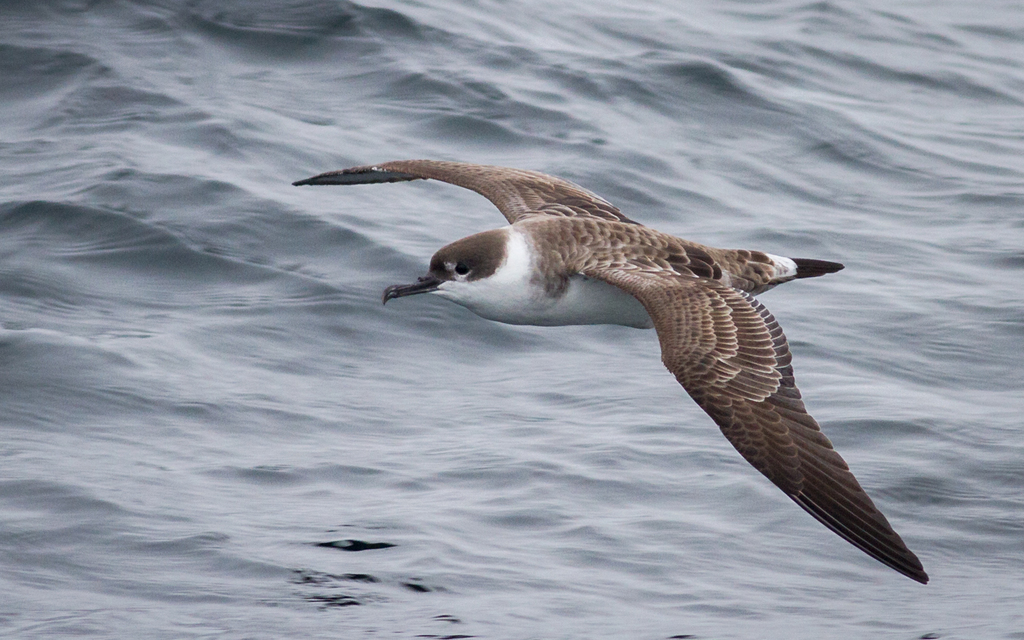
This shearwater is 43–51 cm (16.9–20.1 in) in length with a 105–122 cm (3.5–4.0 ft) wingspan. It is identifiable by its size, dark upper parts, and white under parts, with the exception of a brown belly patch and dark shoulder markings. It has a black cap, black bill, and a white "horseshoe" on the base of the tail. The stiff flight, like a large Manx shearwater, is also distinctive. The only other large shearwaters in its range are the Cory's Shearwater and the all-dark Sooty Shearwater.
Range & habitat
The great shearwater, like the sooty shearwater, follows a circular migration route, moving north up the eastern seaboard of first South and then North America, before crossing the Atlantic in August. It can be quite common off the southwestern coasts of Great Britain and Ireland before heading back south again, this time down the eastern littoral of the Atlantic.
Wikipedia: “Distribution and habitat”
What it does
This bird has the typically "shearing" flight of the genus, dipping from side to side on stiff wings with few wingbeats, the wingtips almost touching the water. Its flight is powerful and direct, with wings held stiff and straight.
Breeding. This species breeds on Nightingale Island, Inaccessible Island, Tristan da Cunha, and Gough Island. It is one of only a few bird species to migrate from breeding grounds in the Southern Hemisphere to the Northern Hemisphere, the normal pattern being the other way around. This shearwater nests in large colonies, laying one white egg in a small burrow or in the open grass. These nests are visited only at night to avoid predation by large gulls.
Food and feeding. The great shearwater feeds on fish and squid, which it catches from the surface or by plunge-diving. It occasionally feeds on crustaceans, fish entrails and other refuse discarded by fishing vessels. It readily follows fishing boats, where it indulges in noisy squabbles. This is a gregarious species, which can be seen in large numbers from ships or appropriate headlands. They have a piercing "eeyah" cry usually given when resting in groups on the water. Great shearwaters are among the seabird species with the highest incidence of plastic ingestion.
Wikipedia: “Behaviour and ecology”
Listen
Looking for field recordings…
Where it lives
Recorded sightings
—
geo-referenced records in GBIF, from museums, herbaria and field observers.
Drag the globe to turn it. Dots are where records exist, not a range map; darker means more records.
In the stacks
Searching the stacks…
Every page naming Ardenna gravis in the Biodiversity Heritage Library →
This page is assembled live from iNaturalist, GBIF, Wikipedia, the Source Library and the Internet Archive. It is not yet part of the hand-edited codex. iNaturalist taxon 475120.