On eBird ↗
Lesser Yellow-headed Vulture
Live sightings near you, the range map, bar charts of when it is seen, and Macaulay Library photos and recordings.
Lesser Yellow-headed Vulture
Cathartes burrovianus
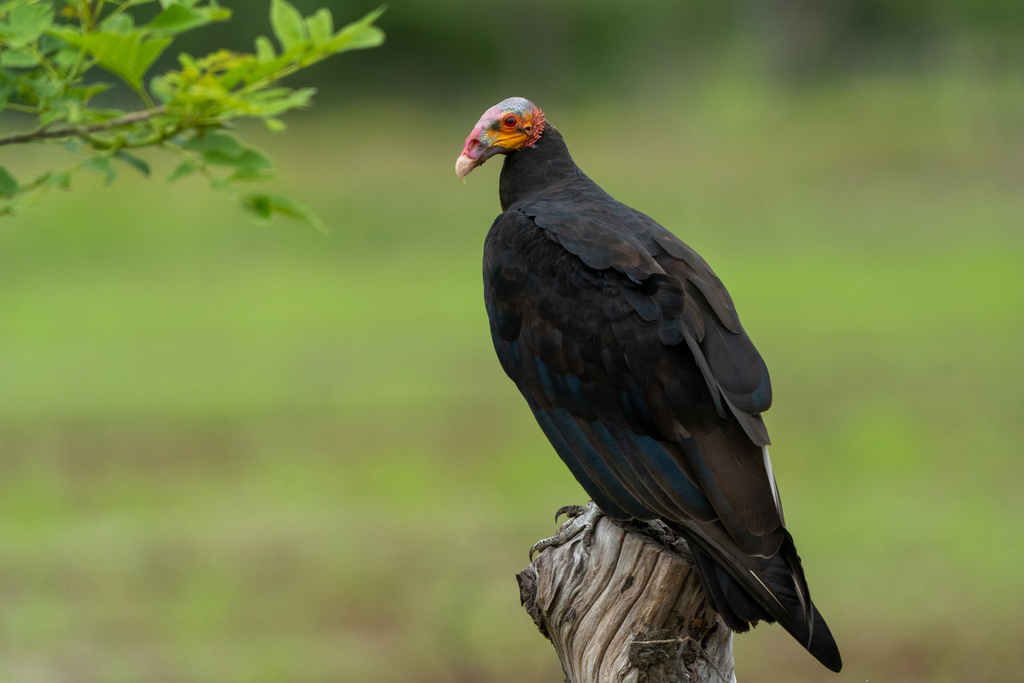
The lesser yellow-headed vulture (Cathartes burrovianus), also known as the savannah vulture, is a species of bird in the New World vulture family Cathartidae. It was considered to be the same species as the greater yellow-headed vulture until they were split in 1964. It is found in Mexico, Central America, and South America in seasonally wet or flooded lowland grassland, swamps, and heavily degraded former forest. It is a large bird, with a wingspan of 150–165 cm (59–65 in). The body plumage is black, and the head and neck, which are featherless, are pale orange with red or blue areas. It lacks a syrinx, so therefore its vocalizations are limited to grunts or low hisses.
The lesser yellow-headed vulture feeds on carrion and locates carcasses by sight and by smell, an ability which is rare in birds. It is dependent on larger vultures, such as the king vulture, to open the hides of larger animal carcasses as its bill is not strong enough to do this. Like other New World vultures, the lesser yellow-headed vulture utilizes thermals to stay aloft with minimal effort. It lays its eggs on flat surfaces, such as the floors of caves, or in the hollows of stumps. It feeds its young by regurgitation.
From the article Lesser yellow-headed vulture on Wikipedia (CC BY-SA), quoted section by section
Description
This is the lightest and smallest of the extant New World vultures despite sometimes measuring at least as long and longer winged than black vultures. The lesser yellow-headed vulture is 53–66 cm (21–26 in) in length, with a wingspan of 150–165 cm (59–65 in) and a tail length of 19–24 cm (7.5–9.4 in). Its weight ranges from 0.95 to 1.55 kg (2.1 to 3.4 lb). Its plumage is black with a green sheen. The throat and the sides of the head are featherless. The head and neck are bare of feathers, and the skin is yellow, with a reddish forehead and nape and a gray-blue crown. The irises of its eyes are red, its legs are white, and its beak is flesh-colored. The eye has a single incomplete row of eyelashes on the upper lid and two rows on the lower lid. The tail is rounded and relatively short for a vulture; the tip of the closed wing extends beyond the tail. Immature lesser yellow-headed vultures have browner plumage, a dusky head, and a white nape.
The beak is thick, rounded, and hooked at the tip. The front toes are long with small webs at their bases and are not adapted to grasping. The opening of the nostril is longitudinal, and the nostrils lack a septum. …
Range & habitat
It is found in Argentina, Belize, Bolivia, Brazil, Chile, Colombia, Costa Rica, Ecuador, El Salvador, French Guiana, Guatemala, Guyana, Honduras, Mexico, Nicaragua, Panama, Paraguay, Peru, Suriname, Uruguay, and Venezuela. Its natural habitats are subtropical or tropical seasonally wet or flooded lowland grassland, swamps, mangroves, and heavily degraded former forest. It may wander over dry fields and clearings. It is not generally found in high-altitude regions.
This bird with its somehow crow-like aspect gave foot to the naming of the Quebrada de los Cuervos (Crows Ravine) in Uruguay, where they dwell together with the black vulture and the turkey vulture.
Wikipedia: “Distribution and habitat”
What it does
The lesser yellow-headed vulture flies solitarily, with wings held in a dihedral position. It glides at a low altitude over wetlands while locating food, and perches on fence posts or on other low perches. When flying, it travels alone and is rarely found in groups. The flight of the lesser yellow-headed is an example of static soaring flight, which uses thermals to maintain altitude without the need to flap its wings. This vulture rarely soars high in the air, preferring low altitudes. This bird is believed to be somewhat migratory in response to the changes in water level where it lives. The lesser yellow-headed vulture, like other New World vultures, has the unusual habit of urohidrosis, in which it urinates or defecates on its legs to cool them by evaporation.
Breeding. Lesser yellow-headed vultures do not build nests, but rather lay eggs on the ground, cliff ledges, the floors of caves, or in the hollow of a tree. Eggs are cream colored and heavily blotched with brown and gray spots, particularly around the larger end. Two eggs are generally laid. The chicks are altricial—they are blind, naked and relatively immobile upon hatching. The chicks do not grow their down feathers until later. The parents feed their young by regurgitating pre-digested food into their beak, where the chicks then drink it. The young fledge after two to three months.
Feeding. …
Wikipedia: “Ecology and behavior”
In human culture
The lesser yellow-headed vulture's genus, Cathartes, means "purifier" and is from the Latinized form of the Greek kathartēs/καθαρτης. The common name, vulture, is derived from the Latin word vulturus, which means "tearer" and is a reference to its feeding habits.
Wikipedia: “Etymology”
Listen
Looking for field recordings…
Where it lives
Recorded sightings
—
geo-referenced records in GBIF, from museums, herbaria and field observers.
Drag the globe to turn it. Dots are where records exist, not a range map; darker means more records.
In the stacks
Searching the stacks…
Every page naming Cathartes burrovianus in the Biodiversity Heritage Library →
This page is assembled live from iNaturalist, GBIF, Wikipedia, the Source Library and the Internet Archive. It is not yet part of the hand-edited codex. iNaturalist taxon 4761.