- Animals
- ›Chordates
- ›Vertebrates
- ›Amphibians
- ›Frogs and Toads
- ›Narrow-mouthed Frogs
- ›Microhylinae
- ›Glyphoglossus
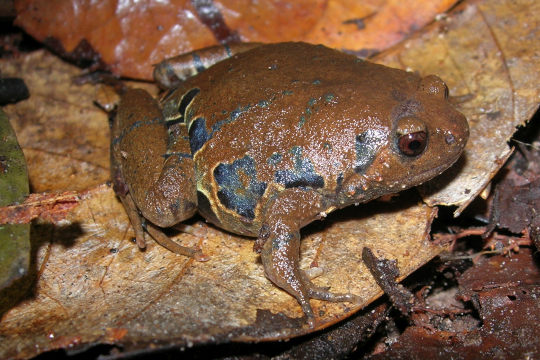
Smith's Squat Frog
Glyphoglossus smithi
Glyphoglossus smithi, also known as Smith's squat frog or Smith's burrowing frog, is a species of frog in the family Microhylidae. It is endemic to Sabah and Sarawak in Malaysian Borneo. However, it is likely to occur more widely than currently known and be present in Brunei and Indonesia. The specific name smithi honours Dr Harrison Willard Smith, an American scientist who collected the holotype from the Limbang River district.
From the article Glyphoglossus smithi on Wikipedia (CC BY-SA), quoted section by section
Description
Adult females measure up to 39 mm (1.5 in) in snout–vent length. The overall appearance is stocky. The head is small, slightly wider than it is long. The snout is truncate. The tympanum is present but hidden under skin. The finger tips are not expanded but the toe tips are expanded into small discs. The toes are about one-fourth webbed. Skin is smooth. Colouration is dark brown above with dark markings edged with pink or red. A conspicuous red or pink arc may be present above the anus.
Range & habitat
Glyphoglossus smithi occurs in lowland rainforests. It is a secretive, burrowing species that is rarely observed. The eggs are probably laid in pools of standing water on the forest floor. It is threatened by habitat loss caused by clear-cutting. The type locality in Sarawak has experienced severe habitat loss and the species might no longer persist there. The Sabah locality is, however, within the Danum Valley Conservation Area, which is well protected.
== References ==
Wikipedia: “Habitat and conservation”
Listen
Looking for field recordings…
Where it lives
Recorded sightings
—
geo-referenced records in GBIF, from museums, herbaria and field observers.
Drag the globe to turn it. Dots are where records exist, not a range map; darker means more records.
In the stacks
Searching the stacks…
Every page naming Glyphoglossus smithi in the Biodiversity Heritage Library →
This page is assembled live from iNaturalist, GBIF, Wikipedia, the Source Library and the Internet Archive. It is not yet part of the hand-edited codex. iNaturalist taxon 476451.