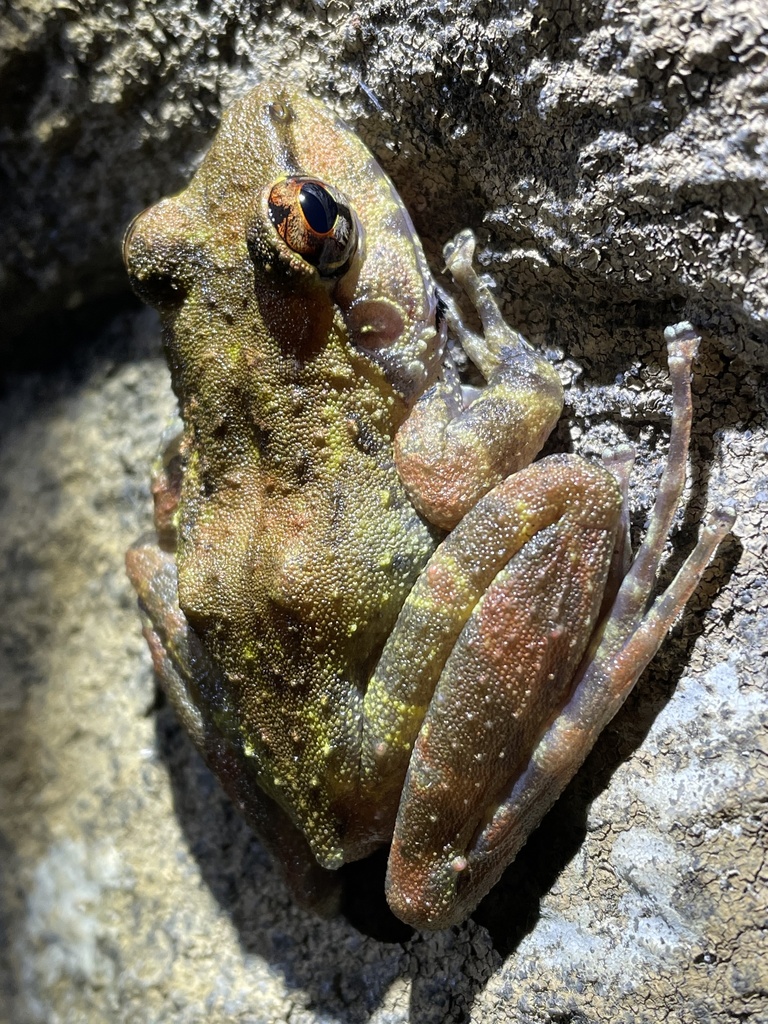
Arthroleptides yakusini
The southern torrent frog (Arthroleptides yakusini) is a species of frog in the family Petropedetidae endemic to Tanzania, where it is found in the Uluguru, Udzungwa, and Mahenge Mountains. It is one of many, often taxonomically unrelated, frogs referred to as torrent frogs. It occurs mainly around rocky montane streams surrounded by mature forest at elevations of 300–2,800 m (984.3–9,186.4 ft) above sea level, but also can be found on the forest floor away from water, and may be tolerant of open woodland environments. While it is sometimes claimed to be found in the Nguru Mountains as well, molecular evidence shows that this population may instead represent an unnamed species.
This frog is a nocturnal species, spending the daytime hidden away under rocks and emerging to feed after nightfall. It can grow over 70 mm (2.8 in) in snout-vent length, with males commonly growing larger than females. With its wide jaws, it is believed to prey on smaller frogs. The upper side of its body is mainly gray-brown with mottled patterns and an orange-reddish stripe stretching across each eye, camouflaging it against the leaf litter, while the underside is pale. During the breeding season, mature males produce advertisement calls to attract mates and develop a number of secondary sexual characteristics, including swollen forearms, spines on the throat and chin, knobs on the metacarpal area and a soft protrusion called a tympanic papilla on each tympanum.
From the article Southern torrent frog on Wikipedia (CC BY-SA), quoted section by section
Description
A large species of frog, the snout-vent length of the southern torrent frog commonly exceeds 54 mm (2.1 in), and reaches over 70 mm (2.8 in) in some exceptionally large males. Unusually for a frog, the males tend to grow larger than the females. This species has countershading coloration, with the upper surface of the body being gray-brown with mottled dark patterns while the belly and chest are pale. The limbs have similarly pale undersides, while the back of the thighs have white speckles over a darker background color. The throat is dark with speckled pale patterns, and an orange-reddish stripe passes through the upper part of the eye in many individuals. Smaller individuals may have transverse bands of color on their backs. This frog has wide jaws, the width of which ranges between 40 and 44% of the individual's snout-vent length, and nostrils located near the front of the snout. The eyes cannot be seen when the frog is viewed from below. The tympana are dark and round, and in large males the width of each tympanum is slightly less than the distance between the front corners of the eyes. However, females and smaller males have proportionally much smaller tympana, with the width of each being only about 20% of the distance between the eyes. …
Range & habitat
The southern torrent frog is endemic to Tanzania, where it occurs in mountain ranges from 300–2,800 m (984.3–9,186.4 ft) above sea level. It was first discovered in the Uluguru and Udzungwa mountain ranges, and in 2004 it was reported to occur in the Mahenge Mountains as well. Though sometimes claimed to also be found in the Nguru Mountains, molecular evidence suggests this population actually represents a separate, currently unnamed species within the same genus. The southern torrent frog mostly inhabits rocky streams surrounded by montane forest, with a preference for mature forest (though it may tolerate open woodland habitats more than the related Usambara torrent frog), and has an estimated extent of occurrence of 3,113.18 km2 (1,202.0 sq mi). It can also occur further from these streams, with adults sometimes being found some distance away from water on the forest floor.
Wikipedia: “Distribution and habitat”
What it does
After the short rains begin in November, adult males of this species start producing advertisement calls at night to attract mates, and may do so from the ground or atop rocks or fallen tree trunks. The advertisement call is made up of a series of "wauk" sounds, which are repeated at long intervals of as much as 25 seconds. Four to eight pulses comprise the call, which last from 30.6 to 81.2 milliseconds, and ranges from 1.2 to 1.4 kilohertz in emphasized frequency. The female lays her eggs on vertical or sloping rock surfaces covered with a film of water, which may be produced either by the drifting spray of a waterfall or natural drainage. The eggs are dark in color, camouflaging them against the dark rocks they are deposited on, and occur either in small clusters of four to five or large aggregations of around 200. Each egg measures about 2 mm (0.079 in) in diameter and is enclosed in a 4 mm (0.16 in) capsule. After hatching, the tadpoles do not directly enter the water and instead remain on the wet rocks, where they graze on algae and may occur in densities as high as 22 individuals per square meter (10.764 square feet). At the age of 8 to 10 weeks, metamorphosis is complete and the tail is reabsorbed, at which point the juvenile frogs move into forest leaf litter and vegetation near streams after leaving their nursery rock.
Wikipedia: “Life cycle”
Listen
Looking for field recordings…
Where it lives
Recorded sightings
—
geo-referenced records in GBIF, from museums, herbaria and field observers.
Drag the globe to turn it. Dots are where records exist, not a range map; darker means more records.
In the stacks
Searching the stacks…
Every page naming Arthroleptides yakusini in the Biodiversity Heritage Library →
This page is assembled live from iNaturalist, GBIF, Wikipedia, the Source Library and the Internet Archive. It is not yet part of the hand-edited codex. iNaturalist taxon 476493.