- Animals
- ›Echinoderms
- ›Sea Stars and Brittle Stars
- ›Sea Stars
- ›Spinulosacean Sea Stars
- ›Spinulosida
- ›Echinasterid Sea Stars
- ›Henricia
- ›Henricia leviuscula
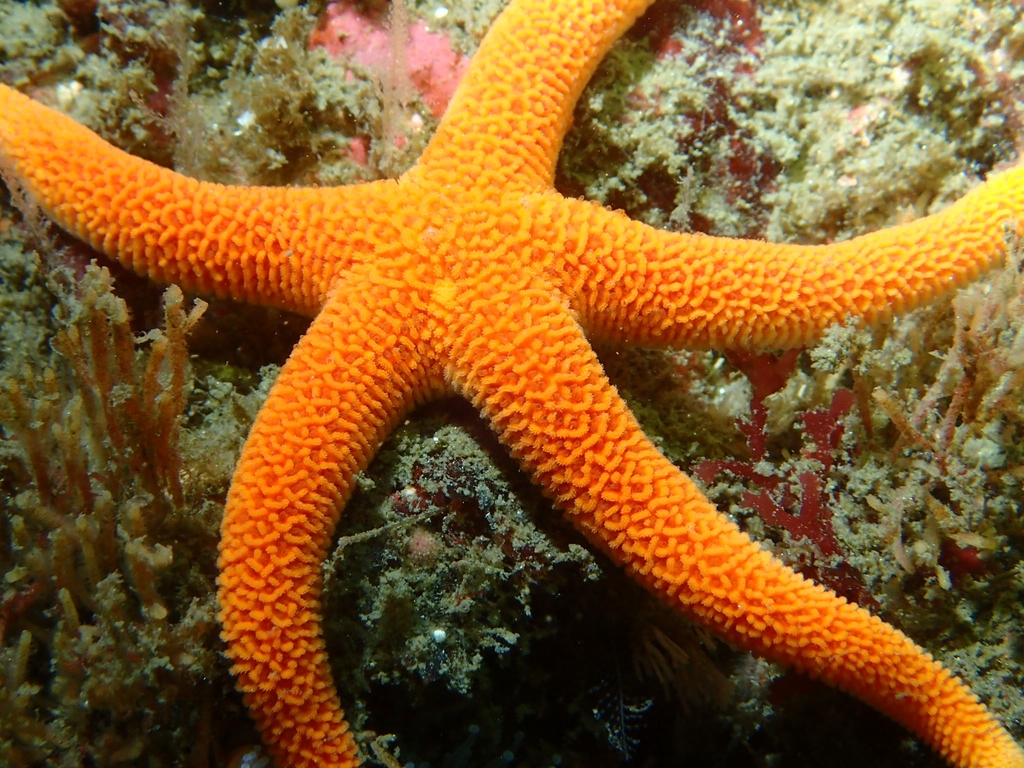
Pacific Blood Star
Henricia leviuscula
Henricia leviuscula, commonly called the Pacific blood star, it is a species of starfish found along the Pacific coast of North America.
From the article Henricia leviuscula on Wikipedia (CC BY-SA), quoted section by section
Description
They can usually be identified by their bright orange-red color, but there can also be many variations from tan to almost purple. The disk can be a mottled gray color. There can also be a saddle-like marking of lilac blotches between the rays, but the rays are not mottled. They commonly have 5 rays (occasionally 4–6). The rays are smooth and appear smooth due to the lack of pedicellariae and spines. The species is relatively small; the diameter is usually over 8 cm and rarely gets larger than 12 cm. As with all seastars the blood star has a madreporite which can be seen in the image below.
Range & habitat
Its habitat is the intertidal zone under rocks and protected places from the low-tide line to about 400 m deep. They often have a commensal scaleworm, Arctonoe vittata.
Wikipedia: “Habitat”
What it does
Sexes are dioecious and females are not known to brood young. This statement is in conflict with other sources that state that smaller females brood their young and larger females discharge eggs directly in the water and do not brood them. This is one reason that is leading biologists to believe this is a species complex. Embryonic stages do not adhere to one another but float freely. Post-hatching larvae are ciliated and swim. Spawned eggs have been measured at 1342 μm diameter.
Wikipedia: “Reproduction and life history”
Where it lives
Recorded sightings
—
geo-referenced records in GBIF, from museums, herbaria and field observers.
Drag the globe to turn it. Dots are where records exist, not a range map; darker means more records.
In the stacks
Searching the stacks…
Every page naming Henricia leviuscula in the Biodiversity Heritage Library →
This page is assembled live from iNaturalist, GBIF, Wikipedia, the Source Library and the Internet Archive. It is not yet part of the hand-edited codex. iNaturalist taxon 47664.