- Animals
- ›Chordates
- ›Vertebrates
- ›Amphibians
- ›Frogs and Toads
- ›Old World Tree Frogs
- ›Rhacophorinae
- ›Pseudophilautus
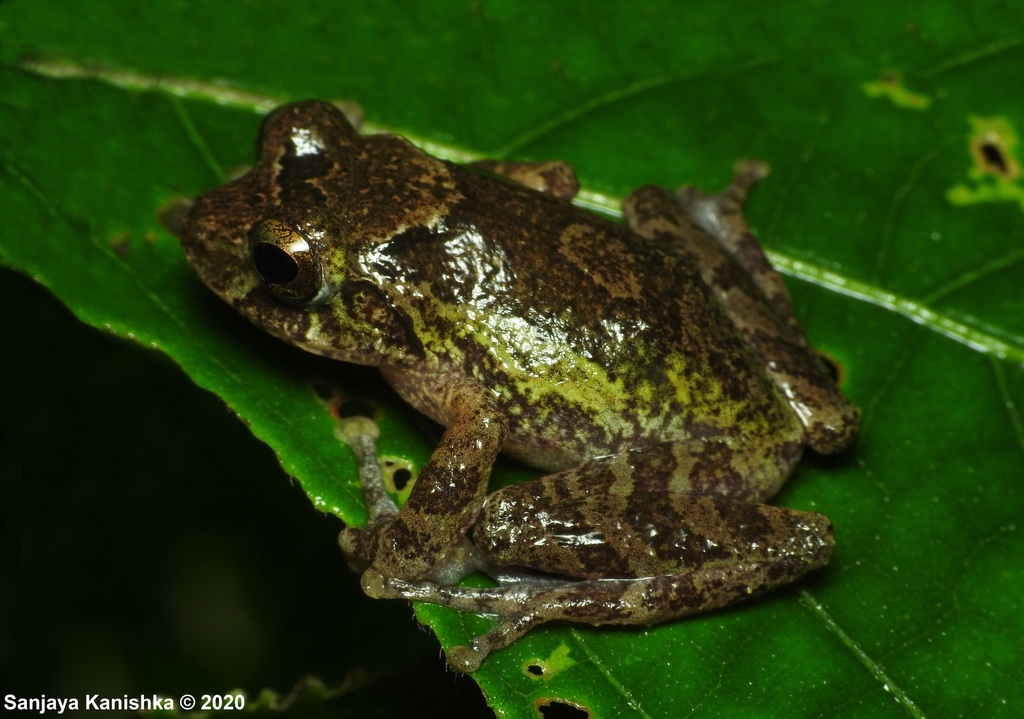
Dayawansa's Shrub Frog
Pseudophilautus dayawansai
Pseudophilautus dayawansai (Dayawansa's shrub frog) is a species of frog in the family Rhacophoridae, endemic to Sri Lanka.
Its natural habitats are wet lowland forests of Sri Lanka. It is threatened by habitat loss. People have observed it perched in shrubs as high as 2 meters above the ground. It is one of the 8 species of rhacophorids that was discovered from Adam's Peak recently. Scientists know it exclusively from the type locality: Sripada Peak in the Peak Wilderness, 1679 meters above sea level.
From the article Pseudophilautus dayawansai on Wikipedia (CC BY-SA), quoted section by section
Description
The adult male frog measures 24.5 – 26.2 mm in snout-vent length and the adult female frog about 30.1 mm long. This species can be easily identified by yellow patches on eyes, snout, and sides of the body. There are black rings on forehead and dorsum is brownish in color. There is also a light brown mark on the back in the shape of a triangle. The skin of the dorsum is brown in color with darker brown marks. The legs are dark brown with some maroon color. ==Life cycle==Like other frogs in Pseudophilautus, they undergo direct development, hatching from eggs as froglets with no free-swimming tadpole stage.
== References ==
In human culture
The frog was named after Dr. Nihal Dayawansa, a senior lecturer in zoology in University of Colombo.
Wikipedia: “Etymology”
Listen
Looking for field recordings…
Where it lives
Recorded sightings
—
geo-referenced records in GBIF, from museums, herbaria and field observers.
Drag the globe to turn it. Dots are where records exist, not a range map; darker means more records.
In the stacks
Searching the stacks…
Every page naming Pseudophilautus dayawansai in the Biodiversity Heritage Library →
This page is assembled live from iNaturalist, GBIF, Wikipedia, the Source Library and the Internet Archive. It is not yet part of the hand-edited codex. iNaturalist taxon 476930.