- Animals
- ›Echinoderms
- ›Sea Stars and Brittle Stars
- ›Sea Stars
- ›Forcipulatacean Sea Stars
- ›Forcipulatidan Sea Stars
- ›Asteriid Sea Stars
- ›Meyenaster
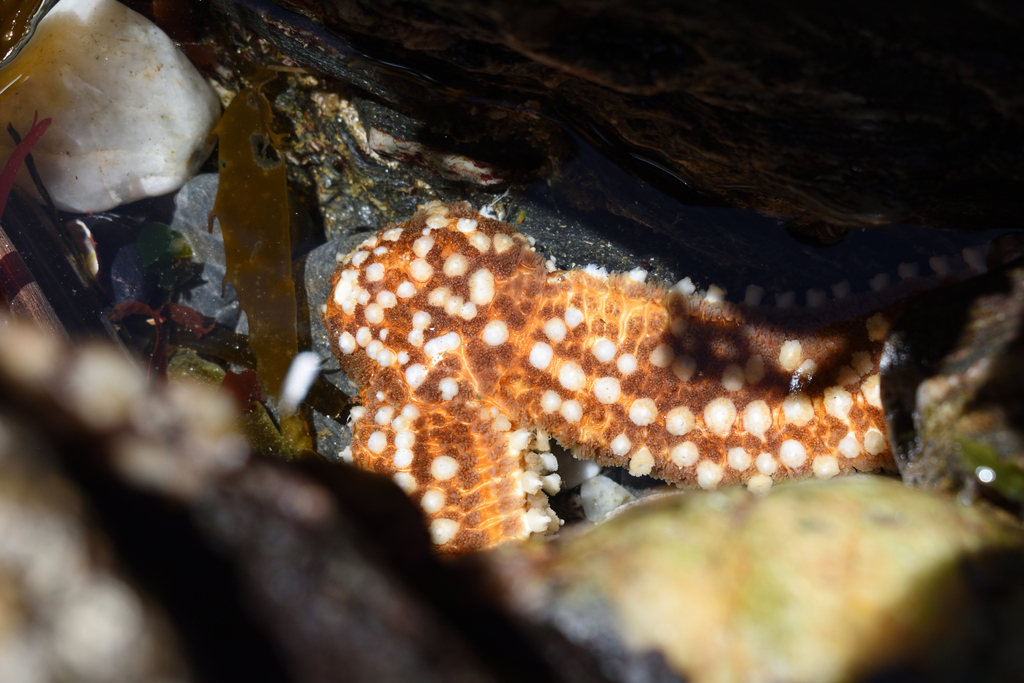
Large Spiny Star
Meyenaster gelatinosus
Meyenaster is a genus of starfish in the family Asteriidae. It is a monotypic genus and the only species is Meyenaster gelatinosus which was first described by the Prussian botanist and zoologist Franz Julius Ferdinand Meyen in 1834. It is found in the southeastern Pacific Ocean on the coasts of South America.
From the article Meyenaster on Wikipedia (CC BY-SA), quoted section by section
Description
Meyenaster gelatinosus is a white starfish with six arms and a mean radius ranging from 150 to 210 mm (5.9 to 8.3 in).
Range & habitat
Meyenaster gelatinosus is native to the southeastern Pacific Ocean where it is found on the coasts of Chile. It is abundant in kelp forests in the subtidal zone as well as being found on sand and gravel bottoms, and among seagrasses. It is usually found in areas with strong surge away from quiet locations.
Wikipedia: “Distribution and habitat”
What it does
In the kelp forests, M. gelatinosus is one of the dominant predators along with the starfish Stichaster striatus, Luidia magellanica and Heliaster helianthus, the fish Pinguipes chilensis, Semicossyphus darwini and Cheilodactylus variegatus, and the Chilean abalone (Concholepas concholepas), a gastropod mollusc. If M. gelatinosus manages to trap the multiarmed H. helianthus, it everts its stomach over several of the arms of its prey, and these become autotomised as a result of the predation; while the M. gelatinosus feeds on the shed arms, H. helianthus makes its escape. In a study in Chile, up to 76% of H. helianthus were found to have regenerating arms. In a study in Tongoy Bay in north central Chile, M. gelatinosus was found to be a generalist predator in sand and gravel habitats, but showed a marked preference for the Peruvian scallop (Argopecten purpuratus) in seagrass meadows. During the study, the number of scallops declined dramatically when they were heavily harvested commercially over a short period. This caused the starfish to increase its preference for the scallop in both habitats, but it was forced to broaden its diet in the seagrass areas, substituting small epifauna for the missing scallops. The starfish can feed on all sizes of scallop, from 4 to 14 cm (2 to 6 in) in diameter, but particularly preys on the larger specimens. …
Wikipedia: “Ecology”
Where it lives
Recorded sightings
—
geo-referenced records in GBIF, from museums, herbaria and field observers.
Drag the globe to turn it. Dots are where records exist, not a range map; darker means more records.
In the stacks
Searching the stacks…
Every page naming Meyenaster gelatinosus in the Biodiversity Heritage Library →
This page is assembled live from iNaturalist, GBIF, Wikipedia, the Source Library and the Internet Archive. It is not yet part of the hand-edited codex. iNaturalist taxon 482949.