On eBird ↗
Canarian Oystercatcher
Live sightings near you, the range map, bar charts of when it is seen, and Macaulay Library photos and recordings.
Canarian Oystercatcher
Haematopus meadewaldoi
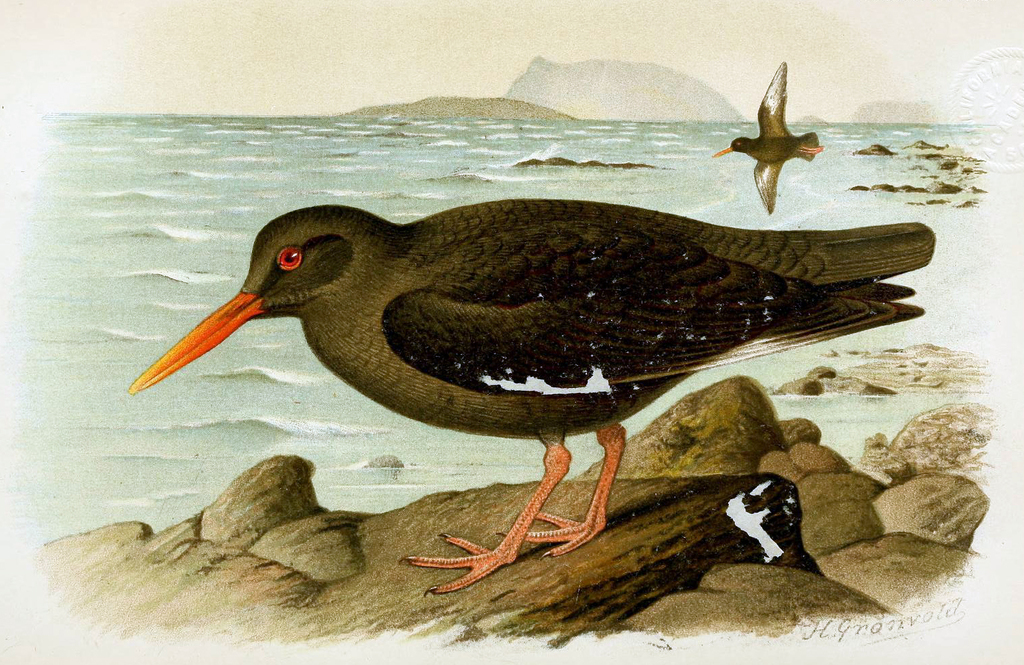
The Canary Islands oystercatcher, Canarian oystercatcher, or Canarian black oystercatcher (Haematopus meadewaldoi)
is an extinct shorebird of uncertain taxonomy endemic to Fuerteventura, Lanzarote, and their offshore islets (Islote de Lobos and the Chinijo Archipelago) in the Canary Islands in Spain. Its population declined sharply beginning in the 1800s due primarily to overharvesting by humans of their shared food sources in the intertidal zone. Since the 1940s, the Canary Islands oystercatcher has been considered to be extinct.
From the article Canary Islands oystercatcher on Wikipedia (CC BY-SA), quoted section by section
Description
[[File:Haematopus niger - 1820-1860 - Print - Iconographia Zoologica - Special Collections University of Amsterdam - UBA01 IZ17300023.tif |thumb|left|upright|19th century illustration]] The Canary Islands oystercatcher was of similar size as its relatives, the African and Eurasian oystercatchers, at about 43 cm (17 in). It was slightly lighter than the African species, which weighs between 600–800 grams (21–28 oz), with females being heavier than males. Its bill was 80–86 mm (3.1–3.4 in) long in males and markedly longer in females, around 87–92 mm (3.4–3.6 in). The tarsus measured around 53 mm (2.1 in), and the wings were around 250 mm (9.8 in) long. Its bill was laterally compressed, and with a blunt, lighter tip. The eye was red, with a narrow reddish-orange naked eye ring, and the legs and feet were dark pink with ivory-coloured nails. As usual in oystercatchers, it had no hallux and the second and third toes were connected by a small web. The overall appearance of the Canary Islands oystercatcher was extremely similar to the African species, to the extent that even museum specimens are difficult to distinguish except by measurements, or genetic tests. Its bill was longer and its wings were shorter than in the African species. H. …
What it does
Like other oystercatchers, this species did not build a nest but laid its eggs in a scrape on the seaside; apparently it chose the most deserted locations such as the mouths of barrancos (erosion gullies); eggs or nests were never recorded by researchers. Its courtship was reported to be peculiar, with two or three males joining in a "dancing" display, presenting themselves to best effect. Once the females had chosen a partner, they remained monogamous, probably for life if the pairing proved successful as in most other species of the genus. The clutch size was undocumented but possibly there was only one egg; groups of three, but not four birds were commonly seen. The eggs can be assumed to have been camouflaged as in its relatives; in the case of this species, they thus were probably rather dark overall, dull brownish grey with plenty of black, dark brown, and dark purplish splotches and scribbles. Egg size was probably about 60 mm × 40 mm (2.4 in × 1.6 in) on average. The breeding season is also unknown, but from observations of courtship and birds in laying condition, it started around April. Comparison with its relatives suggests that incubation lasted for around 30 days, maybe less, with the chicks taking around 35 days again to fledge. The three-bird groups started to occur on more populated regions in June. …
Wikipedia: “Reproduction”
Listen
Looking for field recordings…
Where it lives
Recorded sightings
—
geo-referenced records in GBIF, from museums, herbaria and field observers.
Drag the globe to turn it. Dots are where records exist, not a range map; darker means more records.
In the stacks
Searching the stacks…
Every page naming Haematopus meadewaldoi in the Biodiversity Heritage Library →
This page is assembled live from iNaturalist, GBIF, Wikipedia, the Source Library and the Internet Archive. It is not yet part of the hand-edited codex. iNaturalist taxon 4849.