On eBird ↗
South Island Oystercatcher
Live sightings near you, the range map, bar charts of when it is seen, and Macaulay Library photos and recordings.
South Island Pied Oystercatcher
Haematopus finschi
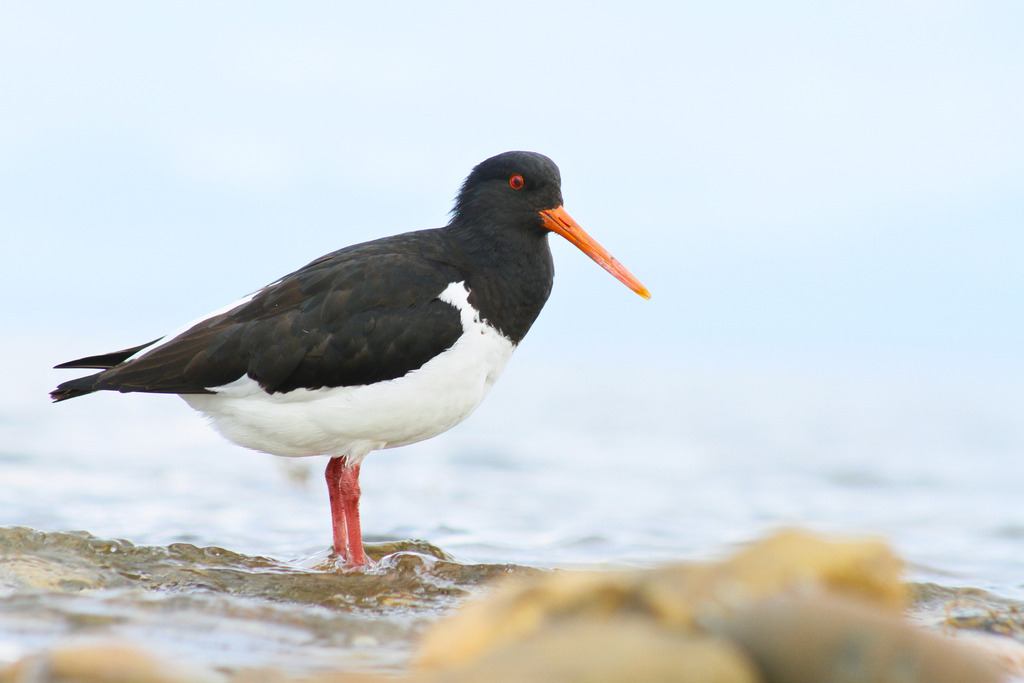
The South Island oystercatcher or South Island pied oystercatcher (Haematopus finschi) is one of two common oystercatcher species found in New Zealand. Its name is often contracted to the acronym "SIPO" (rhyming with "typo"). The indigenous Māori name is tōrea. The scientific name commemorates the German ethnographer, naturalist and colonial explorer Friedrich Hermann Otto Finsch (8 August 1839 – 31 January 1917, Braunschweig).
From the article South Island oystercatcher on Wikipedia (CC BY-SA), quoted section by section
Description
The South Island oystercatcher is easily identifiable as a pied oystercatcher – a large wader with striking black and white plumage, long red-orange bill, and red legs. It is distinguished from the pied morph of the variable oystercatcher by a white lower back, more white on the wing, and a demarcation line of black and white further forward on the breast, and from the pied oystercatcher of Australia by a longer bill and shorter legs, as well as the forward demarcation line of white on the back being pointed rather than square. It is 46 cm in length; its wingspan is 80–86 cm; it weighs 550 g.
Range & habitat
The South Island oystercatcher is endemic to New Zealand where it breeds inland on the South Island, after which most of the population moves to estuaries and harbors on the North Island. It has been recorded occasionally as a vagrant on Norfolk Island, Lord Howe Island, and the eastern coast of mainland Australia. Its breeding habitat comprises braided river systems, open paddocks, cultivated land, lake beaches, subalpine tundra, and herb fields. Non-breeding habitat includes coastal estuaries, bays, beaches, sand flats, and intertidal mudflats.
Wikipedia: “Distribution and habitat”
At the table
It mostly feeds on mollusks and worms. A major food source for oystercatchers is the New Zealand cockle, Austrovenus stutchburyi. It is estimated that an individual oystercatcher can eat around 200,000 cockles in a single year.
Wikipedia: “Food”
Listen
Looking for field recordings…
Where it lives
Recorded sightings
—
geo-referenced records in GBIF, from museums, herbaria and field observers.
Drag the globe to turn it. Dots are where records exist, not a range map; darker means more records.
In the stacks
Searching the stacks…
Every page naming Haematopus finschi in the Biodiversity Heritage Library →
This page is assembled live from iNaturalist, GBIF, Wikipedia, the Source Library and the Internet Archive. It is not yet part of the hand-edited codex. iNaturalist taxon 4851.