On eBird ↗
Blackish Oystercatcher
Live sightings near you, the range map, bar charts of when it is seen, and Macaulay Library photos and recordings.
Blackish Oystercatcher
Haematopus ater
The blackish oystercatcher (Haematopus ater) is a species of wading bird in the oystercatcher family Haematopodidae. It is found in Argentina, Chile, the Falkland Islands and Peru, and is a vagrant to Uruguay. The population is estimated at 15,000–80,000.
From the article Blackish oystercatcher on Wikipedia (CC BY-SA), quoted section by section
Description
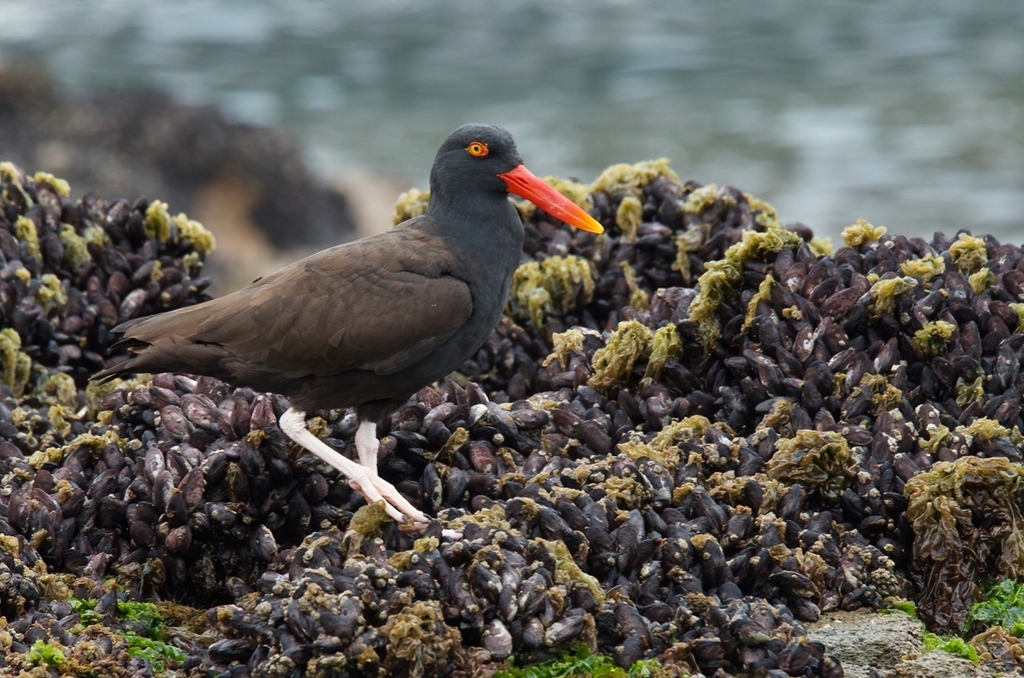
The blackish oystercatcher's plumage is slaty-black with wings and back rather dark brown. The long bill is blood-red and the legs are white. The sexes are similar in appearance. The bird is easily overlooked on a rocky shore, its dark colour blending with the rocks on which it walks as it forages, and it does not draw attention to itself. Its presence, however, can easily be detected by its loud and distinctive warning calls. Its song, when given in duet, consists of an excited chatter of piping whistles. Calls include notes that sound like "pip" and "peeeeyeeee".
Range & habitat
The blackish oystercatcher is native to the coasts of Argentina, Chile, the Falkland Islands and Peru, and it is a vagrant to Uruguay. Its natural habitats are rocky shores. It feeds in the intertidal zone on rocky shorelines, in rockpools and on pebble beaches. Rarely, it can be found on sandy beaches hunting for mole crabs.
Wikipedia: “Distribution and habitat”
Listen
Looking for field recordings…
Where it lives
Recorded sightings
—
geo-referenced records in GBIF, from museums, herbaria and field observers.
Drag the globe to turn it. Dots are where records exist, not a range map; darker means more records.
In the stacks
Searching the stacks…
Every page naming Haematopus ater in the Biodiversity Heritage Library →
This page is assembled live from iNaturalist, GBIF, Wikipedia, the Source Library and the Internet Archive. It is not yet part of the hand-edited codex. iNaturalist taxon 4852.