- Animals
- ›Chordates
- ›Vertebrates
- ›Ray-finned Fishes
- ›Spiny-rayed fishes
- ›Jacks, Flounders, Barracudas, and Allies
- ›Jacks, Remoras, and Allies
- ›Remoras
- ›Remora
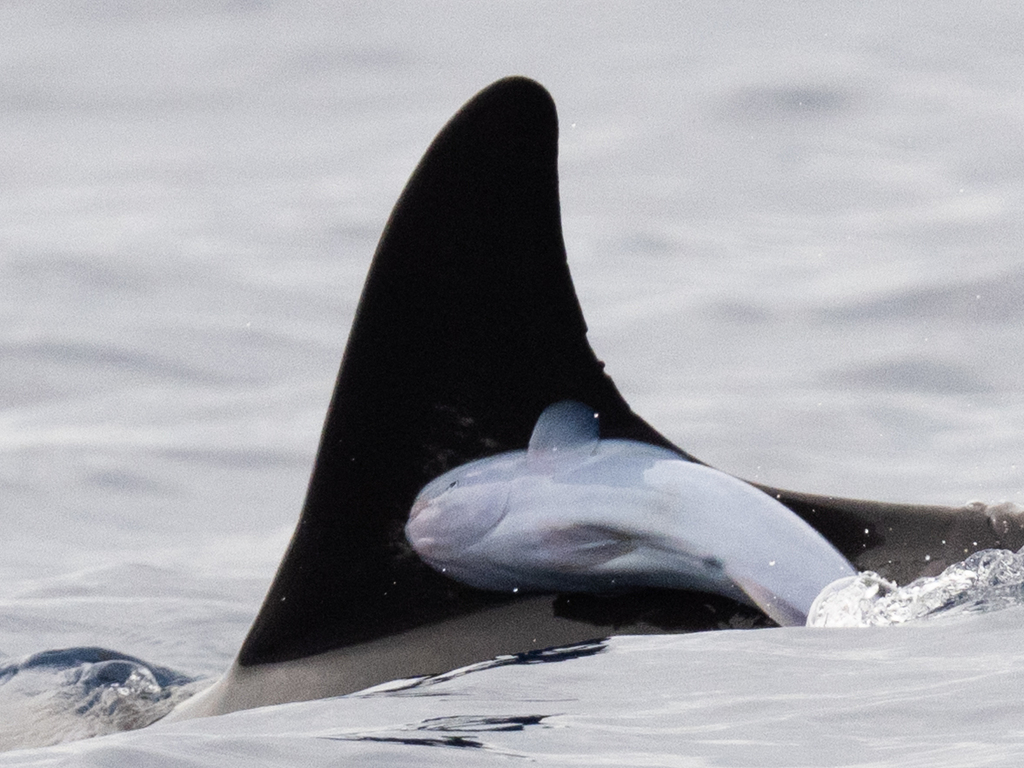
Whalesucker
Remora australis
The whalesucker (Remora australis) is a species of remora in the family Echeneidae, so named because it attaches itself exclusively to cetaceans, in a mutualistic interaction. It is found worldwide in tropical and warm waters; in the Gulf of Mexico and western Atlantic Ocean, it occurs from Texas to Brazil, and in the eastern Pacific Ocean, it occurs from Vancouver Island to Chile. It is the rarest member of the remora family, though this may reflect more the uncommon collection of cetaceans in the wild rather than the whalesucker's actual abundance.
From the article Whalesucker on Wikipedia (CC BY-SA), quoted section by section
Description
The adhesive disk atop the head of the whalesucker is the largest amongst the remoras, bearing 25–28 lamellae and measuring 47–59% of the standard length. The head itself measures 26–28% of the standard length. The dorsal fin rays number 23–26, the anal fin rays 24–26, and the pectoral fin rays 22–24. The jaws contain numerous large, stout canine teeth; the palatine and lingual patches are absent, and there are 17–20 gill rakers. The coloration is uniform brown, dark brown, or greyish-brown on the head, trunk, and fins. Whalesuckers observed off Fernando de Noronha ranged from light grey to slate grey, with lighter fin margins. The smaller individuals are barred or blotched, while individuals over 35 cm (14 in) long have yellowish fins. This species can reach 76 cm (30 in) in total length. The whalesucker shares similar homologous structures to each living species of Echeneidae: each has a strong lower jaw, projecting forward and upward that becomes nearly horizontal to the surface of each remora's adhesion disk. Additionally, remoras' ability to move across the skin of their hosts allows them to shovel other parasites and detritus stuck on the host's body into their mouth, which leavens extra effort made by the remora. The functionality of the adhesion disc relies on friction and suction to keep the whalesucker attached to its host. …
Wikipedia: “Morphology”
Where it lives
Recorded sightings
—
geo-referenced records in GBIF, from museums, herbaria and field observers.
Drag the globe to turn it. Dots are where records exist, not a range map; darker means more records.
In the stacks
Searching the stacks…
Every page naming Remora australis in the Biodiversity Heritage Library →
This page is assembled live from iNaturalist, GBIF, Wikipedia, the Source Library and the Internet Archive. It is not yet part of the hand-edited codex. iNaturalist taxon 48840.