On eBird ↗
Diademed Sandpiper-Plover
Live sightings near you, the range map, bar charts of when it is seen, and Macaulay Library photos and recordings.
Diademed Sandpiper-Plover
Phegornis mitchellii
The diademed sandpiper-plover or diademed plover (Phegornis mitchellii) is a species of bird in the plover family Charadriidae. It is monotypic within the genus Phegornis. The relationship of this species to other plovers is uncertain, a 2010 study sugested it may be related to the Australian dottrells.
From the article Diademed sandpiper-plover on Wikipedia (CC BY-SA), quoted section by section
Description
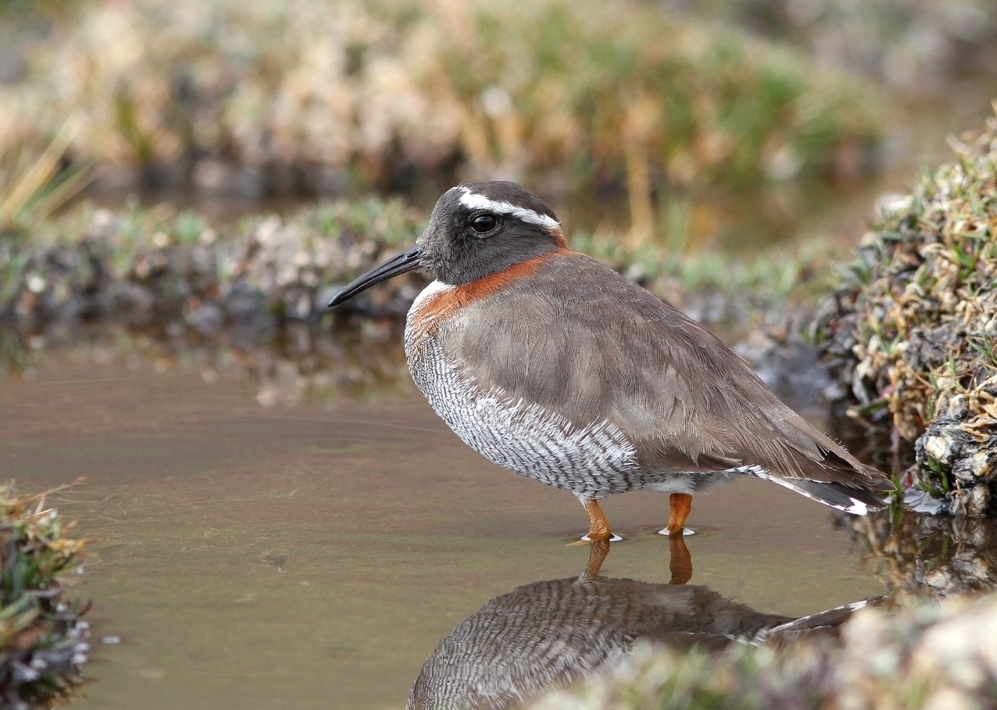
The diademed sandpiper-plover is 16.5 to 19 cm (6.5 to 7.5 in) long and weighs 28 to 46 g (0.99 to 1.6 oz). The sexes are alike. Their bill is black and slightly decurved. Their legs and feet are orange. The adult's face is black with a wide white supercilium than extends around the back of the head. Their crown is black, their nape bright rufous, most of their upperparts dark brownish gray, and their rump and uppertail coverts are black. The tail is black with white tips to the feathers. Their throat is white, their chest, belly, and flanks are barred black and white, and their vent and undertail coverts are unmarked white. Juveniles are much duller than adults. Their upperparts are mostly brownish gray with cinnamon speckles and bars. Their supercilium is grayish and their nape is washed with cinnamon or rufous.
Range & habitat
The diademed sandpiper-plover is found in the Andes from central Peru's Department of Junín south through western Bolivia to central Chile and south-central Argentina. It is a habitat specialist found almost entirely in peatlands and bogs between the frost line and snow line. The habitat is "characterized by a network of grassy banks interspersed with long streams and vernal pools". In elevation it ranges between 4,100 and 5,000 m (13,500 and 16,400 ft) in Peru though in the southern part of its range it is found as low as 2,000 m (6,600 ft).
Wikipedia: “Distribution and habitat”
What it does
The diademed sandpiper-plover is almost always seen alone or in pairs. It is not known if this is true social monogamy, territoriality, a function of its sparse population, or because of lack of enough study.
Migration. The diademed sandpiper-plover is an elevational migrant in the southern part of its range. Those nesting in the highest areas move to lower ones in March and return in October. The southernmost population is thought to be at least partially north–south migratory as well.
Feeding. The diademed sandpiper-plover typically forages alone or in pairs, probing in wet ground or in shallow water and picking prey from the water surface and aquatic plants. Its diet has not been detailed but is known to be mostly aquatic invertebrates.
Breeding. The diademed sandpiper-plover's egg period is from October to December in Chile and extends into January in Bolivia. Its nest is a hollow in the ground or a platform of dried grass. All documented clutches were of two eggs. The incubation period and time to fledging are not known.
Vocalization. A diademed sandpiper-plover call given while foraging and in flight is "a clipped pic or pic-pic". What are thought to be alarm calls are "a plaintive, slightly drawn-out wheehu, a less plaintive, fairly sharp whee-u!, and a surprisingly loud screamed whistle, whEEHU!."
Wikipedia: “Behavior”
Listen
Looking for field recordings…
Where it lives
Recorded sightings
—
geo-referenced records in GBIF, from museums, herbaria and field observers.
Drag the globe to turn it. Dots are where records exist, not a range map; darker means more records.
In the stacks
Searching the stacks…
Every page naming Phegornis mitchellii in the Biodiversity Heritage Library →
This page is assembled live from iNaturalist, GBIF, Wikipedia, the Source Library and the Internet Archive. It is not yet part of the hand-edited codex. iNaturalist taxon 4910.