- Animals
- ›Chordates
- ›Vertebrates
- ›Ray-finned Fishes
- ›Carps, Characins, Catfishes and Allies
- ›Catfishes
- ›Siluroidei
- ›Eeltail Catfishes
- ›Plotosus
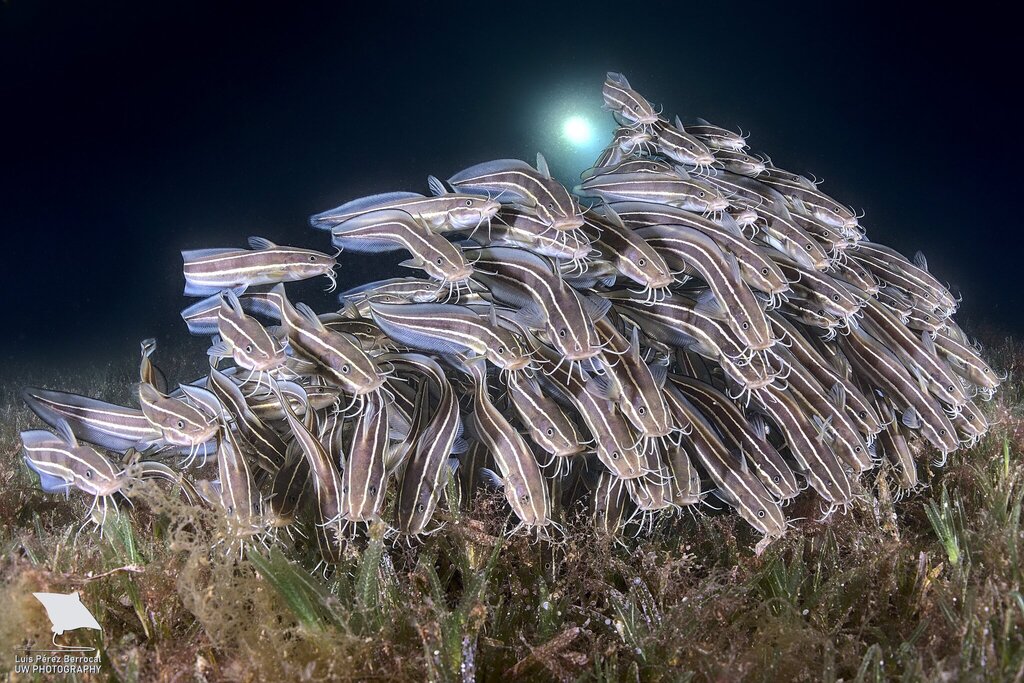
Striped Eel Catfish
Plotosus lineatus
Plotosus lineatus, commonly known as the striped eel catfish, is a species of catfish belonging to the eeltail family Plotosidae. Like most other members of the genus, this species possesses highly venomous spines that can be used to sting when threatened; the venom can cause mild to severe symptoms in humans. This species is native to the Indo-Pacific but is now present in the Mediterranean via Lessepsian migration through the Suez Canal.
From the article Plotosus lineatus on Wikipedia (CC BY-SA), quoted section by section
Description
Plotosus lineatus can reach a maximum length of 32 cm (13 in), and the body is brown with cream-colored or white longitudinal bands. The second dorsal, caudal and anal fins are fused together as in eels, but the rest of the body is quite similar to that of a freshwater catfish. The mouth is surrounded by four pairs of barbels, four on the upper jaw and four on the lower jaw. Each of the first dorsal and the pectoral fins has a highly venomous spine.
Range & habitat
Plotosus lineatus occurs in the Indo-Pacific; this includes the western Pacific (e.g. Singapore). Since 2002, it has been recorded in the eastern Mediterranean Sea as well, and is now common from Levantine waters to the Gulf of Gabes. It sometimes enters freshwater ecosystems in East Africa and Madagascar.
Wikipedia: “Distribution”
What it does
Juveniles of Plotosus lineatus form dense ball-shaped schools of about 100 fish, while adults are solitary or occur in smaller groups of around 20 and are known to hide under ledges during the day. Adults search and stir the sand incessantly for crustaceans, mollusks, worms, and sometimes fish. Plotosus lineatus is an oviparous fish; the eggs are demersal and upon hatching, fries become a part of zooplankton.
Wikipedia: “Behavior and reproduction”
Toxicity
Plotosus lineatus has venomous spines on their fins that they use to sting for self-defense. Their skin also possess cells that secrete venom. The venom is composed of crinotoxins and plototoxins, which are mainly hemolytic but are also edema-forming, nociceptive, and tetanic. Symptoms from P. lineatus stings range from mild to severe, and include extreme pain, dizziness, erythema, edema, necrosis, numbness, vomiting, muscle spasms, respiratory distress, shock, and sepsis. Though dangerous to humans, with many envenomation incidents happening when fishermen are trying to handle the fish caught in their nets, no death has actually been recorded from stinging. The sting is known to be lethal to fish, crabs, and rodents in laboratory tests.
Wikipedia: “Venom”
In human culture
The fish is known in Israel as "Nasrallah fish" after the Lebanese cleric and political figure Hassan Nasrallah.
Wikipedia: “In popular culture”
Where it lives
Recorded sightings
—
geo-referenced records in GBIF, from museums, herbaria and field observers.
Drag the globe to turn it. Dots are where records exist, not a range map; darker means more records.
In the stacks
Searching the stacks…
Every page naming Plotosus lineatus in the Biodiversity Heritage Library →
This page is assembled live from iNaturalist, GBIF, Wikipedia, the Source Library and the Internet Archive. It is not yet part of the hand-edited codex. iNaturalist taxon 49210.