On eBird ↗
Spotted Thick-knee
Live sightings near you, the range map, bar charts of when it is seen, and Macaulay Library photos and recordings.
Spotted Thick-knee
Burhinus capensis
The spotted thick-knee (Burhinus capensis), also known as the spotted dikkop or Cape thick-knee, is a wader in the family Burhinidae. It is native to tropical regions of central and southern Africa.
From the article Spotted thick-knee on Wikipedia (CC BY-SA), quoted section by section
Description
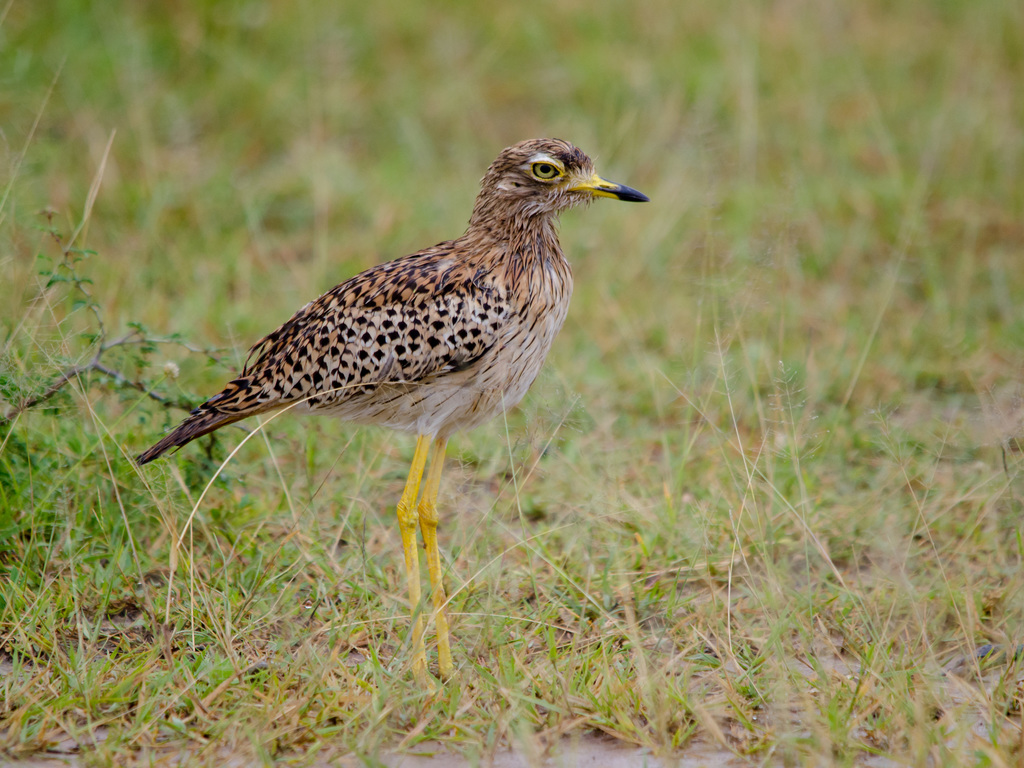
The spotted thick-knee, which can reach up to 45.5 cm (17.9 in) in height, has long legs and brown-and-white speckled plumage which provides camouflage, making it difficult to spot the bird in the grasslands and savannas where it roams. Its head is large and round with a prominent yellow eye and a short, stout beak. When in flight or standing in a characteristic position with its wings raised, it shows a striking contrasting pattern. Its legs are long and yellow and the tibiotarsal joint is expanded, giving it the name "thick-knee".
Range & habitat
The spotted thick-knee is native to the grasslands and savannas of sub-Saharan Africa. Its range extends from Senegal, Mali and Mauritania in the west to Ethiopia, Kenya, Tanzania and South Africa in the east and south respectively, as well as in south Yemen in West Asia.
Wikipedia: “Distribution”
What it does
The spotted thick-knee is nocturnal and squats on the ground during the daytime, making it difficult to spot. It hunts exclusively on the ground, feeding on insects, small mammals and lizards.
Wikipedia: “Behaviour”
Listen
Looking for field recordings…
Where it lives
Recorded sightings
—
geo-referenced records in GBIF, from museums, herbaria and field observers.
Drag the globe to turn it. Dots are where records exist, not a range map; darker means more records.
In the stacks
Searching the stacks…
Every page naming Burhinus capensis in the Biodiversity Heritage Library →
This page is assembled live from iNaturalist, GBIF, Wikipedia, the Source Library and the Internet Archive. It is not yet part of the hand-edited codex. iNaturalist taxon 4922.