- Animals
- ›Chordates
- ›Vertebrates
- ›Ray-finned Fishes
- ›Spiny-rayed fishes
- ›Freshwater Sunfishes, Grunters, and Allies
- ›Grunters, Stripeys, and Allies
- ›Nibblers
- ›Girella
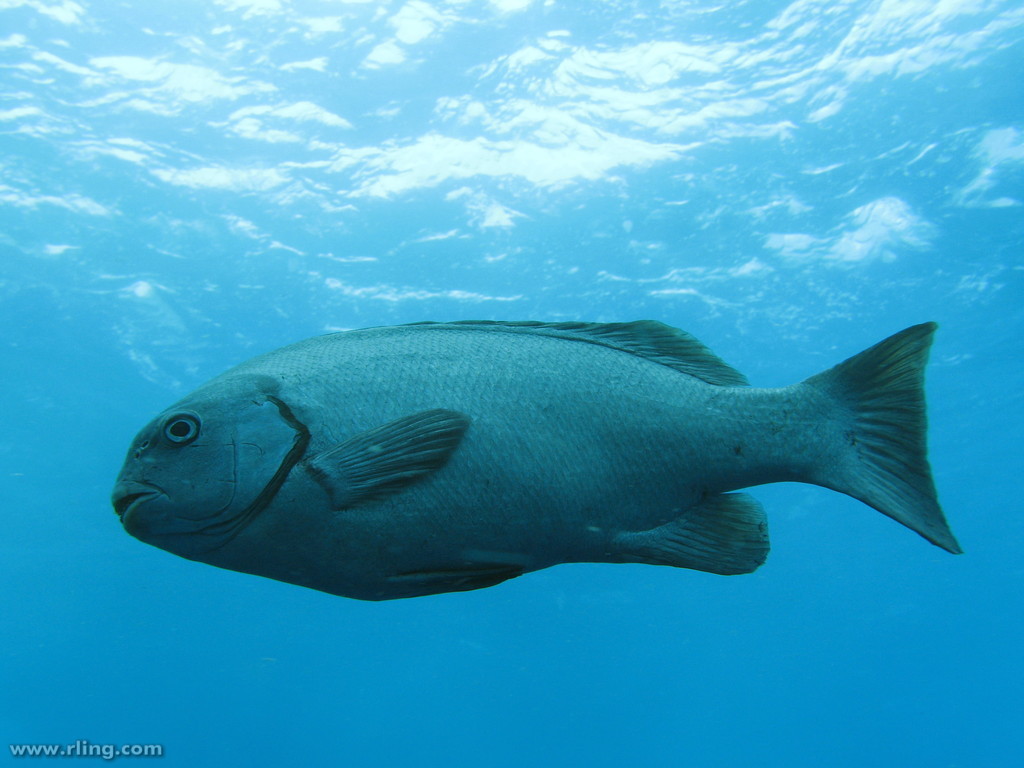
Rock Blackfish
Girella elevata
Girella elevata, the rock blackfish or black drummer is a species of sea chub native to coastal waters, around 25 metres (82 ft) depth, from Australia to New Zealand. This species can reach a length of 62 centimetres (24 in) SL. It is a highly sought after target of recreational fishermen due to its reputation as a brutally tough fighter when hooked (hence its other moniker, pig) and fine eating qualities. Because its preferred habitat is in the...
From the article Girella elevata on Wikipedia (CC BY-SA), quoted section by section
Description
Girella elevata has a moderately deep, compressed oval shaped body with a narrow caudal peduncle and a small head which has a slightly bulging forehead. It has a small mouth which does not extend as far as the eye. Each jaw is equipped with a two rows of teeth, an outer row of flattened three-crowned teeth which do not overlap and an inner row of similar but much smaller teeth. It has ctenoid scales which cover much of the body and it has a continuous lateral line which is arched in parallel with the body's dorsal profile. The dorsal fin is continuous and there is almost no difference in form between the spiny and rayed parts of the dorsal fin. The spiny part is about a third longer than the rayed portion. The spines become longer towards the trail and the soft rays are noticeably longer than the spines. The soft-rayed part of the dorsal fin is rounded. The anal fin is similar in shape to and lies opposite to the soft-rayed part of the dorsal fin. It has a very large and deeply forked caudal fin It has small pectoral fins in which the upper rays are the longest and small pelvic fins, located below, and just to the rear of the base of the pectoral fins. The dorsal fin has 14-16 spines and 11-12 soft rays while the anal fin has three spines and 11-12 soft rays. …
Range & habitat
Girella elevata is found in the south-western Pacific Ocean in coastal eastern Australia and northern New Zealand. In Australia it occurs from Noosa Heads, Queensland south to Apollo Bay in Victoria and northern Tasmania, although it is rare west of Wilsons Promontory in Victoria. It is also found around Lord Howe Island in the Tasman Sea. Rock blackfish have been reported in waters off Japan, although these were most likely Girella leonina or punctata, both having “blackfish” as part of their Japanese names (both of which are primary targets of Japanese ISO fishers, who sometimes charter helicopters for day trips to offshore islands to fish for them). Another related species that can be mistaken for elata is the dusky sea chub, Girella freminvillii, which has been seen in the Galápagos Islands.
Wikipedia: “Distribution”
Where it lives
Recorded sightings
—
geo-referenced records in GBIF, from museums, herbaria and field observers.
Drag the globe to turn it. Dots are where records exist, not a range map; darker means more records.
In the stacks
Searching the stacks…
Every page naming Girella elevata in the Biodiversity Heritage Library →
This page is assembled live from iNaturalist, GBIF, Wikipedia, the Source Library and the Internet Archive. It is not yet part of the hand-edited codex. iNaturalist taxon 493100.