- Animals
- ›Chordates
- ›Vertebrates
- ›Ray-finned Fishes
- ›Carps, Characins, Catfishes and Allies
- ›Minnows, Suckers, Carps, and Loaches
- ›Loaches
- ›True Loaches
- ›Pangio
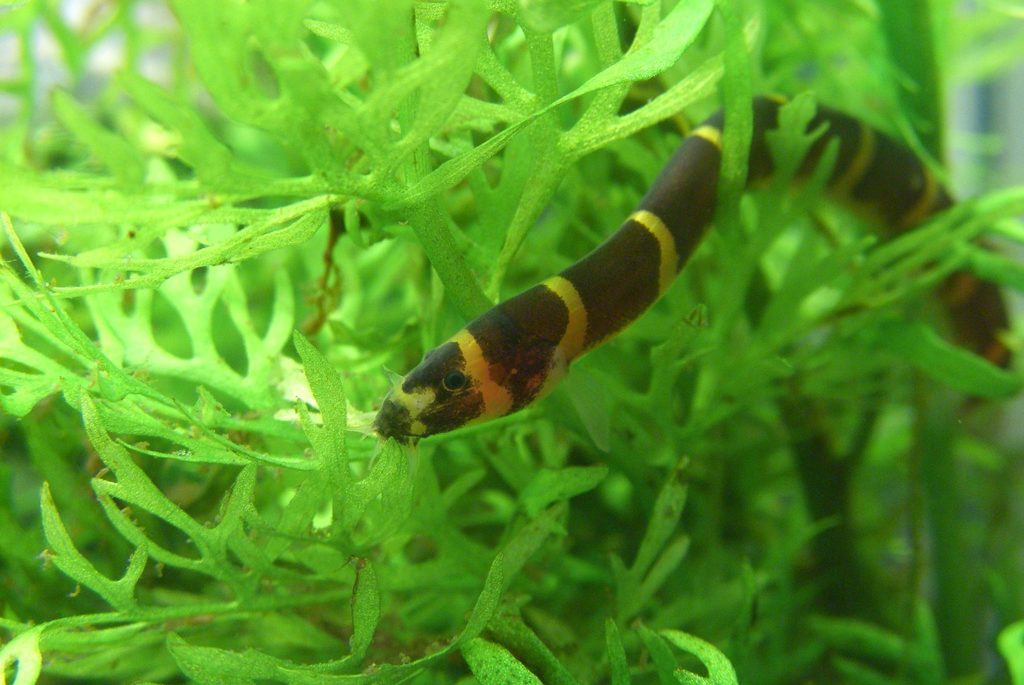
Kuhli Loach
Pangio kuhlii
The true Kuhli loach (Pangio kuhlii), which can be used synonymously with "coolie" loach, occasionally referred to as eel loach, is a small eel-like freshwater fish belonging to the loach family (Cobitidae). They originate from the island of Java in Indonesia. This serpentine, worm-shaped creature is very slender and nocturnal. Its distinctive orange-pink coloration with triangular black stripes and long lifespan makes it a popular aquarium species.
From the article Kuhli loach on Wikipedia (CC BY-SA), quoted section by section
Description
The kuhli loach is an eel-shaped fish with slightly compressed sides (Anguilliform body structure), four pairs of barbels around the mouth, and very small fins. The dorsal fin starts behind the middle of the body, and the anal fin well behind this. The eyes are covered with transparent skin. The body has 10 to 15 dark brown to black vertical bars, and the gaps between them are salmon pink to yellow with a light underside. The stripes can be different on every individual but are mainly thick and solid stripes that can sometimes be split to reveal orange along the dorsal side. When the fish is not actively breeding, distinctions between males and females are not readily apparent. Males have a more muscular dorsal cross-section. Additionally, their pectoral fins tend to be larger and more paddle-shaped, often containing pigment. When breeding, the females often become larger than the male and their greenish ovaries can be seen through the skin before spawning. Spawning is not easy, but when it occurs a few hundred greenish eggs are laid among the roots of floating plants. Kuhli loaches reach maturity at 2 3⁄4 inches (7 cm) and have a maximum length of 4 inches (10 cm). This fish can live for up to about 14 years. They also have a spine below each eye that can be deployed as a defense mechanism that can harm any potential predators.
Range & habitat
Kuhli loaches are from the island of Java, Indonesia, and additionally can be found in Malaysia, Sumatra. They are found throughout the Sunda shelf (excluding Sarawak) and Thailand. They have been reportedly found in China, though there are suspicions that it is a case of misidentification of perhaps a different Pangio species. The abundance of this species is unknown.
Wikipedia: “Distribution”
What it does
The natural habitat of the kuhli loach is the sandy beds of slow-moving rivers and clean mountain streams. They prefer shallow waters and can be found in dam peripheries, reservoirs, and swamps. They like to congregate where the sun cannot reach them, often in shallow, muddy pools. These habitats usually have places to hide, such as a substantial amount of leaf litter and other plant material. They are a social fish and are typically found in small clusters (they are not schooling fish but enjoy the company of their species), but are cautious and nocturnal by nature and swim near the bottom where they feed around obstacles. In the wild, kuhli loaches spawn synchronously in very shallow water. The kuhli loach is a bottom dweller that burrows into soft places. If the water is turbid they can breathe air through a mechanism called facultative breathing, which allows them to live in below favorable conditions.
Wikipedia: “Ecology”
In human culture
The kuhli loach was originally described as Cobitis kuhlii by Achille Valenciennes in 1846 to commemorate Heinrich Kuhl's work as a naturalist and zoologist. In scientific literature, it has been referred to as Acanthophthalmus kuhlii. The genus name Acanthophthalmus is a junior synonym of Pangio. Its older generic name 'Acanthophthalmus' comes from the meaning 'thorn' or 'prickle-eye', after a spine beneath each eye.
Wikipedia: “Etymology”
Where it lives
Recorded sightings
—
geo-referenced records in GBIF, from museums, herbaria and field observers.
Drag the globe to turn it. Dots are where records exist, not a range map; darker means more records.
In the stacks
Searching the stacks…
Every page naming Pangio kuhlii in the Biodiversity Heritage Library →
This page is assembled live from iNaturalist, GBIF, Wikipedia, the Source Library and the Internet Archive. It is not yet part of the hand-edited codex. iNaturalist taxon 493696.