- Animals
- ›Chordates
- ›Vertebrates
- ›Birds
- ›Pelicans, Herons, Ibises, and Allies
- ›Herons, Egrets, and Bitterns
- ›Typical Herons and Egrets
- ›Egretta
On eBird ↗
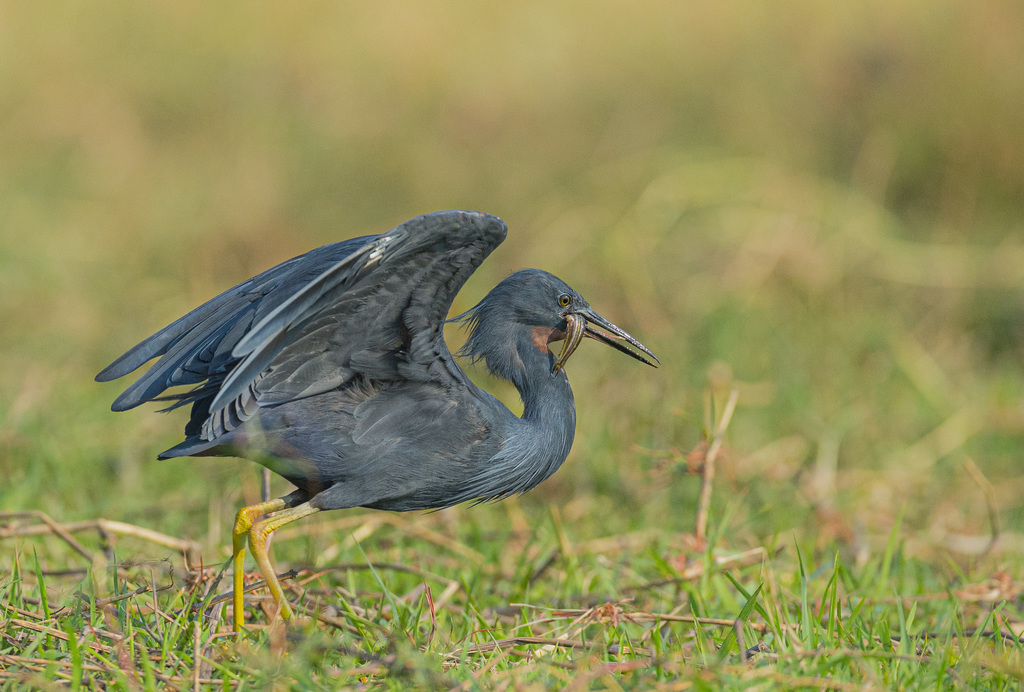
Slaty Egret
Live sightings near you, the range map, bar charts of when it is seen, and Macaulay Library photos and recordings.
Slaty Egret
Egretta vinaceigula
The slaty egret (Egretta vinaceigula) is a small, dark egret found in southern Africa. It is one of the species to which the Agreement on the Conservation of African-Eurasian Migratory Waterbirds (AEWA) applies. It is classified as Vulnerable, the biggest threat being habitat loss.
From the article Slaty egret on Wikipedia (CC BY-SA), quoted section by section
Description
Until 1971, the slaty egret and more widespread black egret Egretta ardesiaca were thought to be colour morphs of the same species but the slaty egret shows consistent features which separate it from the black egret. These are the yellow legs and the vinous brown throat of the slaty egret, which extends down right onto the belly in immature birds. The slaty egret does not display the characteristic "mantling" behaviour of the black egret.
Range & habitat
The slaty egret lives in south-central Africa. The largest populations are found in Zambia and Botswana. In Zambia there are maybe 500 to 1,000 individuals, mainly found at Liuwa Plain National Park, Kafue Flats and Lake Bangweulu in some years but there are no confirmed breeding records. In northern Botswana there is a population of probably over 2,000 birds, mainly in the vicinity of the Okavango Delta and Chobe River. In this area there are at least 10 known colonies. This population extends into northern Namibia where an estimated 300 birds can be found the Chobe floodplain and Caprivi Strip. There is a single confirmed report of unsuccessful nesting in the Nylsvley Nature Reserve in the Limpopo Province of South Africa. It is more nomadic when not breeding, and has been recorded in Democratic Republic of Congo, Zimbabwe, and rarely in northern South Africa. In Mozambique its presence on the Zambezi Delta has not been confirmed and it may occur in Angola and possibly Malawi. Slaty egrets are almost always found in small numbers, e.g. rarely more than c. 100, the world population is probably in the order of 3,000 to 5,000 individuals.
Wikipedia: “Distribution and population”
What it does
Slaty egrets are largely sedentary but they show some movement in response to rains, which cause seasonal variations in wetland conditions. These movements are poorly understood. It is a year-round resident in some areas, such as Zambia, yet it is not known to breed in that country. Infrequent records from countries abutting the main range i.e. Malawi, Zimbabwe, Mozambique and South Africa, demonstrate that slaty egrets are somewhat nomadic. It prefers to feed mainly on small fish, especially cichlids, but in ephemeral wetlands where there are no fish, it will feed on frogs, aquatic invertebrates and tadpoles. It hunts by sight in clear, shallow water. It will also glean snails from lily pads and can catch dragonflies and other insects using a "standing flycatching" technique. It is a daytime forager, and often forages in association with other wading birds. Slaty egrets usually forage in small flocks of four to eight birds, although it may forage solitarily or even in larger aggregations of up to 60 birds.
Wikipedia: “Behaviour”
Listen
Looking for field recordings…
Where it lives
Recorded sightings
—
geo-referenced records in GBIF, from museums, herbaria and field observers.
Drag the globe to turn it. Dots are where records exist, not a range map; darker means more records.
In the stacks
Searching the stacks…
Every page naming Egretta vinaceigula in the Biodiversity Heritage Library →
This page is assembled live from iNaturalist, GBIF, Wikipedia, the Source Library and the Internet Archive. It is not yet part of the hand-edited codex. iNaturalist taxon 4945.