On eBird ↗
Yellow-browed Bulbul
Live sightings near you, the range map, bar charts of when it is seen, and Macaulay Library photos and recordings.
Yellow-browed Bulbul
Acritillas indica
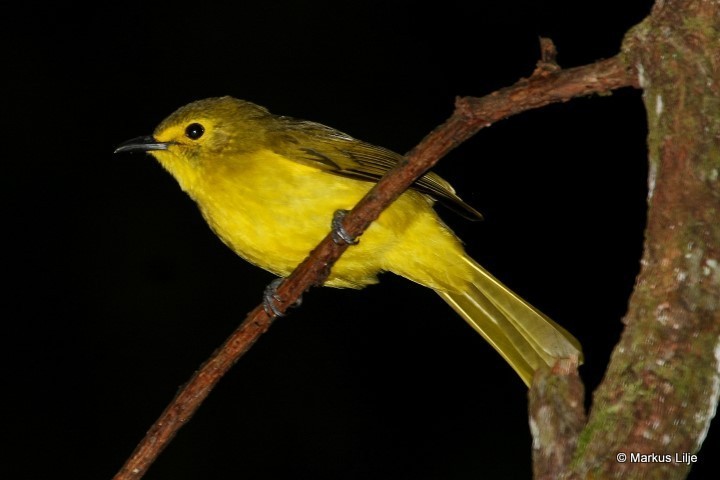
The yellow-browed bulbul (Acritillas indica), or golden-browed bulbul, is a species of songbird in the bulbul family, Pycnonotidae. It is found in the forests of southern India and Sri Lanka. The yellow-browed bulbul is mainly yellow on the underside and olive above with a distinct yellow brow. They are easily located by their loud calls but tend to skulk within foliage below the forest canopy. While its taxonomic classification has changed over time, it is currently the sole species within the monotypic genus Acritillas, which is closely related to Hemixos.
From the article Yellow-browed bulbul on Wikipedia (CC BY-SA), quoted section by section
Description
This bulbul is about 20 cm (7.9 in) long, lacks a crest and has the upperparts olive-green with a prominent yellow brow and goggle with the underparts being all yellow. The sexes do not differ in plumage. The bill is black and the iris is reddish brown. The population in the northern Western Ghats (A. i. icterica) is paler yellow than the populations further south (A. i. indica). A somewhat disjunct population is found in the Eastern Ghats. In Sri Lanka, southwestern populations (A. i. gugliemi) are greener, while the northern populations are included in the nominate subspecies.
The calls include a whistle-like call and sharp pick-wick notes.
Range & habitat
The yellow-browed bulbul has been considered as the wet-zone counterpart of the dry-zone white-browed bulbul. It is found mainly below the forest canopy of the hill forests and plantations in the Western Ghats and Sri Lanka. They also occur in parts of the Eastern Ghats including the Kolli hills, Nallamalas and parts of Tirupathi and Mamandur regions in Andhra Pradesh.
Wikipedia: “Distribution and habitat”
What it does
Yellow-browed bulbuls are found in pairs or small groups and call loudly. They feed mainly on berries and insects. The breeding season is during the dry spell before the monsoons, mainly January to May. The nest is a cup built in a low fork covered with moss and cobwebs on the outside, giving the appearance of a large white-eye nest, and lined with fine root fibres. The typical clutch size in India is three eggs and in Sri Lanka two. A study of 153 nests in Silent Valley National Park of India found 92% of nests had two eggs. Peak breeding in the Silent Valley National Park of Kerala was found in January and February. About a week is taken for building the nest and the eggs are incubated for about 13 days. The eggs are pale pink or white with reddish brown speckling. The eggs hatch synchronously and the nestlings fledge after about 13 days. Nestlings are fed with caterpillars, soft insects and berries.
== References ==
Wikipedia: “Behaviour and ecology”
Listen
Looking for field recordings…
Where it lives
Recorded sightings
—
geo-referenced records in GBIF, from museums, herbaria and field observers.
Drag the globe to turn it. Dots are where records exist, not a range map; darker means more records.
In the stacks
Searching the stacks…
Every page naming Acritillas indica in the Biodiversity Heritage Library →
This page is assembled live from iNaturalist, GBIF, Wikipedia, the Source Library and the Internet Archive. It is not yet part of the hand-edited codex. iNaturalist taxon 495192.