On eBird ↗
Djibouti Spurfowl
Live sightings near you, the range map, bar charts of when it is seen, and Macaulay Library photos and recordings.
Djibouti Spurfowl
Pternistis ochropectus
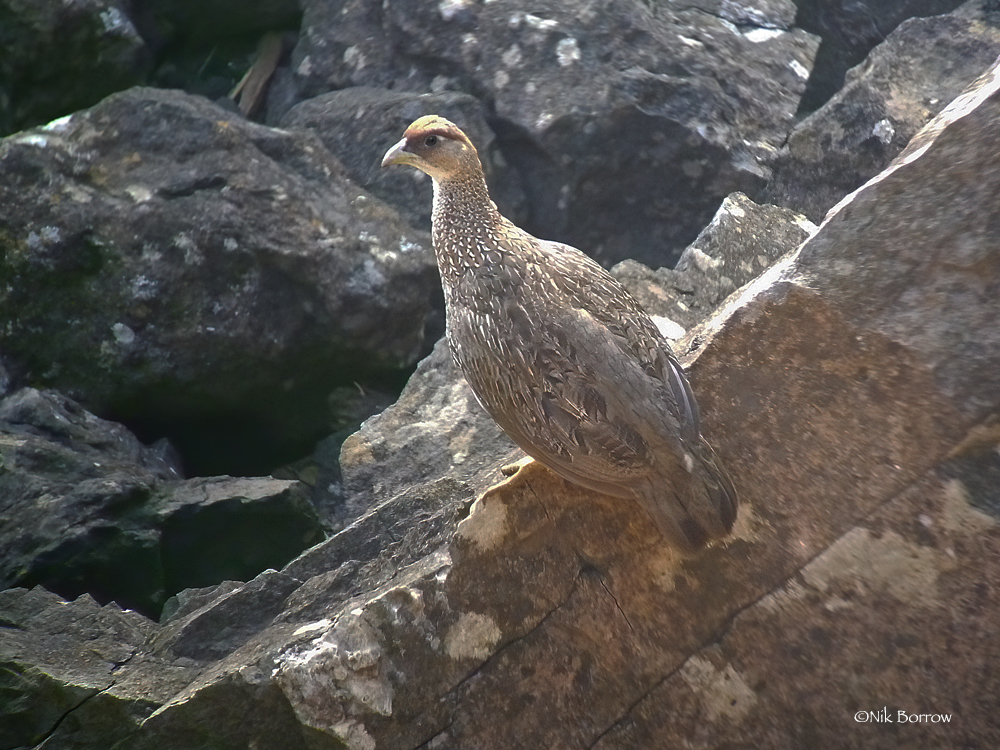
The Djibouti spurfowl or Djibouti francolin (Pternistis ochropectus) is a bird species in the pheasant family, Phasianidae. It is critically endangered and found only in Djibouti, a nation in the Horn of Africa. This species is grayish-brown overall with white stripes and streaks on its underparts which become finer towards the upperparts. It has black markings on the head and a gray crown and has a short tail. It is 35 cm (1.15 ft) in length, and weighs 940 g (33 oz).
Its natural habitat is high elevation dry forest composed primarily of African juniper. However, the juniper forests preferred by the spurfowl are dying, so it may be found in other habitats, such as box-tree forest. This bird is only known from two locations in Djibouti, one of which is largely unsurveyed. It can be found in small groups and is extremely shy. It is known to feed on berries, seeds, and termites, and it breeds between December and February. It is considered a critically endangered species because it underwent a 90% population decline in twenty years. The degrading of its juniper habitat through man-made disturbances, such as overgrazing, is a major threat to the spurfowl's survival. Ongoing conservation work includes the restoration of some juniper forest, and surveys to obtain accurate population counts and to raise awareness.
From the article Djibouti spurfowl on Wikipedia (CC BY-SA), quoted section by section
Description
This spurfowl is a large, rotund bird of approximately 35 cm (1.15 ft) in length and 940 g (33 oz) in weight. It is grayish-brown overall with white stripes and streaks on its underparts which become finer toward the head. The bird is darker on its back than on its underside. The nape has a hint of rufous, while the top of the head is gray. The forehead, lore, and eye stripe form a black mask, and the chin and throat are whitish. The eyes are brown. The feathers on the body and neck have a gold or straw-colored center that is bordered with dark brown and edged in white. The tail is short. The bill is black with some yellow on the lower mandible, and the Djibouti spurfowl's legs are a greenish-yellow. The sexes are similar, although the male averages slightly larger than the female and has two prominent spurs on the legs, whereas the female is virtually unspurred. The female also has more rufous in its tail. The juvenile resembles the adults, but is duller, with buff barring, rather than streaking, on the underparts. The call of this species is a rattling erk erk erk-kkkkkkkk that descends into a chuckling gurgle. Feeding birds may give a low conversational clucking. No other spurfowl share this bird's restricted range (although the yellow-necked spurfowl occurs elsewhere in Djibouti) so it is unlikely to be confused with any other species.
Range & habitat
The Djibouti spurfowl is endemic to Djibouti, a nation in eastern Africa, and is known from only two locations. One is the Forêt du Day in the Goda Mountains, approximately 25 km (16 mi) north of the Gulf of Tadjoura. This site is only 15 km2 (3,700 acres) and is undergoing habitat changes. The other site is located in the Mabla Mountains, which are 80 km (50 mi) northeast of the Forêt du Day and remain unsurveyed. This site has been exposed to more human disturbance than the Forêt du Day, and is therefore considered less viable. Combined, the total estimated range of this bird is 58 km2 (14,000 acres). This spurfowl prefers dense African juniper woodland with a closed canopy between 700 and 1,780 m (2,300 and 5,840 ft) in elevation, and preferably on a plateau. Mixed in with this forest habitat are box-trees (Buxus hildebrandtii) and African olives (Olea europaea africana). This spurfowl has been found in secondary woodland, box-tree woodlands (Buxus hildebrandtii), and acacia woodland (Acacia seyal). It is also known to venture into more open woodland and wadis following the breeding season. Much of the bird's African juniper forest habitat has been damaged or destroyed due to human usage; the ability of this dead woodland to support the Djibouti spurfowl remains unknown, although some juveniles have been seen in it. …
Wikipedia: “Distribution and habitat”
What it does
This species lives in small groups and is very shy, often remaining in dense vegetation to avoid detection, and therefore its ecology is very little studied. It is believed that the spurfowl may migrate from lower altitudes to higher altitudes and juniper forest in the warmer months. Its main predator is the common genet. The bird is most active and most likely to call between 6 am and 9 am. After this it may spend most of the day perched motionless in a tree up to 4 m (13 ft) above the ground. It eats berries, seeds, termites and figs. It scratches the ground to collect seeds and, when it finds an area disturbed by warthogs, also scratches the ground for termites. It is monogamous and breeds between December and February. Only one nest has been recorded; this was located on a mountain ledge, and was a shallow grass-lined depression in the earth. These birds roost in nearby trees at heights of 5 to 8 m (16 to 26 ft). It is probably monogamous, and local people say that the clutch is typically 7–9 eggs, but this is unconfirmed.
Wikipedia: “Ecology and behavior”
Listen
Looking for field recordings…
Where it lives
Recorded sightings
—
geo-referenced records in GBIF, from museums, herbaria and field observers.
Drag the globe to turn it. Dots are where records exist, not a range map; darker means more records.
In the stacks
Searching the stacks…
Every page naming Pternistis ochropectus in the Biodiversity Heritage Library →
This page is assembled live from iNaturalist, GBIF, Wikipedia, the Source Library and the Internet Archive. It is not yet part of the hand-edited codex. iNaturalist taxon 495930.