On eBird ↗
Hartlaub's Spurfowl
Live sightings near you, the range map, bar charts of when it is seen, and Macaulay Library photos and recordings.
Hartlaub's Spurfowl
Pternistis hartlaubi
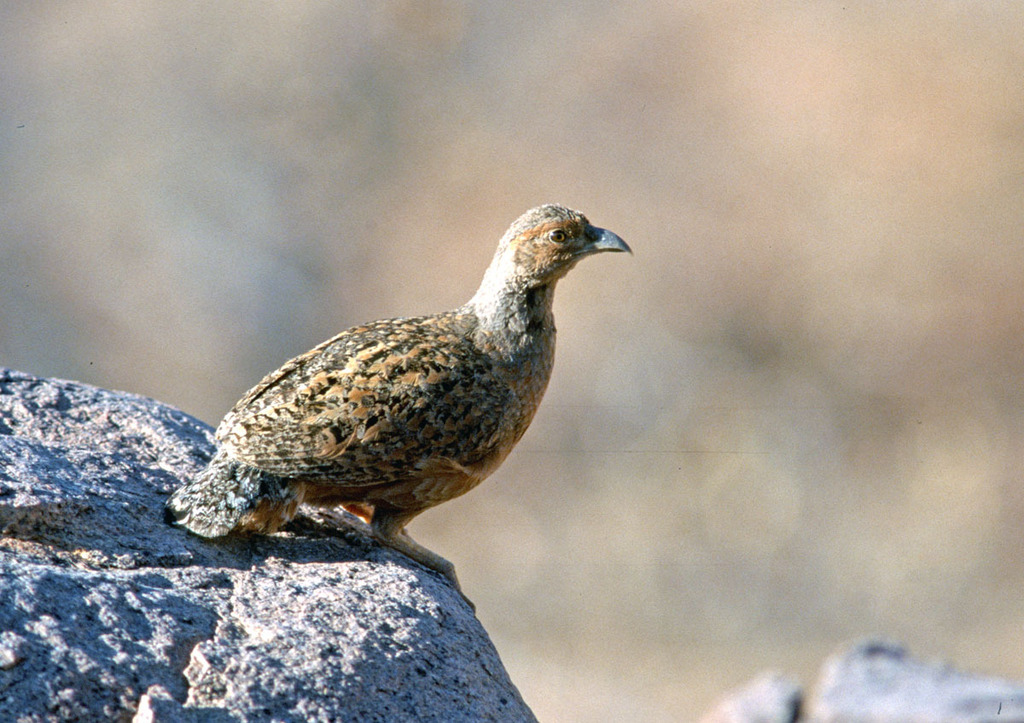
Hartlaub's spurfowl or Hartlaub's francolin (Pternistis hartlaubi) is a species of bird in the pheasant family Phasianidae. It is endemic to the escarpment zone of Namibia and Angola. The common name and Latin binomial commemorate the German physician and ornithologist Gustav Hartlaub.
From the article Hartlaub's spurfowl on Wikipedia (CC BY-SA), quoted section by section
Description
Hartlaub's Spurfowl is the smallest African spurfowl and is highly sexually dimorphic both in plumage and in size. The male is on averages 28 cm (11 in) in length and weighs 245–290 g (8.6–10.2 oz); the smaller female is around 25 cm (9.8 in) in length and weighs 210–240 g (7.4–8.5 oz). The male has a dark brownish forehead, a prominent white eyestripe and rufous ear coverts. The upperparts are brown-grey with darker bars and streaks. The underparts are pale grey with extensive dark streaks. The upper mandible is brownish and the lower mandible is yellow. The legs are yellow with flattened spurs. The female has upperparts that are similar to those of the male. The underparts, head, neck are a dull rufous without the brown streaking. Both sexes have disproportionately large bills. The juvenile male is similar to the adult male but has finer streaking on the upperparts. The young female is similar to an adult.
Range & habitat
Hartlaub's spurfowl is endemic to southwest Africa, occurring only in northcentral to northwestern Namibia and a small area of southwestern Angola. Hartlaub's spurfowl is an inhabitant of medium-altitude arid and semiarid regions from 800–1,600 m (2,600–5,200 ft). Throughout its range, its preferred habitat consists of higher ground, mostly on rocky granite and sandstone outcrops (koppies to locals), surrounded by semidesert steppe. Invariably, relatively dense grass and shrubbery are associated with these outcrops. The red-billed spurfowl (Pternistis adspersus) and the Orange River francolin (Scleroptila gutturalis) occur alongside this species, but they occupy different habitats. Red-billed spurfowls prefer bush along watercourses and Orange River francolins can be found on the slopes leading up to the rocky outcrops occupied by Hartlaub's spurfowl.
Wikipedia: “Distribution and habitat”
What it does
Habitat use, foraging behavior, and diet of male and female Hartlaub's spurfowl are related to the availability of corms, seed, and insects of different sizes in different habitats. They primarily forage on granitic outcrops, and use a variety of feeding techniques, with significant sexual differences in foraging behavior, and to a lesser degree, dietary composition. Males consume a greater diversity of food items than females, although considerable dietary overlap occurs between the sexes, and sexual differences in feeding techniques result in some food items being prioritized by each sex. In particular, distinct functional differences results from females' almost exclusive digging habits, in contrast to males' wider range of foraging techniques, including an apparently male-specific foraging technique of exposing cryptic termites. The relatively larger-billed females specializes on digging out the corms of Cyperus spp., which within the species, appears to be primarily carried out by females, with males spending proportionally more time foraging for a more diverse diet of insects and seed. This sexual difference in diet is thought to be adaptive, in response to predator and sexual selection pressures. …
Wikipedia: “Food and feeding”
Listen
Looking for field recordings…
Where it lives
Recorded sightings
—
geo-referenced records in GBIF, from museums, herbaria and field observers.
Drag the globe to turn it. Dots are where records exist, not a range map; darker means more records.
In the stacks
Searching the stacks…
Every page naming Pternistis hartlaubi in the Biodiversity Heritage Library →
This page is assembled live from iNaturalist, GBIF, Wikipedia, the Source Library and the Internet Archive. It is not yet part of the hand-edited codex. iNaturalist taxon 495931.