 NL·0539
Herbarium of the Nature Library
- Name
- Mola mola
- Family
- Molidae
- Native to
- Temperate and tropical oceans worldwide
- Habitat
- Open ocean (pelagic), Mesopelagic (twilight zone)
Ocean sunfish
Mola mola
Also calledPez luna (Spanish) · Manbō (Japanese) · Poisson-lune (French) · Pesce luna (Italian) · Mondfisch (German)
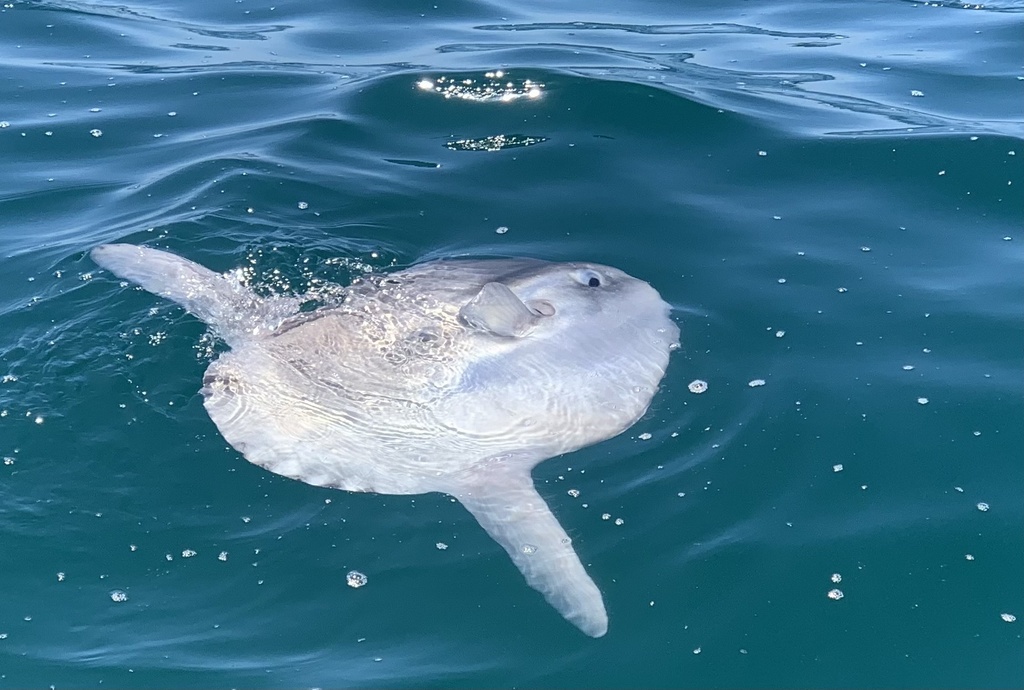
A giant, tail-less disc of a fish that seems to be all head, propelled by flapping its tall dorsal and anal fins. It is among the heaviest bony fishes and the most fecund vertebrate known.
The ocean sunfish, also known as the common mola, is one of the largest ray-finned fish in the world. It is the type species of the genus Mola, and one of five extant species in the family Molidae. It was formerly misidentified as the heaviest bony fish, which is actually a different and closely related species of sunfish, Mola alexandrini. Adults typically weigh between 247 and 1,000 kg. It is native to tropical and temperate waters around the world. It resembles a fish head without a tail, and its main body is flattened laterally. Sunfish can be as tall as they are long, between 175 and 180 centimetres, when their dorsal and ventral fins are extended. Wikipedia
What it can do
- iA single female was found carrying an estimated 300 million eggs, the highest count for any vertebrate
- iiGrows from a larva a few millimetres long to over a tonne
- iiiLies flat at the surface to warm up after deep, cold dives and lets seabirds pick off its parasites
- ivReplaces the tail with a rudder-like 'clavus' formed from dorsal and anal fin elements
In the field
Field marks
- aHuge, laterally flattened oval body with no true tail
- bTall dorsal and anal fins set far back, the dorsal often flopping above the surface
- cWavy-edged clavus in place of a tail fin
- dSmall mouth with beak-like fused teeth
- eGrey to silvery, rough sandpaper skin
- Not to be confused with
- Hoodwinker sunfish (Mola tecta) has a smooth clavus without a central lobe; bump-head sunfish (Mola alexandrini) has a head bump and chin bulge. A surfaced dorsal fin is mistaken for a shark's, but sunfish fins waggle side to side.
- Where to see it
- Crystal Bay, Nusa Penida (Bali); Galápagos (Punta Vicente Roca); Azores; Monterey Bay
- When
- Bali Jul–Oct when cold upwelling arrives
Life & habits
- Diet
- Jellyfish, salps, siphonophores, also small fish, squid and crustaceans
- Habitat
- Open ocean from the surface to several hundred metres
- Size
- Commonly 1.8 m long and up to 1,000 kg; exceptional individuals over 2 t
Visits reef and kelp-edge 'cleaning stations' where fish such as bannerfish and wrasses pick parasites off its skin.
Where it lives
Recorded sightings
—
geo-referenced records in GBIF, from museums, herbaria and field observers.
Native range
Temperate and tropical oceans worldwide
Drag the globe to turn it. Dots are where records exist, not a range map; darker means more records.
In the old herbals & bestiaries
Woodcuts and engravings matched from the Source Library’s scanned books by name. Plates marked “relative” show a close kin rather than this exact species. Click a plate to read the page it came from, with translation.

History of Animals, Book II: On Oviparous Quadrupeds
Conrad Gessner · 1586 · p.527

History of Animals, Book II: On Oviparous Quadrupeds
Conrad Gessner · 1586 · p.526

Books on Marine Fishes
Guillaume Rondelet · 1554 · p.444

De Piscibus Libri V et De Cetis Liber Unus
Ulisse Aldrovandi · 1661 · p.606

Louis Renard — Poissons, ecrevisses et crabes (1754)
Louis Renard · 1754 · p.159
In the stacks
Searching the stacks…
Every page naming Mola mola in the Biodiversity Heritage Library →
Marginalia
In parts of Japan and Taiwan sunfish meat and intestines are eaten as a local delicacy; in German it has been called Schwimmender Kopf, the 'swimming head'.
Curiosity
The heaviest bony fish ever measured was a bump-head sunfish (Mola alexandrini) of 2,744 kg found off the Azores in 2021, a close relative of Mola mola.
Kinship






Photographs: iNaturalist contributors under the licences shown. Records: GBIF.org. Historical plates: Source Library (CC BY-SA 4.0; originals public domain). Summary text: Nature Library editors and Wikipedia (CC BY-SA). Medicinal and edibility notes are historical and educational, not advice. iNaturalist taxon 49601.