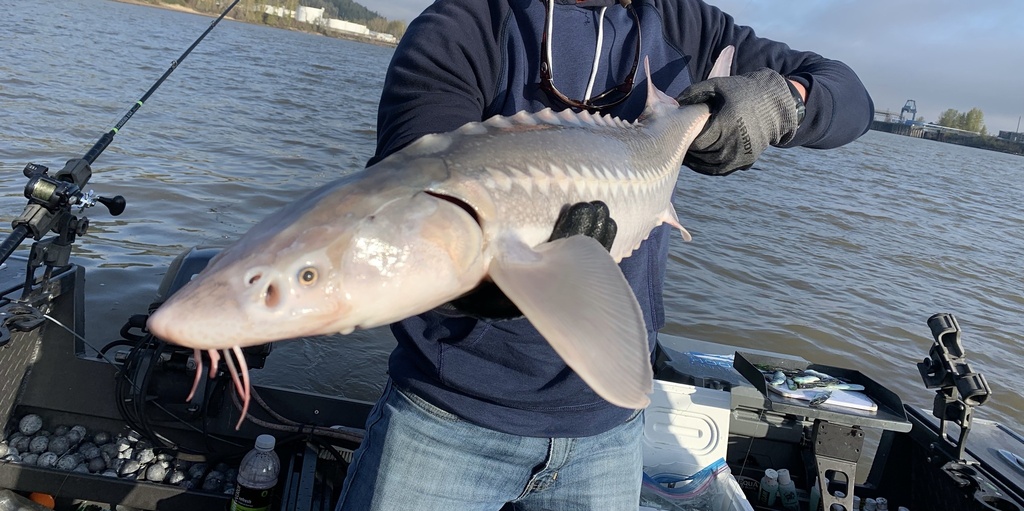
Sturgeons
Acipenseridae
Sturgeon are the 27 species of fish belonging to the family Acipenseridae. The earliest sturgeon fossils date to the Late Cretaceous, and are descended from other, earlier acipenseriform fish, which date back to the Early Jurassic period, some 174 to 201 million years ago. They are one of two living families of the Acipenseriformes alongside paddlefish (Polyodontidae). Sturgeons are native to subtropical, temperate and sub-Arctic rivers, lakes and coastlines of Eurasia and North America. Sturgeons are long-lived, late-maturing fishes with distinctive characteristics, such as a heterocercal caudal fin similar to those of sharks, and an elongated, spindle-like body that is smooth-skinned, scaleless, and armored with five lateral rows of bony plates called scutes.
Several species can grow quite large, typically ranging 2–3.5 m (7–12 ft) in length. The largest sturgeon on record was a beluga female captured in the Volga Delta in 1827, measuring 7.2 m (23 ft 7 in) long and weighing 1,571 kg (3,463 lb). The family is grouped into five genera: Acipenser, Huso, Scaphirhynchus, Sinosturio, and Pseudoscaphirhynchus. One species (S. dabryanus) may be extinct in the wild, and another (P. fedtschenkoi) may be entirely extinct. Beginning in 2011 H. naccarii was presumed extinct in the wild, but in 2022 was downgraded to critically endangered. A Maastrichtian-age fossil found in Morocco shows that they also once lived in northern Africa during the Cretaceous.
3 branches of this family, most-observed first · about 27 known species

Sea Sturgeons
genusAcipenser
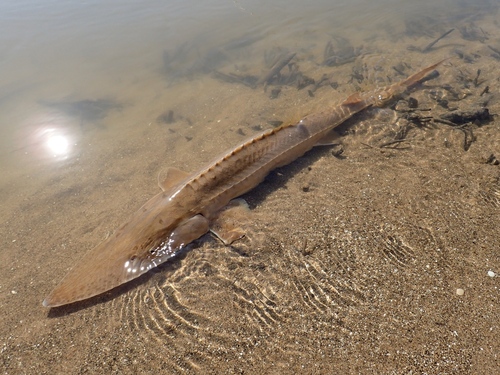
Shovelnose Sturgeons
genusScaphirhynchus

Central Asian Sturgeons
genusPseudoscaphirhynchus
Where it lives
Recorded sightings
—
geo-referenced records in GBIF, from museums, herbaria and field observers.
Drag the globe to turn it. Dots are where records exist, not a range map; darker means more records.
In the stacks
Searching the stacks…
Every page naming Acipenseridae in the Biodiversity Heritage Library →
This page is assembled live from iNaturalist, GBIF, Wikipedia, the Source Library and the Internet Archive. It is not yet part of the hand-edited codex. iNaturalist taxon 49825.