- Animals
- ›Chordates
- ›Vertebrates
- ›Ray-finned Fishes
- ›Spiny-rayed fishes
- ›Perches, Scorpionfishes, Sticklebacks, and Allies
- ›Icefishes and allies
- ›Catadromous Icefishes
- ›Pseudaphritis
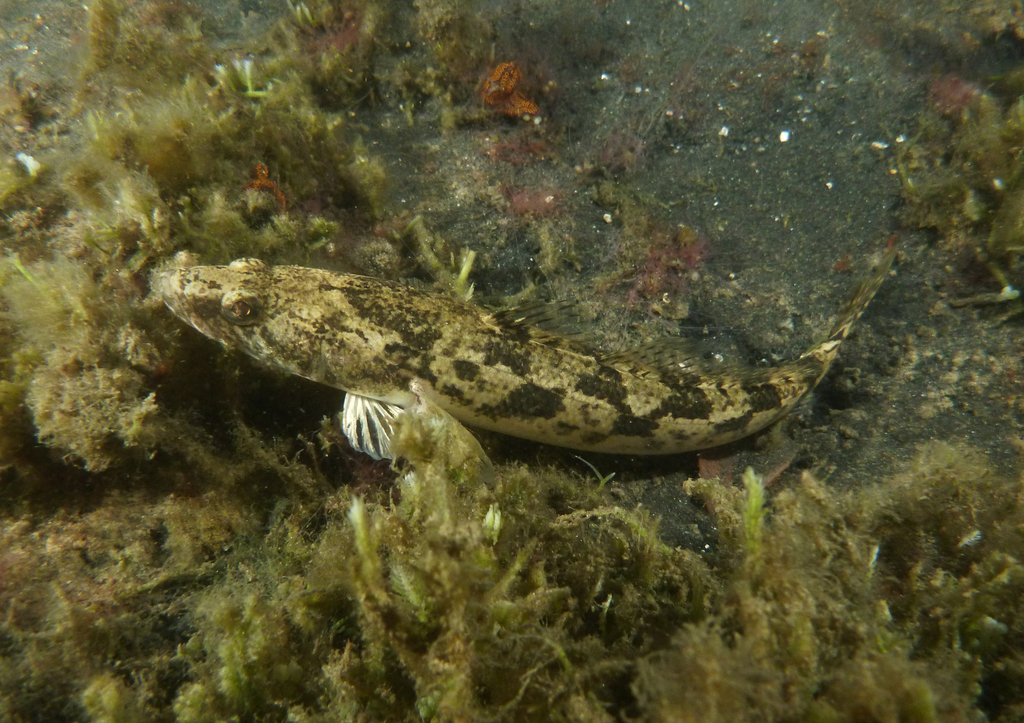
Congolli
Pseudaphritis urvillii
The congoli (Pseudaphritis urvillii), also known as the freshwater flathead, marble fish, marbled flathead, sand trout, sanding, sandy, sandy whiting or tupong, is a species of marine ray-finned fish. It is the only species of fish in the monotypic family Pseudaphritidae and the genus Pseudaphritis. It was initially classified as a member of the family Bovichtidae.
From the article Congoli on Wikipedia (CC BY-SA), quoted section by section
Description
The congolli is a slender, mottled fish, with a silvery-white underside. Its head is slightly flattened, with eyes positioned towards the top and the snout is pointed. It has two separate dorsal fins. The colour varies according to where it lives: it may be bluish, purplish or reddish-brown, marbled with greenish-brown above, and a yellowish white to silvery colour below. Juvenile fish have black saddles on their dorsal surfaces. The largest adult measured is about 36 centimetres (14 in) long. Usually, adults grow up to 17 centimetres (6.7 in) long.
Range & habitat
The congolli is found in fresh, brackish and marine waters around south-eastern Australia, including Tasmania, and is endemic to Australia. It lives mostly in slow-moving waters of estuaries, rivers and streams. Water temperatures in its habitat range from 5 to 20 °C (41 to 68 °F). This fish will inhabit areas with log snags, overhanging banks, and leaf litter. Between late April and August, it migrates south to estuaries and sea to breed. In 2017, congolli were recorded in five rivers on Kangaroo Island in South Australia for the first time, thanks to a project conducted by Department of Environment, Water and Natural Resources (DEWNR) and carried out by a number of citizen science volunteers. Tupongs have made a recovery in the Glenelg River in south-western Victoria, after years of absence.
Wikipedia: “Distribution and habitat”
What it does
The congolli is a carnivorous ambush predator, and feeds on insects (especially in freshwater), fish, crustaceans (especially in estuaries), worms, molluscs, and other invertebrates.
Wikipedia: “Diet”
Where it lives
Recorded sightings
—
geo-referenced records in GBIF, from museums, herbaria and field observers.
Drag the globe to turn it. Dots are where records exist, not a range map; darker means more records.
In the stacks
Searching the stacks…
Every page naming Pseudaphritis urvillii in the Biodiversity Heritage Library →
This page is assembled live from iNaturalist, GBIF, Wikipedia, the Source Library and the Internet Archive. It is not yet part of the hand-edited codex. iNaturalist taxon 498780.