
Limpkins
Aramidae
Aramidae is a bird family in the order Gruiformes. The limpkin (Aramus guarauna) is the only living member of this family, although other species are known from the fossil record, such as Papulavis annae from the Eocene of France, Aramus paludigrus from the Middle Miocene of Colombia and Badistornis aramus from the Oligocene of South Dakota, USA.
Another Oligocene fossil from Europe, Parvigrus pohli, has been described as a mosaic of the features shared by the limpkins and the cranes. It shares many morphological features with the cranes and limpkins, but also was much smaller than either group, and was more rail-like in its proportions. In the paper describing the fossil, Gerald Mayr suggested that it was similar to the stem species of the Grues (the cranes and limpkins), and that the limpkins evolved massively long bills as a result of the specialisation to feeding on snails. In contrast, the cranes evolved into long-legged forms to walk and probe on open grasslands.
1 branches of this family, most-observed first · about 1 known species
See this branch on the Wheel of Life →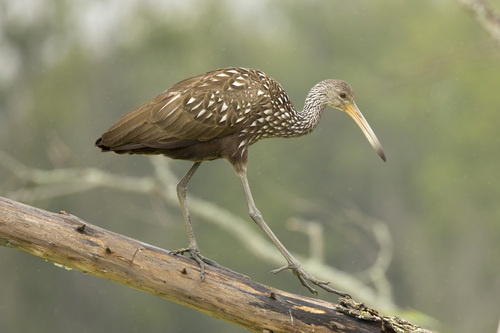
Where it lives
Recorded sightings
—
geo-referenced records in GBIF, from museums, herbaria and field observers.
Drag the globe to turn it. Dots are where records exist, not a range map; darker means more records.
In the stacks
Searching the stacks…
Every page naming Aramidae in the Biodiversity Heritage Library →
This page is assembled live from iNaturalist, GBIF, Wikipedia, the Source Library and the Internet Archive. It is not yet part of the hand-edited codex. iNaturalist taxon 5.