On eBird ↗
Laysan Honeycreeper
Live sightings near you, the range map, bar charts of when it is seen, and Macaulay Library photos and recordings.
Laysan Honeycreeper
Himatione fraithii
The Laysan honeycreeper (Himatione fraithii), also known as the Laysan ʻapapane or Laysan honeyeater, is an extinct species of finch that was endemic to the island of Laysan in the Northwestern Hawaiian Islands. The bird was first recorded in 1828, and in 1892 it received its scientific name from Walter Rothschild, who placed it in the genus Himatione along with the ʻapapane. The specific name, fraithii, refers to George D. Freeth, the self-appointed governor of Laysan, but was misspelled. Rothschild attempted to emend it to freethi in a later publication. This was accepted by most subsequent authors throughout the 20th century, and the bird was also considered a subspecies of the ʻapapane, as H. sanguinea freethii, for most of this time. By the 21st century, after further research, the original name was reinstated and it was considered a full species again. As a Hawaiian honeycreeper, a grouping within the finch subfamily Carduelinae, its ancestors are thought to have come from Asia.
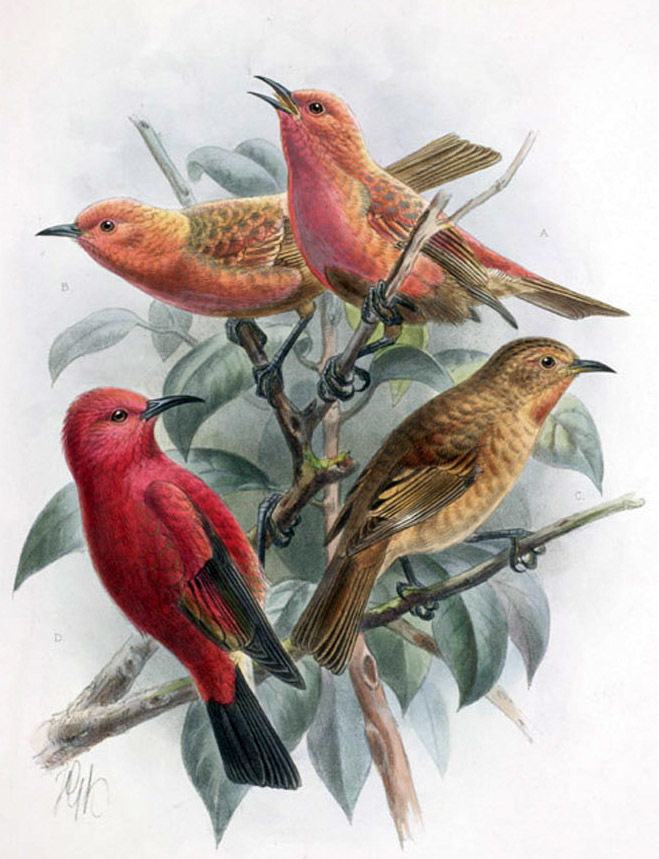
The Laysan honeycreeper was 13–15 cm (5–6 in) long and its wing measured 64–69 mm (2.5–2.7 in). It was bright scarlet vermilion with a faint tint of golden orange on the head, breast and upper abdomen; the rest of its upper parts were orange scarlet. The lower abdomen was dusky gray that faded into brownish white, and the undertail covert feathers were grayish. The wings, tail, bill, and legs were dark brown, and the iris was black with a brown outline. Immature birds were brown with paler lower parts, and had green edges to their wing-covert feathers. The bill was slender and downturned.
From the article Laysan honeycreeper on Wikipedia (CC BY-SA), quoted section by section
Description
The Laysan honeycreeper was a small bird, with published length measurements ranging from 13–15 cm (5–6 in). The wing measured 64–69 mm (2.5–2.7 in), the tail 61 mm (2.4 in), the culmen (upper surface of the beak) 14 mm (0.55 in), and the tarsometatarsus (lower leg bone) was 23 mm (0.9 in). It was bright scarlet vermilion with a faint tint of golden orange on the head, breast and upper abdomen; the rest of its upper parts were orange scarlet. The lower abdomen was dusky gray that faded into brownish white, and the undertail covert feathers were grayish. The wings, tail, bill, and legs were dark brown, and the iris was black with a brown outline. Immature birds were brown, with paler lower parts, and had green edges to their wing-covert feathers. The bill was slender and downturned. The sexes were alike, though the bill, wings, and tail were slightly shorter in the female. Although Rothschild stated in his 1892 description that the female was paler than the male, the American zoologist Walter K. Fisher indicated in 1903 that such differences may have been age-related instead. Fisher also noted that the illustration of the Laysan honeycreeper published by Rothschild showed the bird as far too pale, giving an inaccurate idea of its color. …
Range & habitat
The Laysan honeycreeper was endemic to Laysan, a remote island that has a total land area of 3.6 km2 (1.4 sq mi), and is the largest of the northwestern Hawaiian Islands in the central Pacific Ocean. Laysan is the eroded remnant of a once high island, built up by volcanic activity, perhaps the flattened top of a volcano that formed in the Miocene. The island rises into up to 12 m (40 ft) high crest elevations. Its subsurface substratum is coralline rock, and its topography suggests it was once part of an atoll with a lagoon that occupies about one-fifth of the island's center, and is now almost filled with sand and coral fragments. The island is ringed by sand dunes, but is otherwise well-vegetated. The island's original flora was the most varied of the northwestern Hawaiian islands, but much of it was destroyed by human activities by 1923, leaving near-desert-like conditions and several extinct plant species, though the extent of the vegetation had almost recovered by 1973. In 1903, Fisher stated that the Laysan honeycreeper was found all over Laysan Island, but was most abundant in the interior among tall grass and low bushes near the open plain that bordered the lagoon, an area where all the landbirds appeared to congregate. This was also the favored nesting area, with its broad patches of the succulent Portulaca that these birds fed from. …
Wikipedia: “Habitat”
What it does
Few naturalists encountered the Laysan honeycreeper and few accounts were left of its life history. It was very active, like the Laysan millerbird (Acrocephalus familiaris familiaris), always present in vegetation around buildings, and though perhaps less trusting than the millerbird, they were reported to sometimes enter buildings to hunt moths and for roosting at night. Palmer stated he generally saw them in pairs. Munro described its flight as "weak and low", and said it could be caught with a hand net, despite being less tame than the other birds. He stated they would gather around houses and drink rainwater from leaks in barrels, indicating that they "missed water" more than the other birds of the island. He speculated they had perhaps not adapted to the meager supply of water there; apart from rain and dew, the only natural moisture was a seep of brackish water. The Laysan honeycreeper was nectarivorous and insectivorous, and insects were probably a more important part of their diet than nectar in some seasons. Unlike the ʻapapane, it also foraged on the ground. The bird originally fed on nectar from the native flower maiapilo (Capparis sandwichiana), but when that species disappeared, it switched to ʻākulikuli (Sesuvium portulacastrum) and ʻihi (Portulaca lutea). It was also observed visiting nohu (Tribulus cistoides) and pōhuehue (Ipomoea pes-caprae). …
Wikipedia: “Behavior and ecology”
Listen
Looking for field recordings…
Where it lives
Recorded sightings
—
geo-referenced records in GBIF, from museums, herbaria and field observers.
Drag the globe to turn it. Dots are where records exist, not a range map; darker means more records.
In the stacks
Searching the stacks…
Every page naming Himatione fraithii in the Biodiversity Heritage Library →
This page is assembled live from iNaturalist, GBIF, Wikipedia, the Source Library and the Internet Archive. It is not yet part of the hand-edited codex. iNaturalist taxon 501513.