- Animals
- ›Chordates
- ›Vertebrates
- ›Cartilaginous Fishes
- ›Sharks and Rays
- ›Sharks
- ›Galean Sharks
- ›Mackerel Sharks
- ›Megamouth Sharks
- ›Megachasma
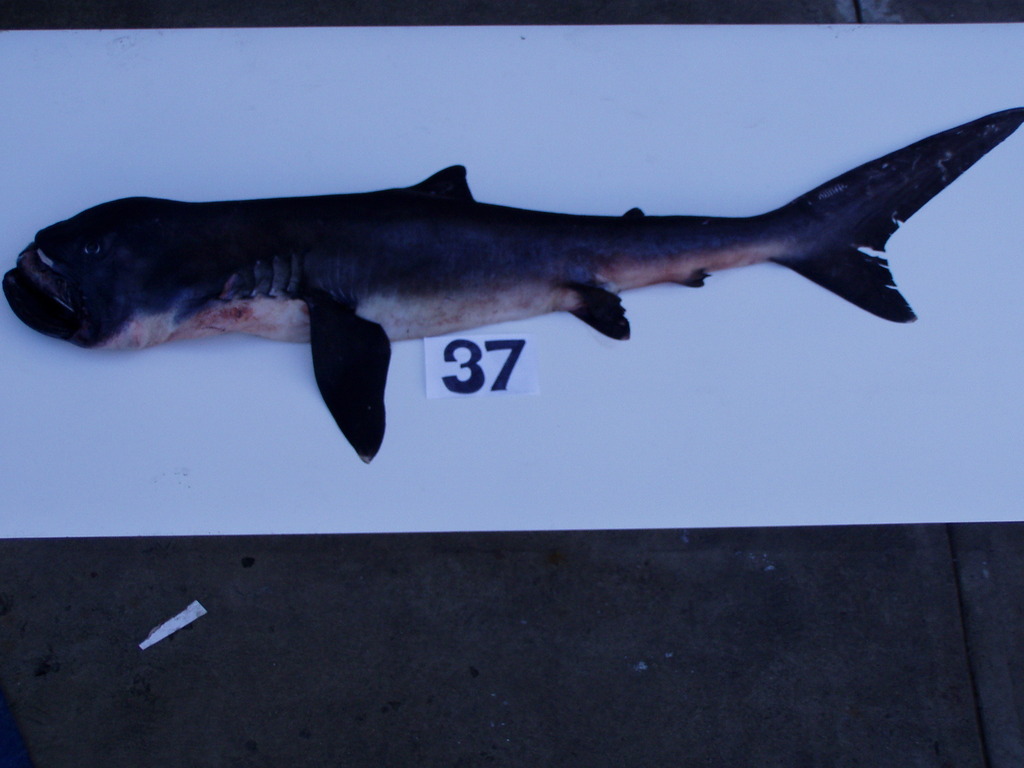
Megamouth Shark
Megachasma pelagios
The megamouth shark (Megachasma pelagios) is a species of deepwater shark. Rarely seen by humans, it measures around 4–5.5 m (13–18 ft) long and is the smallest of the three extant filter-feeding sharks alongside the much larger whale shark and basking shark. According to Sharkman's World Organization, a total of 296 specimens have been observed or caught since its discovery in 1976. Like the other two planktivorous sharks, it swims with its mouth wide open, filtering water for plankton and jellyfish. The diet of megamouth sharks mainly consists of zooplanktonic organisms like krill, jellyfish, shrimp larvae, squat lobsters, and crab larvae. It is recognizable from its large head with rubbery lips. The megamouth is so unlike any other type of shark that it is usually considered to be the sole extant species in the family Megachasmidae, though some scientists have suggested it may belong in the family Cetorhinidae.
From the article Megamouth shark on Wikipedia (CC BY-SA), quoted section by section
Description
The appearance of the megamouth is distinctive, but little else is known about it. It has a brownish-black colour on top, is white underneath, and has an asymmetrical tail with a long upper lobe, similar to that of the thresher shark. The interior of its gill slits are lined with finger-like gill rakers that capture its food. A relatively poor swimmer, the megamouth has a soft, flabby body and lacks caudal keels. The megamouth is considerably less active than the other filter-feeding sharks, the basking shark and the whale shark. The megamouth has a stout body and a long, wide bulbous head. Megamouths are large sharks, able to grow to 5.49 metres (18 ft 0 in) in length. Mature males average at 4 m (13 ft) and females at 5 m (16 ft). Weights of up to 1,215 kg (2,679 lb) have been reported. A 2019 study suggested the megamouth may reach 6 m (20 ft) in maximum length. A 2024 study estimated that a male specimen caught off the coast of Ecuador in 2014 may have measured 8–9 metres (26–30 ft) in total length, based on eyewitness accounts and the dimensions of the caudal fin. Megamouth sharks can be found as far northward as northern Japan; southern California (LACM 43745-1) and near Punta Eugenia, Baja California, and Hawaii. Megamouth sharks can be found at a depth of up to 1,500 metres (4,900 ft). …
What it does
In 1990, a 4.9-m (16-foot) male megamouth shark was caught near the surface off Dana Point, California. This individual was eventually released with a small radio tag attached to its soft body. The tag relayed depth and time information over a two-day period. During the day, the shark swam at a depth around 120–160 m (390–520 ft), but as the sun set, it would ascend and spend the night at depths between 12 and 25 m (39 and 82 ft). Both day and night, its progress was very slow, around 1.5–2.1 km/h (0.81–1.13 kn). In a 2024 study, three sharks were tagged off the coast of Taiwan and tracked over a multi-month period. The sharks reached a maximum depth of about 400–700 m (1310–2300 ft) during the day, on average. At night, they typically reached their minimum depth of 0–50 m (0–165 ft). This pattern of vertical migration is seen in many marine animals as they track the movement of plankton in the water column. Megamouth sharks undergo some seasonal migration as well, although this may be less consistent between individuals. While one shark migrated north from Taiwan during the summer, another migrated south. In one instance, two megamouth sharks were observed together by fishermen off the coast of California. This revealed previously unknown social behaviors between individuals. …
Wikipedia: “Behaviour”
Where it lives
Recorded sightings
—
geo-referenced records in GBIF, from museums, herbaria and field observers.
Drag the globe to turn it. Dots are where records exist, not a range map; darker means more records.
In the stacks
Searching the stacks…
Every page naming Megachasma pelagios in the Biodiversity Heritage Library →
This page is assembled live from iNaturalist, GBIF, Wikipedia, the Source Library and the Internet Archive. It is not yet part of the hand-edited codex. iNaturalist taxon 50869.