On eBird ↗
Thick-billed Grasswren
Live sightings near you, the range map, bar charts of when it is seen, and Macaulay Library photos and recordings.
Thick-billed Grasswren
Amytornis modestus
The thick-billed grasswren (Amytornis modestus) is a species of bird in the Maluridae family. It is endemic to Australia. Its natural habitat is Mediterranean-type shrubby vegetation.
From the article Thick-billed grasswren on Wikipedia (CC BY-SA), quoted section by section
Description
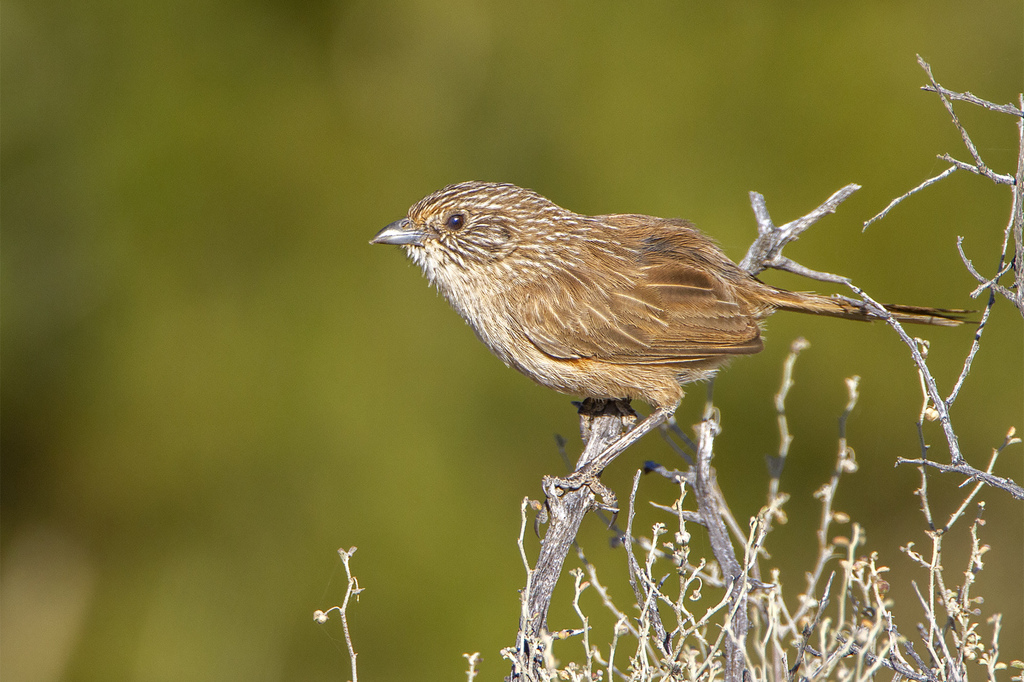
The thick-billed grasswren has dull brown underparts, a long dark-brown tail and noticeable white streaking on the head. It has white streaks continuing down the neck, throat and down to the rump. The white streaks across the chin to the forehead and along the wings and rump, contrast with the red-brown to grey colours of the feathers. Males have distinguishably longer tails. Females also have chestnut flanks. Vocals are a combination of short high-pitched song, repeated. They have a soft, high-pitched call that is often inaudible to human ears.
Range & habitat
The thick-billed grasswren is endemic to Australia and is found throughout the arid regions of northwestern New South Wales, northern parts of South Australia, through to southern sections of the Northern Territory. It is also speculated to still occur in fragmented populations in the Grey Range of Sturt National Park. Chenopod scrublands (consisting largely of saltbush), sandhill cane-grass and flood debris in dry, sandy watercourses. They favour the scrublands with dense chenopod bushes. These denser shrublands usually occur in lower-lying areas, such as watercourses and drainage lines.
Wikipedia: “Distribution and habitat”
What it does
Thick-billed grasswrens are usually sedentary, with these elusive birds seen running, hopping or rarely flying, between vegetative cover to remain undetected. They can also be seen foraging for food at ground level around vegetation. Wrens have a generalist beak type that allows them to eat a range of foods. The thick bill allows for tougher seeds and other food niches to be accessed, compared with the smaller fairy wren species. If disturbed, individuals take refuge in any existing cover – usually vegetation or piles of old flood debris along dry sandy watercourses and even down rabbit burrows. They are often seen solitarily or in pairs. Sources vary, but mating pairs maintain between five, and 20 to 40 hectare territories year-round and rarely, possibly never, band with their neighbours outside the breeding season. Family groups are sometimes seen during the post-fledgling period, while the young are still dependent on their parents. The feather patterns/markings imitate their preferred habitat as a form of camouflage.
Breeding. Breeding occurs between July and September. Nests can usually be seen in low branches in saltbush, can-grass and other similar vegetation. The nest composes of loose grass and bark in the shape of a half dome, with finer grass, fur, feathers lining the nest. …
Wikipedia: “Behaviour and ecology”
Listen
Looking for field recordings…
Where it lives
Recorded sightings
—
geo-referenced records in GBIF, from museums, herbaria and field observers.
Drag the globe to turn it. Dots are where records exist, not a range map; darker means more records.
In the stacks
Searching the stacks…
Every page naming Amytornis modestus in the Biodiversity Heritage Library →
This page is assembled live from iNaturalist, GBIF, Wikipedia, the Source Library and the Internet Archive. It is not yet part of the hand-edited codex. iNaturalist taxon 509111.