- Animals
- ›Echinoderms
- ›Sea Stars and Brittle Stars
- ›Sea Stars
- ›Valvatacean Sea Stars
- ›Valvatidan Sea Stars
- ›Crown-of-thorns Sea Stars
- ›Acanthaster
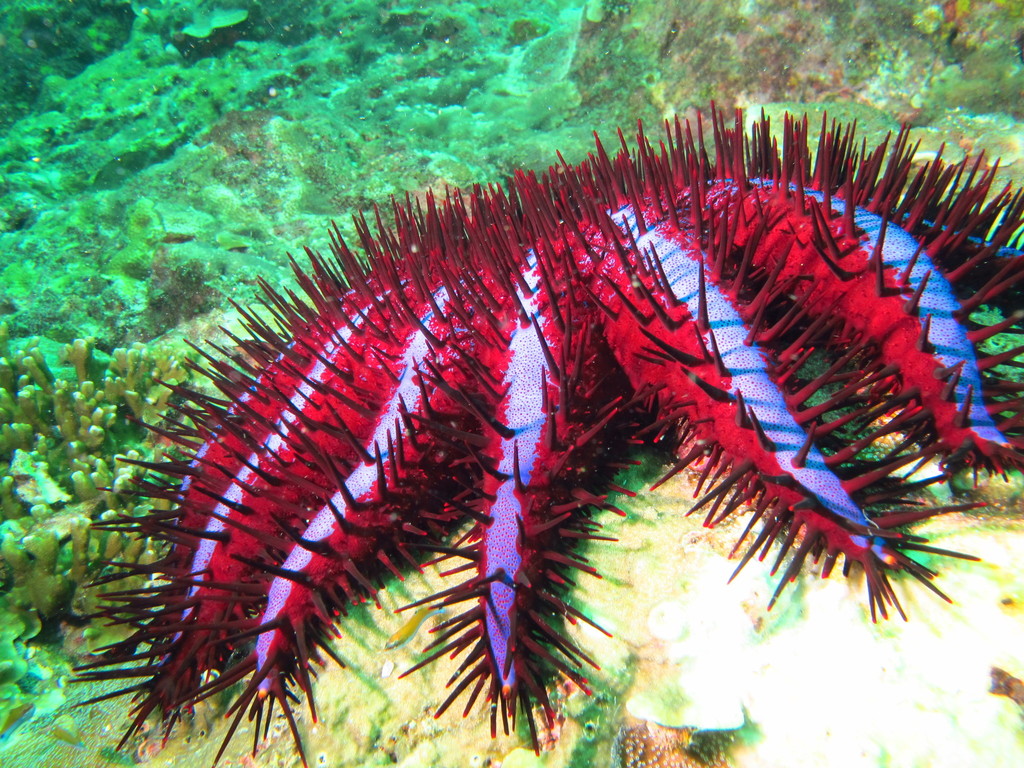
Long-spined Crown-of-Thorns
Acanthaster planci
The crown-of-thorns starfish (Acanthaster planci) is a large starfish that preys upon hard coral polyps. The crown-of-thorns starfish, frequently abbreviated to COTS, receives its name from venomous, thornlike spines that cover its upper surface, resembling the biblical crown of thorns. It is one of the largest starfish in the world.
A. planci has a very wide Indo-Pacific distribution, perhaps most common around Australia, but can occur at tropical and subtropical latitudes from the Red Sea and the East African coast across the Indian Ocean, and across the Pacific Ocean to the west coast of Central America. It occurs where coral reefs or hard coral communities occur in the region. Echinobase is the model organism database for A. planci and a number of other echinoderms.
From the article Crown-of-thorns starfish on Wikipedia (CC BY-SA), quoted section by section
Description
The body form of the crown-of-thorns starfish is fundamentally the same as that of a typical starfish, with a central disc and radiating arms. Its special traits, however, include being disc-shaped, multiple-armed, flexible, prehensile, and heavily spined, and having a large ratio of stomach surface to body mass. Its prehensile ability arises from the two rows of numerous tube feet that extend to the tip of each arm. In being multiple-armed, it has lost the five-fold symmetry (pentamerism) typical of starfish, although it begins its lifecycle with this symmetry. The animal has true image-forming vision. Adult crown-of-thorns starfish normally range in size from 25 to 35 cm (10 to 14 in). They have up to 21 arms. Although the body of the crown of thorns has a stiff appearance, it is able to bend and twist to fit around the contours of the corals on which it feeds. The underside of each arm has a series of closely fitting plates, which form a groove and extend in rows to the mouth. Depending on diet or geographic region, individuals can be purple, purple-blue, reddish grey or brown with red spine tips, or green with yellow spine tips. The long, sharp spines on the sides of the starfish's arms and upper (aboral) surface resemble thorns and create a crown-like shape, giving the creature its name. …
What it does
The adult crown-of-thorns is a corallivorous predator that usually preys on reef scleractinian coral polyps, as well as encrusting sessile invertebrates and dead animals. It climbs onto a section of living coral colony using the large number of tube feet, which lie in distinct ambulacral grooves on the oral surface. It fits closely to the surface of the coral, even the complex surfaces of branching corals. It then extrudes its stomach out through its mouth over the surface to virtually its own diameter. The stomach surface secretes digestive enzymes that allow the starfish to absorb nutrients from the liquefied coral tissue. This leaves a white scar of coral skeleton that is rapidly infested with filamentous algae. An individual starfish can consume up to 6 square metres (65 sq ft) of living coral reef per year. In a study of feeding rates on two coral reefs in the central Great Barrier Reef region, large starfish (40 cm (16 in) and greater diameter) killed about 61 cm2 (9 in2)/day in winter and 357 to 478 cm2 (55 to 74 in2) per day in summer. Smaller starfish, 20–39 cm (8–15 in), killed 155 to 234 cm2 (24 to 36 in2) per day in the equivalent seasons. The area killed by the large starfish is equivalent to about 10 m2 (108 sq ft) from these observations. …
Wikipedia: “Diet”
At the table
Serious discussion and some strongly held views mention the causes of this phenomenon. Some hypotheses focused on changes in the survival of juvenile and adult starfish—the "predator removal hypothesis":
Over-collecting of tritons, a predator of the starfish Overfishing of predators of the starfish such as the Humphead wrasse Decline in predator populations through habitat destruction Warmer sea temperatures enhance larvae development Anthropogenic impacts, such as allochthonous nutrient input Many of the reports of fish preying on Acanthaster are single observations or presumed predation from the nature of the fish. For example, the humphead wrasse may prey on the starfish amongst its more usual diet. Individual puffer fish and trigger fish have been observed to feed crown-of-thorns starfish in the Red Sea, but no evidence has found them to be a significant factor in population control. A study, however, based on the stomach contents of large carnivorous fish that are potential predators of the starfish, found no evidence of the starfish in the fish's guts. …
Wikipedia: “Causes of population outbreaks”
Where it lives
Recorded sightings
—
geo-referenced records in GBIF, from museums, herbaria and field observers.
Drag the globe to turn it. Dots are where records exist, not a range map; darker means more records.
In the stacks
Searching the stacks…
Every page naming Acanthaster planci in the Biodiversity Heritage Library →
This page is assembled live from iNaturalist, GBIF, Wikipedia, the Source Library and the Internet Archive. It is not yet part of the hand-edited codex. iNaturalist taxon 50915.