- Animals
- ›Chordates
- ›Vertebrates
- ›Birds
- ›Hawks, Eagles, Kites, and Allies
- ›Hawks, Eagles, and Kites
- ›Typical Hawks and Harriers
- ›Accipiter
On eBird ↗
Sharp-shinned Hawk
Live sightings near you, the range map, bar charts of when it is seen, and Macaulay Library photos and recordings.
Sharp-shinned Hawk
Accipiter striatus
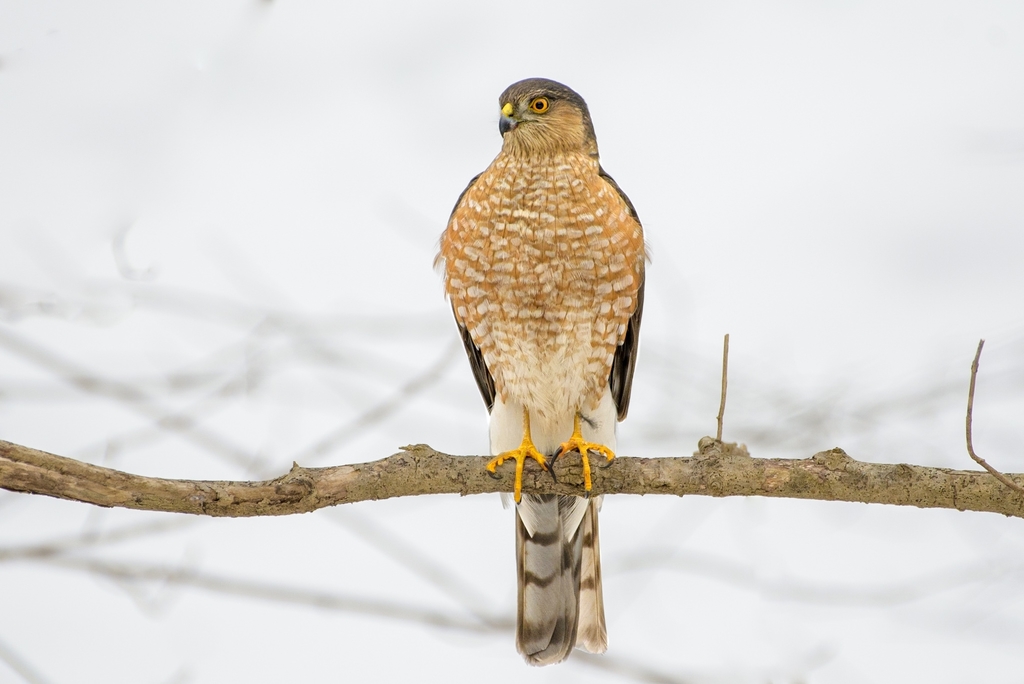
The sharp-shinned hawk (Accipiter striatus) or northern sharp-shinned hawk, colloquially often nicknamed sharpie, is a small hawk, with males being the smallest hawks in the United States and Canada, but with the species averaging larger than some Neotropical species, such as the tiny hawk. The taxonomy is far from resolved, with some authorities considering the southern taxa to represent three separate species, white-breasted hawk (A. chionogaster), plain-breasted hawk (A. ventralis), and rufous-thighed hawk (A. erythronemius). The American Ornithological Society and some other checklists keep all four species conspecific. A recent genetic study additionally recommended splitting the three Caribbean island populations as three additional separate species, though this has not yet been adopted by any of the ornithological authorities.
From the article Sharp-shinned hawk on Wikipedia (CC BY-SA), quoted section by section
Description
This is a small Accipiter hawk, with males 23 to 30 cm (9.1 to 11.8 in) long, with a wingspan of 42 to 58 cm (17 to 23 in) and weight from 82–115 g (2.9–4.1 oz). As common in Accipiter hawks, females are distinctly larger in size, averaging some 30% longer, and with a weight advantage of more than 50% being common. The female measures 29 to 37 cm (11 to 15 in) in length, has a wingspan of 58 to 68 cm (23 to 27 in) and weighs 150 to 219 g (5.3 to 7.7 oz). The wings measure 14.1–22.9 cm (5.6–9.0 in) each, the tail is 12–19 cm (4.7–7.5 in) long and the tarsus is 4.5–5.9 cm (1.8–2.3 in). Measurements given here are for the northern group, but they are comparable for the remaining subspecies. Adults have short broad wings and a medium-length tail banded in blackish and gray with the tip varying among individuals from slightly notched through square to slightly rounded (often narrowly tipped white). The remiges (typically only visible in flight) are whitish barred blackish. The legs are long and very slender (hence the common name) and yellow. The hooked bill is black and the cere is yellowish. The remaining plumage varies depending on group:
Nominate group: Cap dark and upperparts blue-grey (the former darker). Often, a few more-or-less random white spots can be seen on the scapulars (feathers attached to the wing that cover the meeting of wing and body). …
Range & habitat
This species is widespread in North America, Central America, South America and the Greater Antilles. Below, the distributions of the four groups (see Taxonomy) are described as they occur roughly from north to south:
The nominate (A. s. striatus) group is widespread in North America, occurring in all of the forested part of USA and Canada, breeding in most of it. Populations in the northern part of the range migrate south and spend the non-breeding season (winter) in the southern USA, Mexico and Central America as far south as Panama, with a smaller number spending the winter in the Greater Antilles. Resident populations exist in temperate parts of the US, Canada (in a few coastal regions), Mexico (highlands from Sonora to Oaxaca), Cuba, Hispaniola and Puerto Rico. A. (s.) chionogaster (white-breasted hawk) occurs in highlands from far southern Mexico (Chiapas and Oaxaca), through Honduras, Guatemala and El Salvador, to Nicaragua. It is, as far as known, resident, but some local movements may occur. A. (s.) ventralis (plain-breasted hawk) occurs in the coastal mountains of northern Venezuela and Colombia, south through the Andes from western Venezuela, through Colombia, Ecuador and Peru, to central Bolivia. A disjunct population occurs in the Tepuis of southern Venezuela (likely to extend into adjacent parts of Roraima in far northern Brazil, but this remains unconfirmed). …
Wikipedia: “Distribution”
What it does
These birds surprise and capture most of their prey from cover or while flying quickly through dense vegetation. They are adept at navigating dense thickets, although this hunting method is often hazardous to the hawk. The great majority of this hawk's prey are small birds, especially various songbirds such as sparrows, wood-warblers, finches, wrens, nuthatches, tits, icterids and thrushes. Birds caught range in size from a 4.4 g (0.16 oz) Anna's hummingbird to a 577 g (1.272 lb) ruffed grouse and virtually any bird within this size range is potential prey. Typically, males will target smaller birds, such as sparrows and wood-warblers, and females will pursue larger prey, such as American robins and flickers, leading to a lack of conflict between the sexes for prey. These hawks often exploit backyard bird feeders in order to target congregations of ideal prey. They often pluck the feathers off their prey on a post or other perch. Rarely, sharp-shinned hawks will also eat rodents, lizards, frogs, snakes, and large insects, the latter typically being dragonflies captured on the wing during the hawk's migration. Bats have occasionally been recorded as a prey of this hawk.
Wikipedia: “Diet”
Listen
Looking for field recordings…
Where it lives
Recorded sightings
—
geo-referenced records in GBIF, from museums, herbaria and field observers.
Drag the globe to turn it. Dots are where records exist, not a range map; darker means more records.
In the stacks
Searching the stacks…
Every page naming Accipiter striatus in the Biodiversity Heritage Library →
This page is assembled live from iNaturalist, GBIF, Wikipedia, the Source Library and the Internet Archive. It is not yet part of the hand-edited codex. iNaturalist taxon 5097.