On eBird ↗
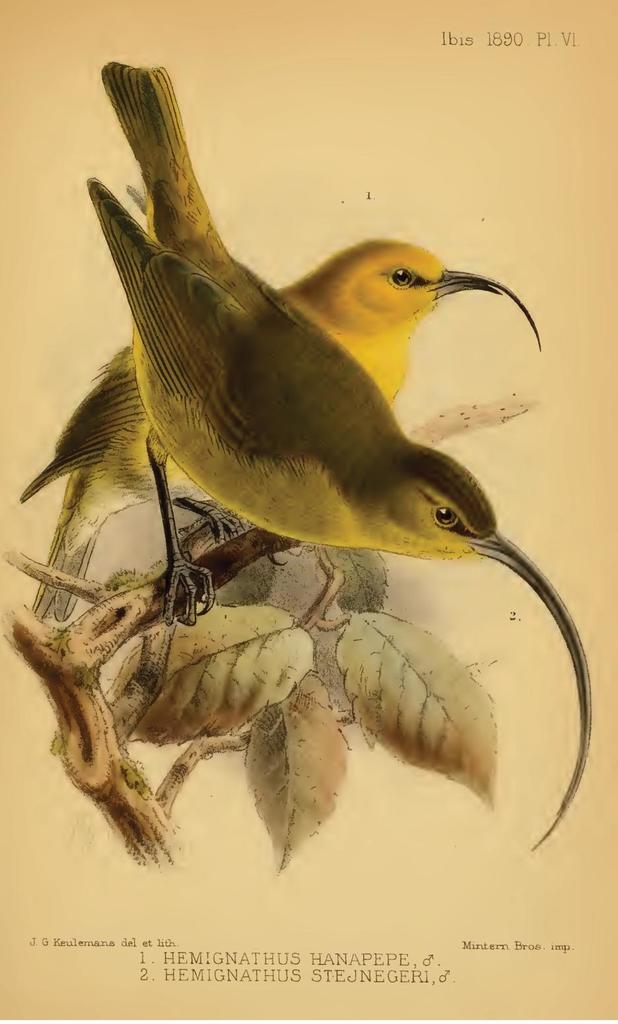
Kauai Akialoa
Live sightings near you, the range map, bar charts of when it is seen, and Macaulay Library photos and recordings.
Kauai Akialoa
Akialoa stejnegeri
The Kauaʻi ʻakialoa (Akialoa stejnegeri) is an extinct species of Hawaiian honeycreeper in the subfamily Carduelinae of the family Fringillidae. It was endemic to the island of Kauaʻi, Hawaii, and became extinct in the 20th century due to introduced avian disease and habitat loss. The Kauaʻi ʻakialoa was about seven and a half inches in length and had a very long downcurved bill, which covered one third of its length. The adult males were bright olive-yellow on top and yellow on the bottom. The throat, breast, and sides of the body were olive-yellow. The females, however, were green-gray above and had a shorter bill.
From the article Kauaʻi ʻakialoa on Wikipedia (CC BY-SA), quoted section by section
Range & habitat
The Kauai ʻakialoa was believed to have lived in forests above 1,148 feet (350 m) above sea level, but was frequently observed flying to the lower elevations of the island. This once very rare and unique bird used its long curved bill to reach the nectar of lobelias and ʻohiʻa blossoms. It also ate insects from under tree bark and from under mats of lichens and moss on trees. Acanthocephalan parasite Apororhynchus hemignathi was discovered in the intestine of the Kauaʻi ʻakialoa in 1896.
Wikipedia: “Habitat and behavior”
Listen
Looking for field recordings…
Where it lives
Recorded sightings
—
geo-referenced records in GBIF, from museums, herbaria and field observers.
Drag the globe to turn it. Dots are where records exist, not a range map; darker means more records.
In the stacks
Searching the stacks…
Every page naming Akialoa stejnegeri in the Biodiversity Heritage Library →
This page is assembled live from iNaturalist, GBIF, Wikipedia, the Source Library and the Internet Archive. It is not yet part of the hand-edited codex. iNaturalist taxon 512275.