On eBird ↗
Akiapolaau
Live sightings near you, the range map, bar charts of when it is seen, and Macaulay Library photos and recordings.
ʻAkiapolaʻau
Hemignathus wilsoni
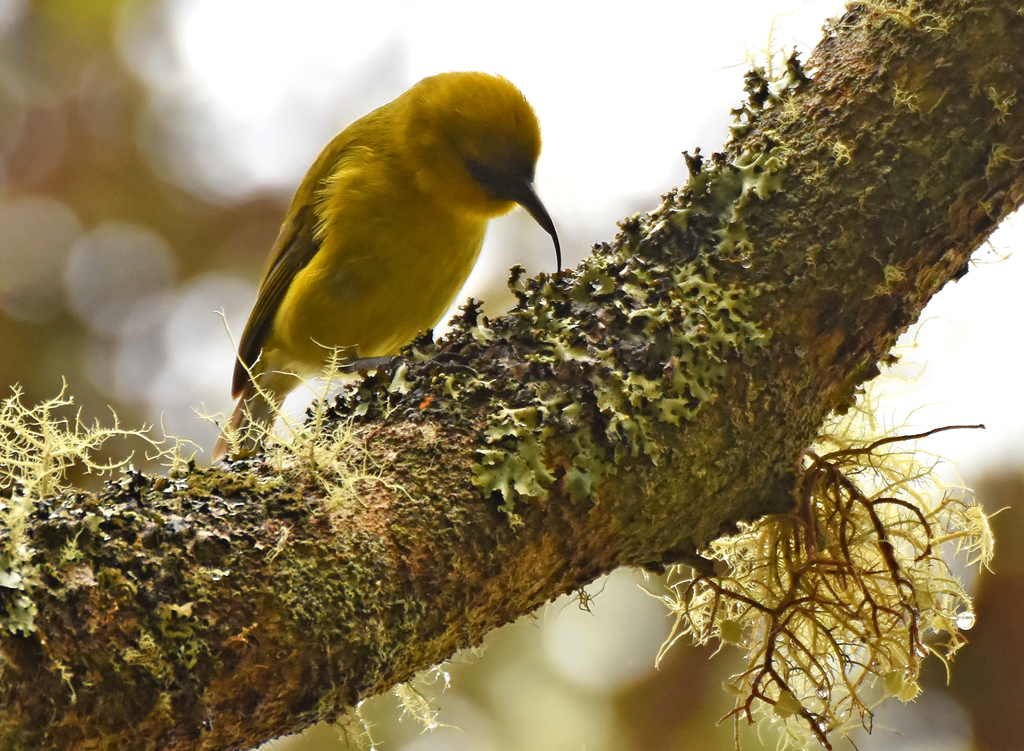
The ʻakiapōlāʻau (ah-kee-ah-POH-lah-ow), also known as the Hawaiian woodpecker, is a species of Hawaiian honeycreeper that is endemic to the island of Hawaii. Its natural habitats are dry and montane moist forests, and it is the only bird species on the island to occupy the woodpecker niche. The bird is 5.5 inches (14 cm) in length, and has an unusually curved beak-(a specialist species). The ʻakiapolaʻau is a pudgy bird which has a whitish bottom and tail, black legs, yellow chest, orangish head, black face mask and bill and gray black wings. The male's song is either a loud, short pit-er-ieu or a rapid warba-warba. Its various calls include an upslurred whistle, a short cheedle-ee warble, and a short sweet. Due to the recent disappearance of the Kauaʻi nukupuʻu in the 1900s and the Maui nukupuʻu in the 1990s, leading to fears that they may be extinct, the ʻakiapōlāʻau may be the last of its genus. It is the only member of the subgenus Heterorhynchus, which has a woodpecker-like feeding habitat and exclusively preys on insects, in contrast to the nukupuʻu, which were both insect-eaters and also hummingbird-like nectarivores.
From the article ʻAkiapōlāʻau on Wikipedia (CC BY-SA), quoted section by section
Range & habitat
The ʻakiapōlāʻau occurs mainly in old-growth mesic and wet forests in Kaʻū, Hilo District, and Hamakua. Koa (Acacia koa) and ʻōhiʻa lehua (Metrosideros polymorpha) are dominant canopy species in its habitat. Disease-carrying mosquitoes have restricted it to elevations of between 1,300 and 2,100 metres (4,300 and 6,900 ft). It formerly inhabited māmane (Sophora chrysophylla) and naio (Myoporum sandwicense) dry forests at elevations of 1,900 to 2,900 metres (6,200 to 9,500 ft) on Mauna Kea, but this population was extirpated in 2002.
Wikipedia: “Distribution”
What it does
It feeds on insects which are found hidden within the branches of the trees, along with the nectar of flowers shaped like its bill. It also looks for invertebrates at the floor of the forest where there is a large amount of natural growth. This bird uses its long bill to peck open the bark to reach the larvae; it then uses its thin upper bill to probe out the meal and its lower bill to crush its meal.
Wikipedia: “Diet”
In human culture
The English common name was adopted around 1905, directly from the Hawaiian-language name ʻakiapōlāʻau. The genus name, Hemignathus, is of Greek origin, meaning 'half-jawed', a reference to the shorter mandible compared to the maxilla in birds of this genus. The specific epithet, wilsoni, honours the British ornithologist, Scott B. Wilson, renowned for his monumental work, Aves Hawaiiensis: The Birds of the Sandwich Islands (1890–1899). This species is monotypic.
Wikipedia: “Taxonomy and etymology”
Listen
Looking for field recordings…
Where it lives
Recorded sightings
—
geo-referenced records in GBIF, from museums, herbaria and field observers.
Drag the globe to turn it. Dots are where records exist, not a range map; darker means more records.
In the stacks
Searching the stacks…
Every page naming Hemignathus wilsoni in the Biodiversity Heritage Library →
This page is assembled live from iNaturalist, GBIF, Wikipedia, the Source Library and the Internet Archive. It is not yet part of the hand-edited codex. iNaturalist taxon 512283.