- Animals
- ›Chordates
- ›Vertebrates
- ›Birds
- ›Hawks, Eagles, Kites, and Allies
- ›Hawks, Eagles, and Kites
- ›Buteonine Hawks, Kites, and allies
- ›Buteo
On eBird ↗
Forest Buzzard
Live sightings near you, the range map, bar charts of when it is seen, and Macaulay Library photos and recordings.
Forest Buzzard
Buteo trizonatus
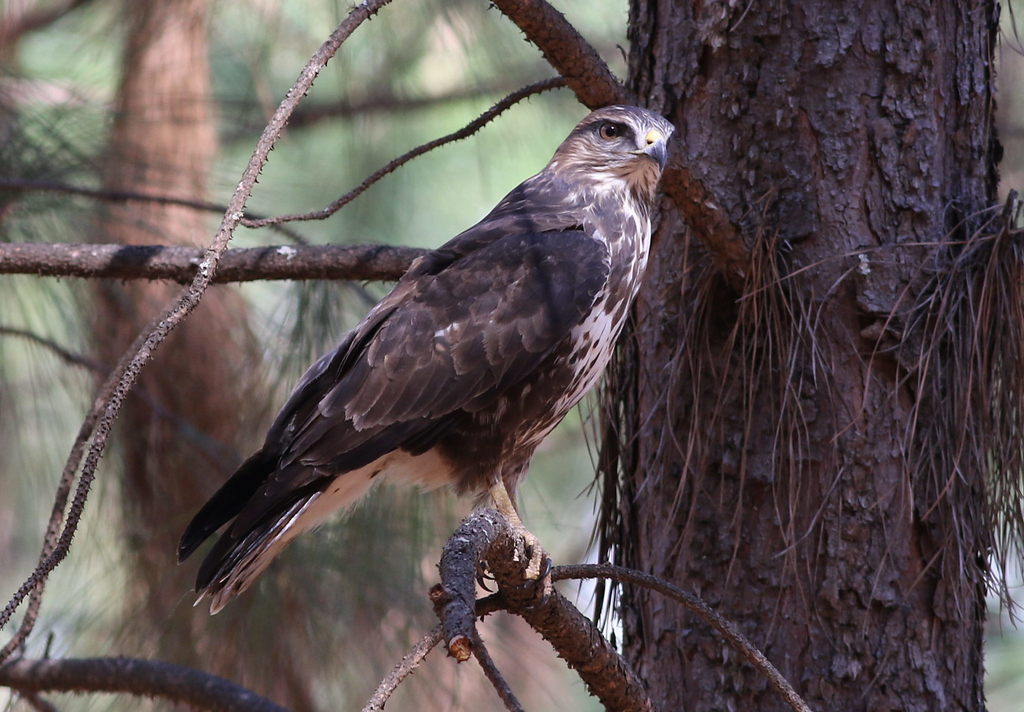
The forest buzzard (Buteo trizonatus), is a species of bird of prey found in Africa, though some authorities have placed it as a subspecies of another species, the mountain buzzard, Buto oreophilus. This is a resident breeding species in woodlands in southern and eastern South Africa.
From the article Forest buzzard on Wikipedia (CC BY-SA), quoted section by section
Description
The forest buzzard is very similar to the abundant summer migrant steppe buzzard Buteo buteo vulpinus, the head, the back and upperwings are brown, marked out with rufous edges to the feathers the amount of which varies between individuals. The chin is whitish and unmarked, the breast and belly are whitish but marked with a variable amount of brown spots, and the undertail coverts are plain whitish. There is variation and some adults show brown barring along the breast sides and the belly while all but the palest birds show a distinctive white 'U' mark in the middle of the otherwise blotched abdomen. The underwings are white, with a reddish-brown tinge on the lesser underwing coverts and a dark comma shaped mark at the tip of primary coverts . The plumage on the thighs are uniformly reddish-brown, and the axillary feathers are white with brown barring. The upper tail is brown, washed with reddish-brown and the tail has some narrow dark brown bands with a broad dark brown subterminal band while the undertail bands can be indistinct. The body length is 41–48 cm (16–19 in) and the wingspan is 102–117 cm (40–46 in).
Range & habitat
The forest buzzard is endemic to South Africa, Lesotho and Eswatini where it occurs in an arc from the mountains of eastern Limpopo Province south through the Drakensberg of Kwazulu-Natal to the Western Cape. It as, at least, a partial migrant and seems to be a winter visitor (June–August) in the Drakensberg of Eastern Cape northwards where there are no breeding records. Two birds ringed in the east (Kwazulu-Natal and Mpumalanga) were subsequently recovered in the south of South Africa having moved between 800–1,300 km (500–810 mi).
Wikipedia: “Distribution and movements”
Listen
Looking for field recordings…
Where it lives
Recorded sightings
—
geo-referenced records in GBIF, from museums, herbaria and field observers.
Drag the globe to turn it. Dots are where records exist, not a range map; darker means more records.
In the stacks
Searching the stacks…
Every page naming Buteo trizonatus in the Biodiversity Heritage Library →
This page is assembled live from iNaturalist, GBIF, Wikipedia, the Source Library and the Internet Archive. It is not yet part of the hand-edited codex. iNaturalist taxon 512762.