On eBird ↗
White-winged Duck
Live sightings near you, the range map, bar charts of when it is seen, and Macaulay Library photos and recordings.
White-winged Duck
Asarcornis scutulata
The white-winged duck or white-winged wood duck (Asarcornis scutulata) is a large species of duck, formerly placed in the genus Cairina with the Muscovy duck (Cairina moschata) and considered allied to the dabbling ducks. However, two genetic studies have indicated that the anatomical similarity to the Muscovy duck is deceiving, with the species appropriately placed in a monotypic genus, as Asarcornis scutulata; it proved evolutionarily closest to a clade containing the diving duck genera Netta and Aythya, while Cairina resolved as close to the genus Aix in a very different part of the family tree.
From the article White-winged duck on Wikipedia (CC BY-SA), quoted section by section
Description
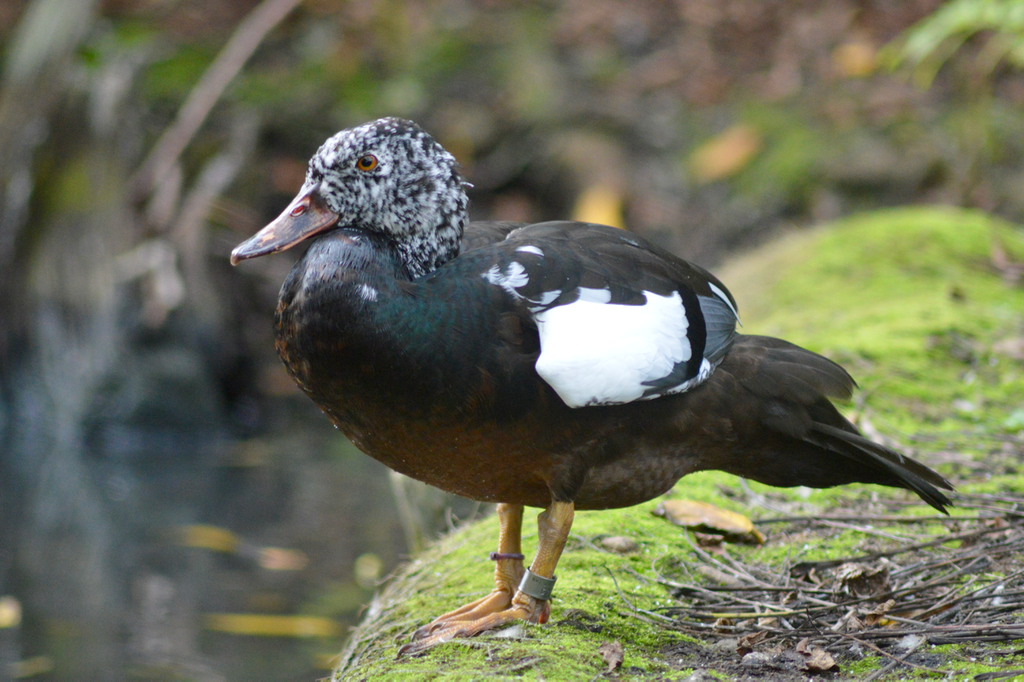
This is one of the largest living species of duck next only to the steamer ducks which are heavier. The Muscovy duck also attains sizes that nearly rival the white-winged duck, but may average a bit smaller in a wild state. Length is 66–81 cm (26–32 in) and wingspan is 116–153 cm (46–60 in). Males weigh 2.94–3.9 kg (6.5–8.6 lb), while females weigh 1.95–3.05 kg (4.3–6.7 lb). The most noticeable feature on adult birds is the dark body contrasting with a whitish head and neck. Males have a mostly dull yellowish bill, blackish mottling on the head and upper neck, white lesser median coverts and inner edges of tertials, and bluish-grey secondaries. In flight, white wing-coverts contrast with the rest of the wings. Females are smaller and usually have more densely mottled head and upper neck. The juvenile is duller and browner. This secretive species feeds mainly at dawn and dusk when moving between daytime roosts and feeding sites. It has been described as omnivorous, regularly consuming pondweed, small fish, aquatic snails, spiders and insects. It inhabits stagnant or slow-flowing natural and artificial wetlands, within or adjacent to evergreen, deciduous or swamp forests, on which it depends for roosting and nesting, usually in tree-holes. …
Range & habitat
Historically the white-winged duck was widely distributed from northeastern India and Bangladesh, throughout South-East Asia to Java and Sumatra. It is now extinct on Java (no records for over 50 years) and probably extinct in Bangladesh, Lao PDR, Vietnam and Peninsular Malaysia. Extant populations remain in India (eastern Assam and adjacent Arunachal Pradesh), Myanmar (chiefly along the Chindwin River in Sagaing and Kachin states), Indonesia (remnant populations on Sumatra), Thailand (very few wild birds in remote western forests, plus a reintroduced population at Phu Khieo Wildlife Sanctuary of uncertain viability), and Cambodia (now only at Preah Vihear). Myanmar's Hukaung Valley Wildlife Sanctuary is regarded as probably the global stronghold. In India the main protected areas holding the species are Nameri National Park and the Dihing–Patkai complex, with smaller populations in Namdapha National Park and several reserved forests; the species has, however, apparently disappeared from former strongholds such as Dibru-Saikhowa National Park and the Doomdooma–Dangori reserve forests, where large populations were recorded in the 1990s. The white-winged duck is the state bird of Assam.
Wikipedia: “Distribution”
Listen
Looking for field recordings…
Where it lives
Recorded sightings
—
geo-referenced records in GBIF, from museums, herbaria and field observers.
Drag the globe to turn it. Dots are where records exist, not a range map; darker means more records.
In the stacks
Searching the stacks…
Every page naming Asarcornis scutulata in the Biodiversity Heritage Library →
This page is assembled live from iNaturalist, GBIF, Wikipedia, the Source Library and the Internet Archive. It is not yet part of the hand-edited codex. iNaturalist taxon 513577.