On eBird ↗
Sirkeer Malkoha
Live sightings near you, the range map, bar charts of when it is seen, and Macaulay Library photos and recordings.
Sirkeer Malkoha
Taccocua leschenaultii
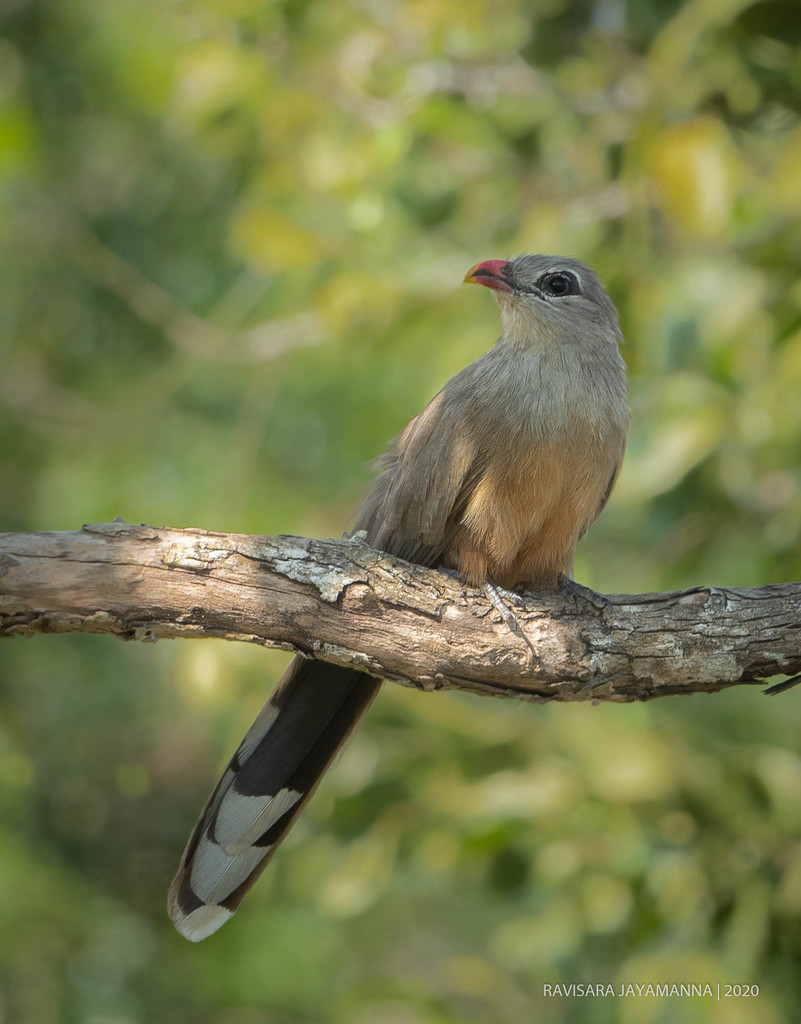
The sirkeer malkoha or sirkeer cuckoo (Taccocua leschenaultii), is a non-parasitic cuckoo found in dry scrub forest and open woodland habitats in the Indian subcontinent. The species is long-tailed, largely olive brown on the upper side with a distinctive curved red beak tipped in yellow. They forage singly or in pairs mainly on or close to the ground creeping between grasses and bushes, often on rocky habitats where they feed on small lizards, insects, and sometimes berries and seeds. They are very silent and the sexes are identical in plumage.
From the article Sirkeer malkoha on Wikipedia (CC BY-SA), quoted section by section
Description
The sirkeer cuckoo is about 42–44 centimetres (16+1⁄2–17+1⁄4 in) long with dark olive brown on the back, wings and the central tail feathers. The underside is rufous. A greenish gloss is visible on the wing and dark parts of the tail feathers. The feathers have dark shafts which are especially prominent on the breast as streaks. The tail is graduated (with outer feathers being sequentially shorter) and tipped broadly in white. The upper tail coverts are long. The chin, throat and breast are pale. The most distinctive feature is the curved red bill with a yellow tip. The eyes have curved and long bristles around the eye but not behind it that resemble eyelashes (an adaptation to protect their eyes when creeping through grass and vegetation) and the iris is reddish brown. They have a short and pale whitish streak over and below the eye and a thin line of black feathers in line with the commissure of the bill that reaches under the eye. A dark bare patch of skin around the eye that tapers behind it exaggerates the size of the eye. The legs are grey. They have zygodactyle feet and are forage on the ground, on rocks or between grass and bushes in scrub and thin forest, often in hilly ground but generally below an altitude of about 1500 m above sea level. They feed on caterpillars, insects and other invertebrates, small vertebrates, and on berries and seeds. …
Range & habitat
All of the sub-Himalayan Indian subcontinent, Bangladesh, Sri Lanka; patchily in Pakistan and Rajasthan. They are thought to have expanded into the Sind region in the 1930s following the construction of the Sukkur barrage and the extension of canal irrigation. Three subspecies have been designated, varying in colouration but showing continuous variation and having no disjunctions in their distribution ranges.
Wikipedia: “Distribution”
Listen
Looking for field recordings…
Where it lives
Recorded sightings
—
geo-referenced records in GBIF, from museums, herbaria and field observers.
Drag the globe to turn it. Dots are where records exist, not a range map; darker means more records.
In the stacks
Searching the stacks…
Every page naming Taccocua leschenaultii in the Biodiversity Heritage Library →
This page is assembled live from iNaturalist, GBIF, Wikipedia, the Source Library and the Internet Archive. It is not yet part of the hand-edited codex. iNaturalist taxon 513662.